
Reviewed October 6, 2026: Incentive guidance, financial definitions and outage backup requirements have been corrected. Older market commentary below provides historical context rather than current forecasts.
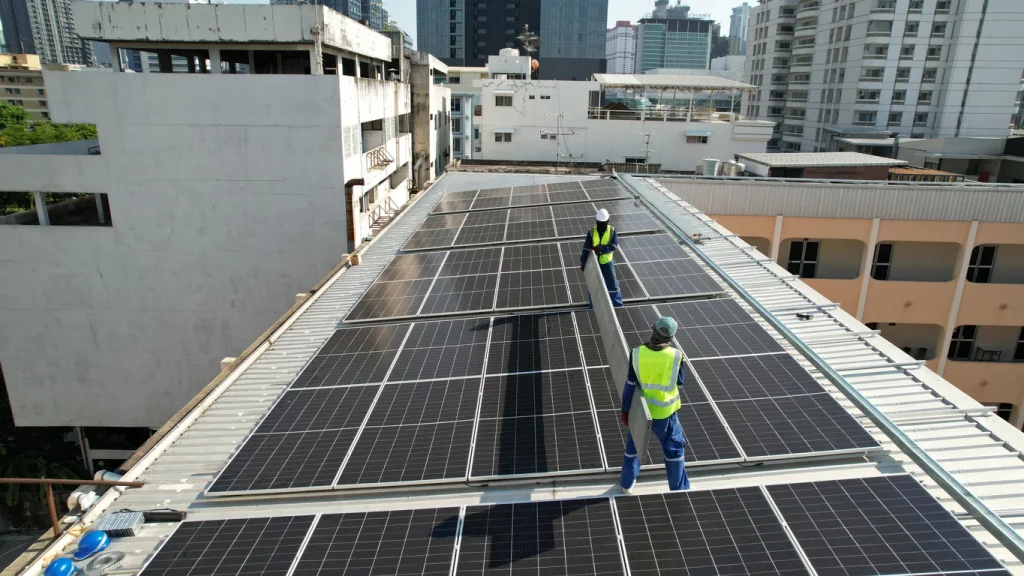
Commercial buildings such as offices, warehouses, schools and hospitals can use rooftop or canopy solar to offset purchased electricity. The financial case depends on the site, tariff, installed cost, operating needs and confirmed incentive eligibility.
How Solar Energy Works in Commercial Settings
Solar energy systems capture sunlight and convert it to electricity. Key components are solar modules (panels), inverters, wiring, and sometimes energy storage. The basic process is:
Solar panels contain silicon cells or similar materials that absorb sunlight.
That light causes electrons to move, producing direct current (DC) electricity.
An inverter converts DC to alternating current (AC) which is used by building systems.
Solar power output fluctuates with weather and time of day. To smooth that, commercial systems often include storage, whether batteries, thermal storage, or mechanical systems. Storage allows buildings to use solar power when panels are not producing, during evenings or cloudy periods.
Evaluate a project using site specific energy modelling and current utility tariffs. National deployment forecasts do not establish the savings or suitability of an individual commercial building.

Key Metrics and Financial Terms to Know
To understand the benefits you must know these:
| Term | Meaning |
|---|---|
| ROI (Return On Investment) | Net financial return divided by investment cost over a specified period; the number of years to recover upfront cost is the payback period |
| ITC (Investment Tax Credit) | U.S. federal tax credit that reduces tax liability when you install a solar system |
| PTC (Production Tax Credit) | Tax credit based on the kWh generated by qualifying systems |
| Capacity Factor | Actual energy generated divided by the energy that would be generated at rated power continuously over the same period |
| Demand Charges | Utility fees based on measured power demand, typically kW, under the applicable tariff |
Six Major Benefits of Solar Energy for Commercial Buildings
Benefits depend on project design and site conditions:
1. Major Savings and Lower Operational Expenses
Commercial buildings have large electricity bills. Solar systems reduce those bills significantly. Even though solar system installation requires upfront capital, over time savings offset that cost. According to multiple sources business solar installations often achieve payback in 3 to 7 years depending on location, system size, and incentives. (GC44)
Solar energy also protects against rising utility rates. Once installed, the solar panels produce electricity without ongoing fuel cost. Businesses can better plan budgets when electricity costs are more stable. (summitsolar.com)
2. Property Value Increases
Solar installations add to property value. Buildings with solar systems are more attractive to buyers and tenants. They sell faster or lease more quickly because lower utility costs and environmental credentials matter. (powerhome.com)
3. Tax Credits, Rebates, and Incentives
Commercial credit eligibility must be assessed separately from the expired residential Section 25D credit. Section 48E has a 6% base investment credit, with a higher rate where applicable requirements are met. Under IRS Notice 2025-42, solar facilities beginning construction after July 4, 2026 generally must be placed in service by December 31, 2027 to avoid the solar credit termination rule. Other eligibility and sourcing restrictions also apply. Have a qualified tax adviser review the project before including a credit in a financial model. Sources: IRS Section 48E overview and IRS Notice 2025-42.
4. Environmental Benefits and Brand Image
Solar energy produces very low greenhouse gas emissions when operating. It reduces reliance on fossil fuel power. Commercial owners using solar improve their sustainability profile. For a business marketing or corporate reputation these factors matter. Customers, investors, communities often prefer businesses that reduce their carbon footprint. (powerhome.com)
5. Resilience and Protection from Outages
Outage backup requires a system designed to isolate from the grid and supply the selected loads safely. Solar and a battery alone do not guarantee backup capability. Confirm inverter functionality, transfer equipment, usable battery capacity and load requirements with the system designer.
6. Low Maintenance and Long Lifespan
Solar panels have few moving parts. They are made of materials such as tempered glass and corrosion-resistant framing. Maintenance typically is periodic cleaning and inspections. Warranties often guarantee 25 years or more of performance. Panels degrade slowly which means many commercial installations provide reliable output for decades. (CIC Construction Group)
Comparison Table of Benefits
Here is a chart summarizing how these benefits compare:
| Benefit | Short-Term Impact (first few years) | Long-Term Impact (over 25 years) |
|---|---|---|
| Cost savings | Reduces monthly bills, lowers demand charges, helps budget stability | Large cumulative savings; utility cost inflation protection |
| Property value | Adds to asset value; improves resale or lease appeal | Sustained building valuation; attracts sustainable tenants |
| Incentives | Lowers initial investment cost through ITC, PTC, rebates | Enhances overall ROI; offsets replacement or upgrade costs |
| Brand & image | Attracts attention; boosts reputation locally | Long-term trust, compliance with ESG or sustainability reporting |
| Reliability | Some resilience during mild grid issues | Significant backup if paired with storage; better operational continuity |
| Maintenance | Low cost; minimal intervention needed | Low degradation; replacements or repairs infrequent |
What Businesses Should Evaluate Before Choosing Solar
To make sure your solar project delivers, you should analyze:
Energy usage profile: How much power you use, when you consume most electricity, how much demand charge you pay.
Roof or site suitability: Roof angle, orientation, shading, structural strength. Some buildings have room on rooftops, side yards, or parking lot canopies to mount panels. (CIC Construction Group)
Incentive eligibility: Whether your business qualifies for ITC, PTC, state or local rebates, or bonus depreciation.
Storage options: Whether battery storage or other storage methods are needed to reduce peak demand or ensure backup during outages.
System lifespan and warranties: What warranties are offered for panels, inverters, structural parts. Make sure degradation rate is acceptable.
Financial modeling: Include upfront costs, incentives, maintenance, energy production estimates, and how quickly you expect savings to cover investment.
Recent Trends Supporting Commercial Solar
These are recent developments that strengthen case for solar:
Solar installation costs have fallen significantly in recent years through improvements in manufacturing and supply chains. (CIC Construction Group)
Renewable energy share in U.S. generation is increasing. States are setting policies to favor clean power. New solar capacity addition is expected to lead growth in power sector through 2025. (CIC Construction Group)
More businesses are combining solar with battery storage and smart monitoring to capture additional value from peak demand reduction and resilience. (SolarTech)
Final Word
Solar energy can offer benefits for commercial buildings. It saves money, improves property value, gives access to tax incentives, enhances brand credibility, provides resilience during power interruptions, and requires low maintenance. The returns are often strong after initial cost is recovered.
If you manage or own a commercial building and are considering solar I recommend you start by analyzing your energy usage, checking eligibility for incentives, evaluating site conditions, and getting quotes from qualified solar contractors. That way you can decide whether solar is right for your building and what financial returns you can expect.
Solar energy is no longer optional for commercial buildings in many places. It is becoming a key part of smart, sustainable, and resilient business operations.