
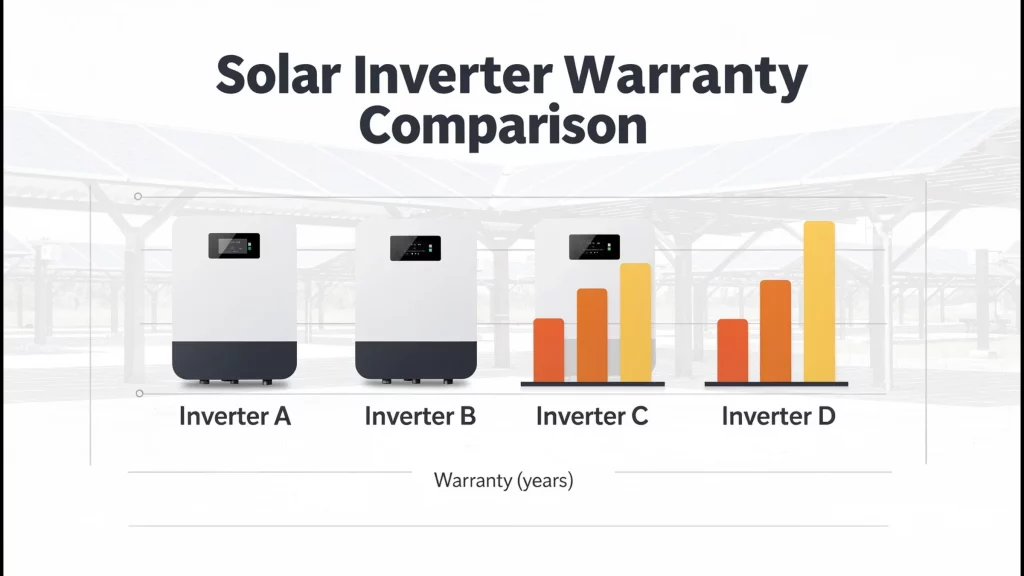
Commercial solar carport structures are powerful assets for businesses. They provide shaded parking, reduce utility bills, enhance sustainability goals, and often support electric vehicle (EV) charging. When designing and installing one of these large systems, it is important to understand how each component is protected, especially the solar inverter. Solar inverters play a crucial role in converting the direct current (DC) power generated by solar panels into alternating current (AC) that buildings and the grid can use. Because inverters are both essential and more likely than panels to experience wear or failure, the solar inverter warranty deserves careful comparison before you invest in a commercial solar carport.
In this blog we explain how inverter warranties work, compare typical terms you’ll find in 2025, and give you the context you need to choose what’s right for your commercial deployment.
Why inverter warranties matter for commercial solar carports
A warranty is a manufacturer’s or installer’s promise to repair or replace defective components within a defined time frame. Inverters are critical because they are the heart of your solar system’s electrical conversion. They also tend to be the first major components needing replacement in a solar array’s lifespan, long before panels reach the end of their productive years.
In commercial solar carport structures, failures or inefficiencies in inverters can reduce electricity output, disrupt operations, and increase maintenance costs. A strong warranty protects your investment and helps ensure predictable performance and financial returns over the long operational life of the system.
Types of inverters and how warranties vary
Solar inverters come in different architectural styles, and each type typically has different warranty terms. Understanding these differences is key when comparing warranties.
String inverters
String inverters connect a series of panels to a single inverter. They are common for medium and large commercial systems. Standard warranties for string inverters usually range from 5 to 12 years. Many manufacturers offer extended coverage up to 15 or 20 years for additional cost.
Microinverters and power optimizers
Microinverters are installed at the panel level, converting DC to AC at each panel. Power optimizers are paired with string inverters to improve panel-level performance. These module-level power electronics (MLPEs) often carry longer warranties, typically up to 25 years, because they are designed to last as long as the panels themselves.
Hybrid and battery-ready inverters
For carport structures with battery storage integration, hybrid inverters combine solar and storage power management. Warranty terms for hybrid inverters are generally similar to string inverters, about 5 to 10 years, with some offering extended coverage.
What inverter warranties typically cover
Most solar inverter warranties cover manufacturing defects and component failures that occur under normal use. However, details matter:
Product warranty
This covers physical defects and failures of the inverter itself, such as malfunctioning power electronics. Product warranties vary widely by brand and technology, with microinverters often offered for 25 years and string inverters commonly covered for 10–12 years.
Extended warranty options
Many manufacturers allow you to extend the standard warranty at the time of purchase for years beyond the default term. Extended warranties help align inverter coverage with the expected lifespan of panels or the business’s investment horizon.
Communications and accessories
Components like communication modules or monitoring devices often have shorter warranties, typically about 5 years. This is because these parts are updated or replaced more frequently due to technological change.
Limitations and exclusions
Standard warranties often exclude labor costs, shipping, environmental damage (such as lightning or flooding), and improper installation. Some extended warranties bundle labor and shipping, reducing out-of-pocket expenses if a replacement is needed. Always read the fine print to understand what is and isn’t covered.
Comparing inverter warranty lengths
Below is an overview of typical warranty durations you can expect in 2025 across common inverter types:
| Inverter type | Typical standard warranty | Extended warranty option |
| String inverter | 5–12 years | Up to 20–25 years available from some brands |
| Microinverter | 10–25 years | Some brands offer full 25-year coverage as standard |
| Power optimizers (paired with string) | 25 years for optimizer, inverter follows string warranty | Extended inverter coverage possible |
| Hybrid inverter | 5–10 years | Some extensions to 12–15 years |
Key insight: Microinverters and power optimizers often come with longer warranties because they are designed to operate at panel level and benefit from consistent electrical conditions. String inverters, being centralized and handling larger loads, are more prone to wear and heat stress, hence shorter standard coverage.
Examples of common inverter warranty terms
To illustrate how real warranties differ, consider typical terms from several well-known inverter types:
- Microinverters: Many of the leading microinverter products on the market come with 25-year product warranties. This long term reflects confidence in durability and is particularly attractive for commercial carports with many distributed units.
- String inverters: Many string inverters have standard warranties of 10–12 years, but manufacturers often offer extended options up to 20–25 years for an additional cost.
- Hybrid inverters: Coverage is generally 5–10 years with some brands providing extension options. For organizations financing solar plus storage, aligning inverter warranty to battery warranty is essential.
These examples show that there is no single “best” warranty length, it depends on technology, manufacturer policies, and how your carport asset is meant to perform over time.
What to consider when comparing warranties
When comparing inverter warranties for commercial solar carports, don’t just look at the number of years. Consider the following aspects as well:
Depth of coverage
Does the warranty include parts only, or does it also cover labor and shipping? A warranty that covers just parts may save less money than one that covers the full cost of replacement and installation.
Alignment with system lifespan
Commercial solar carports are typically designed with 25-year performance expectations (panels often carry 25-year performance warranties). Matching inverter warranty length to overall system life can provide peace of mind and avoid mid-lifespan replacement costs.
Expected replacement cycle
Inverters generally have shorter usable lifespans than panels. Even with a decade-long warranty, plan for inverter replacement at 10–15 years in many systems. Extended warranties can defer these costs but may not eliminate them entirely.
Manufacturer reliability
A long warranty is only valuable if the manufacturer is stable and will honor claims. Research manufacturer reputation and claim fulfillment performance when evaluating warranties.
Transferability
If you sell your commercial property, a transferable warranty can increase buyer confidence and asset value. Some warranties have fees or conditions for transfer, so check these terms carefully.
Aligning warranty strategy with commercial goals
For commercial solar carport structures, your warranty strategy should be part of your financial planning and risk management approach. Here are some practical tips:
Match warranties to finance timelines: For projects financed through loans or power purchase agreements, align warranty periods to the term of financial obligations. This minimizes unexpected capital expenses while the system is still under contract.
Consider extended warranties for critical components: Given that inverters are more likely to fail than panels, investing in extended warranty coverage, especially for centralized string inverters, can provide protection against mid-life replacement expenses.
Include warranty terms in total cost modeling: Don’t just consider upfront cost. Factor in warranty coverage, potential replacement timing, and labor costs when modeling lifetime cost and return on investment.
Final thoughts
Choosing the right solar inverter warranty is a critical part of planning a successful commercial solar carport structure. While solar panels often come with long performance and product warranties, inverters typically have shorter standard coverage because of their mechanical complexity and exposure to heat and electrical stress.
Understanding how different inverter types are protected, and what coverage options are available, allows businesses to align their warranty strategy with long-term energy production goals, financial planning, and risk tolerance. Comparing warranty length, coverage details, manufacturer reputation, and extension options will help ensure your solar carport delivers reliable performance and predictable value for years to come.