
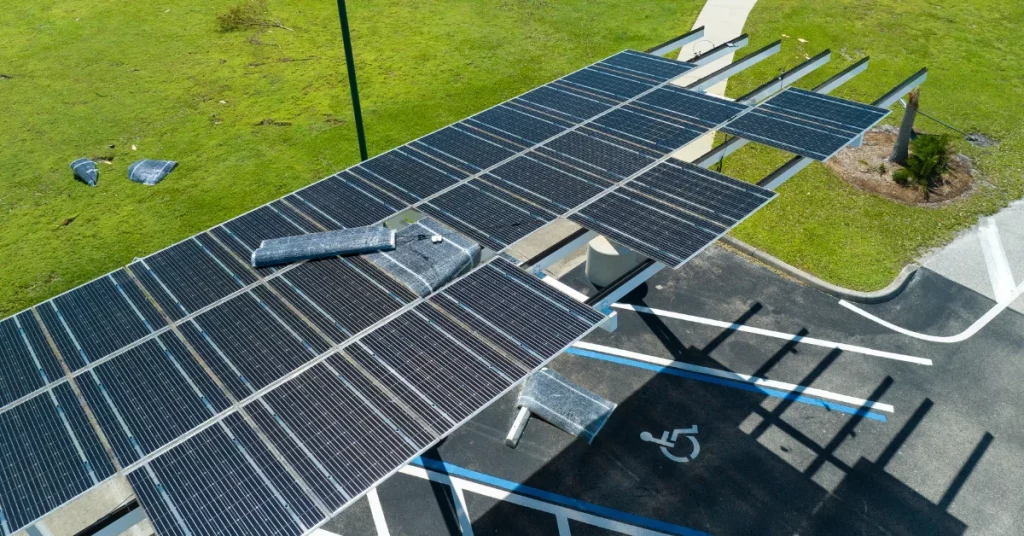
As we settle into 2026, solar microgrid controllers are becoming fundamental technology for modern energy systems that combine renewable generation, storage, and sophisticated control logic. These controllers are particularly relevant for commercial solar carport structures paired with energy storage and microgrid systems, helping businesses achieve resilience, cost savings, and improved energy utilization.
In this blog, we’ll explain what solar microgrids are, why controllers matter, how they work, how they evolved through 2025, and why they are transforming the way commercial solar carports function as part of broader, resilient energy systems.
What a solar microgrid is and why it matters
A microgrid is a localized energy system that includes power generation, storage, and load management, operating as a single controllable unit. It can operate connected to the utility grid or independently in “island mode.” This dual capability means a microgrid can support itself during grid outages or operate in harmony with the grid to optimize costs and reliability.
Microgrids typically combine distributed energy resources (DERs) such as solar photovoltaic (PV) arrays, wind turbines, generators, and especially battery energy storage systems (BESS). A commercial solar carport that integrates solar panels, EV chargers, and batteries can serve as the energy generation and storage core of a microgrid for a facility or campus.
In 2025, the deployment of microgrids in industry and commercial settings accelerated significantly as organizations sought energy resilience against outages, fluctuating utility rates, and extreme weather. U.S. microgrid capacity was projected to reach around 10 gigawatts by the end of 2025, up from roughly 4.4 GW in 2022, indicating widespread adoption.
What a solar microgrid controller does
At the heart of every microgrid is its controller, the “brain” that manages all components and ensures the system operates smoothly, whether it’s connected to the main grid or running independently.
A solar microgrid controller is a software and hardware system that manages the flow of electricity, dispatches power from generation and storage, and maintains stability in voltage and frequency. It monitors loads, distributed energy resources (DERs), and storage, then makes real-time decisions based on demand, generation, and grid conditions.
In essence, a microgrid controller:
- Coordinates energy flows between solar generation, batteries, other generation sources, and the electrical load.
- Balances supply and demand to maximize efficiency and reliability.
- Manages transitions between grid-connected mode and island mode (operating independently when the grid fails).
- Optimizes battery charging and discharging to support demand shifts and reduce energy costs.
- Maintains power quality by ensuring voltage and frequency stability across the system.
Without an advanced controller, a microgrid’s components would operate independently, making it difficult to manage complex interactions between renewable generation, storage, and loads — especially under changing conditions.
How solar microgrid controllers work
Solar microgrid controllers use real-time data and algorithms to manage energy resources within a defined electrical boundary. They operate at multiple levels:
Local and system-wide control
Controllers often combine local control, managing individual inverters, batteries, and loads, with system-wide coordination that ensures all parts of the microgrid work in concert.
Grid-connected vs islanded operation
A key function is deciding when to connect or disconnect from the utility grid. In grid-connected mode, the microgrid may still operate like a traditional solar system with export/import. In islanded mode, caused by outages or planned grid separation, the controller ensures continuity by managing storage and generation locally.
Energy storage optimization
Controllers also handle battery storage logic, optimizing when to charge (often when solar production is high or electricity prices are low) and when to discharge (during peak demand or outages) to minimize costs and support reliability.
Some advanced controllers leverage forecasting, using solar production forecasts, load forecasts, and price signals, to optimize decisions ahead of time, reducing operational costs and enhancing performance. (Tesla)
Why controllers are essential for commercial solar carports
Commercial solar carport structures are increasingly being integrated into broader energy systems. These installations often include significant solar capacity paired with battery storage, EV charging, and facility loads, creating complexity that makes a microgrid controller essential.
Here’s why:
Resilient power during outages
Without a controller, solar and storage assets might not automatically support critical loads during grid failures. A microgrid controller can isolate the facility and ensure continuous power to essential systems such as refrigeration, lighting, or operations centers.
Cost optimization
Commercial and industrial electricity rates often vary with time-of-use pricing or demand charges. Controllers can shift battery discharge to high-cost periods and store excess solar production when prices are low, reducing utility bills.
Maximizing renewable usage
Solar output fluctuates over the day and seasons. Controllers maximize the use of solar generation by balancing loads, storage, and grid interaction, reducing reliance on grid power and cutting operational costs.
Seamless integration of storage and EV charging
In carport environments serving EVs, the controller manages variable demand from chargers, coordinating with storage to ensure charging doesn’t destabilize the local energy system while optimizing cost and energy flow.
Controller trends in 2025
The solar and microgrid space saw several advances in 2025 that sharpened the role of controllers:
Broader adoption in commercial settings
Microgrid projects moved beyond remote or campus use cases into large commercial and industrial facilities, including business parks and campuses with solar carports. These systems demonstrated how controllers enable scalable integration of renewables and storage.
Integration with AI and forecasting
More microgrid controllers began using AI and advanced forecasting to anticipate solar production and load patterns. This shift allowed better decision-making and cost reduction by pre-loading batteries or curtailing loads strategically.
Interoperability and protocol standardization
Improved communication protocols like IEC 61850, Modbus, and DNP3 became more common, allowing controllers to work with a wider variety of inverters, storage systems, and energy assets. This enhances flexibility when integrating different brands and technologies in commercial systems.
Resilience focus
Controllers improved their islanding logic and transition management, meaning microgrids became faster and more reliable when shifting to backup or island mode during grid disruptions. Enhanced algorithms ensure smooth transitions with minimal power quality events.
Real-world examples of controller benefits
By the end of 2025, companies and communities increasingly turned to microgrid controllers to manage distributed energy systems. For example, some microgrid installations at data centers and critical infrastructure have achieved exceptionally high uptime, nearing 99.9 percent availability by autonomously managing distributed sources and demand loads.
In commercial manufacturing and industrial settings, controllers helped reduce peak demand charges by optimizing storage use and shifting loads away from expensive billing periods, sometimes resulting in double-digit percentage cost savings.
Planning for 2026 and beyond
Looking ahead, solar microgrid controllers will continue evolving. Key areas include:
Smarter forecasting and decision support
With more data and AI integration, controllers will increasingly act proactively rather than reactively, boosting efficiency and reducing operational risks.
Distributed control architectures
Instead of a single centralized controller, future systems may use hierarchical or distributed architectures, improving scalability and resilience for large portfolios of microgrids.
Enhanced cybersecurity
As controllers handle mission-critical functions, protecting them from cyber threats will be a central design consideration, involving encryption, secure protocols, and monitoring tools.
Plug-and-play components
Standardization efforts aim to make controllers more interoperable, so commercial solar carport systems can add new DERs or storage seamlessly without extensive reconfiguration.
Concluding thoughts
Solar microgrid controllers are rapidly becoming indispensable for commercial solar carport structures that combine PV generation, storage, EV charging, and facility loads. They provide the intelligence and real-time control needed to balance energy flows, maintain reliability during outages, and reduce operating costs. As the energy landscape evolves in 2026 and beyond, these controllers will play an increasingly strategic role in making renewable energy more resilient, efficient, and economically attractive for businesses of all sizes.
Sources:
National Renewable Energy Laboratory on microgrid controls and functions. (nrel.gov)
Definition and components of a microgrid. (Wikipedia)
Role of microgrid controllers in managing DERs and energy flows. (WTS Energy)
Details on advanced controllers like Tesla’s Microgrid Controller. (Tesla)
Controller features and management of energy resources. (Energy → Sustainability Directory)
Controller benefits and real-world results from industry practice. (LinkedIn)