
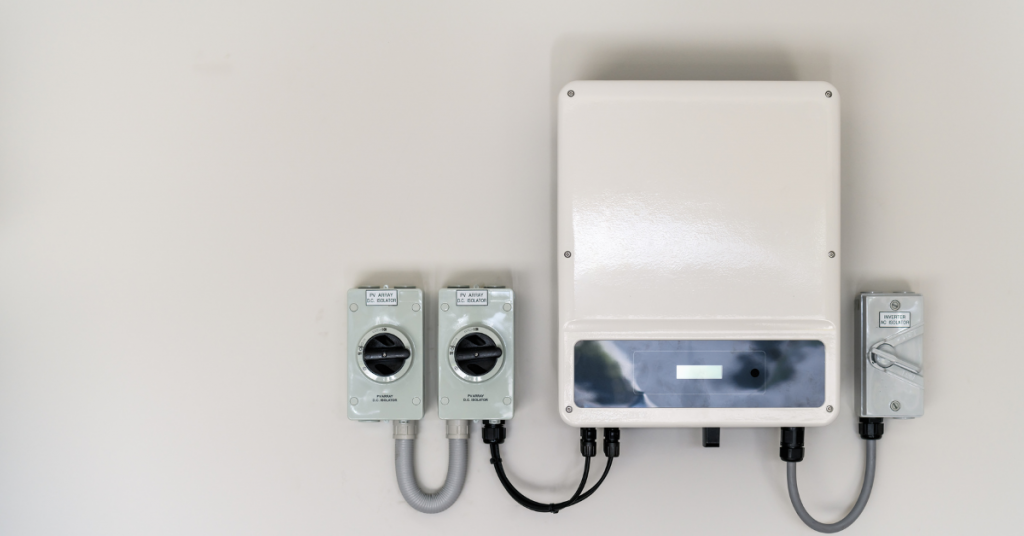
As solar adoption continues to accelerate across residential, commercial, and industrial markets, understanding the role of the solar and power inverter has become more important than ever. While solar panels generate electricity, the inverter is the component that makes that electricity usable for homes, businesses, and the electrical grid.
Modern solar and power inverter technology has evolved significantly in recent years, offering smarter energy management, improved efficiency, battery integration, and advanced monitoring capabilities.
This guide explains what solar and power inverters are, how they work, the different types available in 2026, and how to choose the right inverter for your solar system.
What is a solar and power inverter?
A solar inverter converts the direct current (DC) electricity produced by solar panels into alternating current (AC) electricity that powers appliances, lighting, and electrical systems.
Without an inverter, electricity generated by solar panels cannot be used in most homes or commercial buildings.
In addition to power conversion, modern inverters often provide:
- Energy monitoring
- Grid synchronization
- Battery management
- Safety protection
- Smart energy optimization
The inverter is frequently referred to as the “brain” of the solar energy system.
Why solar inverters are important
The solar and power inverter directly affects system performance, efficiency, and long-term reliability.
A high-quality inverter helps:
- Maximize solar energy production
- Improve energy conversion efficiency
- Protect electrical systems
- Enable battery storage integration
- Monitor system performance in real time
According to the U.S. Department of Energy, inverters are critical for safely integrating solar systems into the electrical grid.
How solar and power inverters work
Solar panels generate DC electricity when sunlight excites electrons inside photovoltaic cells.
The inverter then:
- Receives DC electricity from the solar array
- Converts DC into AC electricity
- Synchronizes power with the utility grid
- Supplies usable electricity to the building
Advanced inverters also monitor voltage, frequency, and energy production continuously.
Main types of solar and power inverters
Several inverter technologies are available in 2026, each designed for different applications.
String inverters
String inverters are the most common type used in residential and commercial solar systems.
In this setup, multiple solar panels are connected together in a “string” that feeds electricity into a single inverter.
Advantages
- Cost-effective
- Reliable and proven technology
- Easier maintenance
Limitations
- Performance can drop if one panel is shaded or underperforming
Best for
- Homes with unshaded roofs
- Standard residential systems
Microinverters
Microinverters are installed directly behind individual solar panels rather than using one central inverter.
Each panel operates independently.
Advantages
- Better shading performance
- Panel-level monitoring
- Improved system optimization
Limitations
- Higher upfront cost
Best for
- Complex roof layouts
- Shaded installations
- Premium residential systems
According to the National Renewable Energy Laboratory (NREL), module-level power electronics like microinverters can improve energy harvest in partially shaded systems.
Hybrid inverters
Hybrid inverters combine solar generation and battery management into one system.
They allow solar systems to:
- Store excess energy
- Provide backup power
- Support energy independence
Advantages
- Battery-ready design
- Simplified installation
- Improved energy management
Best for
- Homes with battery storage
- Backup power systems
- Energy resilience projects
Central inverters
Central inverters are large-scale systems primarily used for utility and commercial solar projects.
Advantages
- Efficient for massive installations
- Lower cost per watt at utility scale
Limitations
- Less flexible than distributed systems
Key features to look for in a solar and power inverter
Choosing the right inverter involves evaluating several important factors.
Efficiency rating
Most modern inverters achieve efficiencies between 95% and 99%.
Higher efficiency means less energy loss during conversion.
Monitoring capabilities
Smart monitoring allows users to track:
- Energy production
- Consumption
- System alerts
- Battery performance
Mobile apps and cloud-based dashboards are now standard features.
Battery compatibility
Many homeowners are preparing for future battery integration.
Hybrid-ready inverters offer greater long-term flexibility.
Warranty coverage
Most reputable inverters include warranties ranging from 10 to 25 years.
Longer warranties often indicate better product reliability.
Safety certifications
Look for products certified to national electrical and safety standards.
Solar inverter sizing explained
Proper sizing is essential for maximizing system performance.
Inverter size is measured in kilowatts (kW) and should align with the solar array capacity.
Most systems use a DC-to-AC ratio between 1.1 and 1.3.
For example:
- 6.5 kW solar array
- 5 kW inverter
- DC-to-AC ratio = 1.3
Proper sizing helps balance performance, efficiency, and cost.
Common solar inverter problems
Like all electrical equipment, inverters can experience issues over time.
Common problems include:
- Overheating
- Error codes
- Voltage faults
- Communication failures
- Reduced energy production
Most modern systems include diagnostic tools that help identify problems early.
How long do solar inverters last?
Solar inverters generally last between:
- 10–15 years for string inverters
- 20–25 years for microinverters
Environmental conditions, maintenance, and usage patterns all affect lifespan.
Solar and power inverter trends in 2026
The inverter market continues evolving rapidly.
AI-powered energy optimization
Advanced software now helps optimize solar generation and battery usage automatically.
Greater battery integration
As energy storage adoption rises, hybrid inverters are becoming increasingly popular.
Smart grid capabilities
Modern inverters support grid stability through voltage regulation and communication technologies.
Higher efficiency technologies
Manufacturers continue improving conversion efficiency and thermal performance.
Residential vs commercial inverter systems
| Feature | Residential | Commercial |
| Typical size | 3–15 kW | 50 kW–MW scale |
| Common inverter type | String or microinverter | String or central inverter |
| Monitoring | Homeowner apps | Enterprise energy management |
| Battery integration | Increasingly common | Growing adoption |
Why inverter quality matters for ROI
The inverter directly impacts total energy production over the system lifespan.
A low-quality inverter may lead to:
- Higher maintenance costs
- Reduced energy output
- More downtime
- Shorter lifespan
Investing in a reliable solar and power inverter often improves long-term ROI significantly.
Conclusion
The solar and power inverter is one of the most important components in any solar energy system. From converting electricity to managing batteries and optimizing energy production, inverters play a critical role in system performance and reliability.
As solar technology advances in 2026, modern inverters are becoming smarter, more efficient, and increasingly integrated with battery storage and energy management systems.
Whether you are installing residential solar, commercial systems, or utility-scale projects, choosing the right inverter can significantly improve long-term energy savings and system performance.
Browse solar inverter products here:
FAQs
What does a solar inverter do?
A solar inverter converts DC electricity from solar panels into usable AC electricity.
What is the best type of solar inverter?
It depends on the project. String inverters are common and cost-effective, while microinverters perform better in shaded conditions.
How long do solar inverters last?
Most solar inverters last between 10 and 25 years depending on type and conditions.
Are hybrid inverters worth it?
Yes, especially for systems using battery storage or backup power solutions.
Can solar panels work without an inverter?
No. Solar panels generate DC electricity, which must be converted into AC power for most applications.
Sources
- U.S. Department of Energy — Solar energy technologies and inverter fundamentals
https://www.energy.gov/eere/solar/solar-energy-technologies-office - National Renewable Energy Laboratory (NREL) — Module-level power electronics research
https://www.nrel.gov/solar/ - Solar Energy Industries Association (SEIA) — Solar market and technology insights
https://www.seia.org/ - IEEE photovoltaic inverter research publications
https://ieeexplore.ieee.org/