
Installing a solar energy system is only the first step toward generating clean, renewable electricity. To maximize energy production, protect equipment, and ensure long-term returns, system owners need visibility into how their solar assets are performing every day. This is where solar monitoring becomes essential.
Solar monitoring allows homeowners, businesses, and utility operators to track energy production, identify performance issues, and optimize system operation in real time. Without monitoring, solar systems can develop faults, experience efficiency losses, or suffer equipment failures that may go unnoticed for months.
As solar and battery storage adoption continues to grow, solar monitoring has become a critical component of modern energy management strategies.
What is solar monitoring?
Solar monitoring refers to the process of collecting, analyzing, and displaying data from a solar energy system.
Monitoring platforms typically gather information from:
- Solar panels
- Inverters
- Battery storage systems
- Energy meters
- Environmental sensors
The data is then displayed through web-based dashboards or mobile applications, allowing users to track system performance in real time. Solar monitoring systems can provide insights into energy production, energy consumption, battery status, and overall system health.
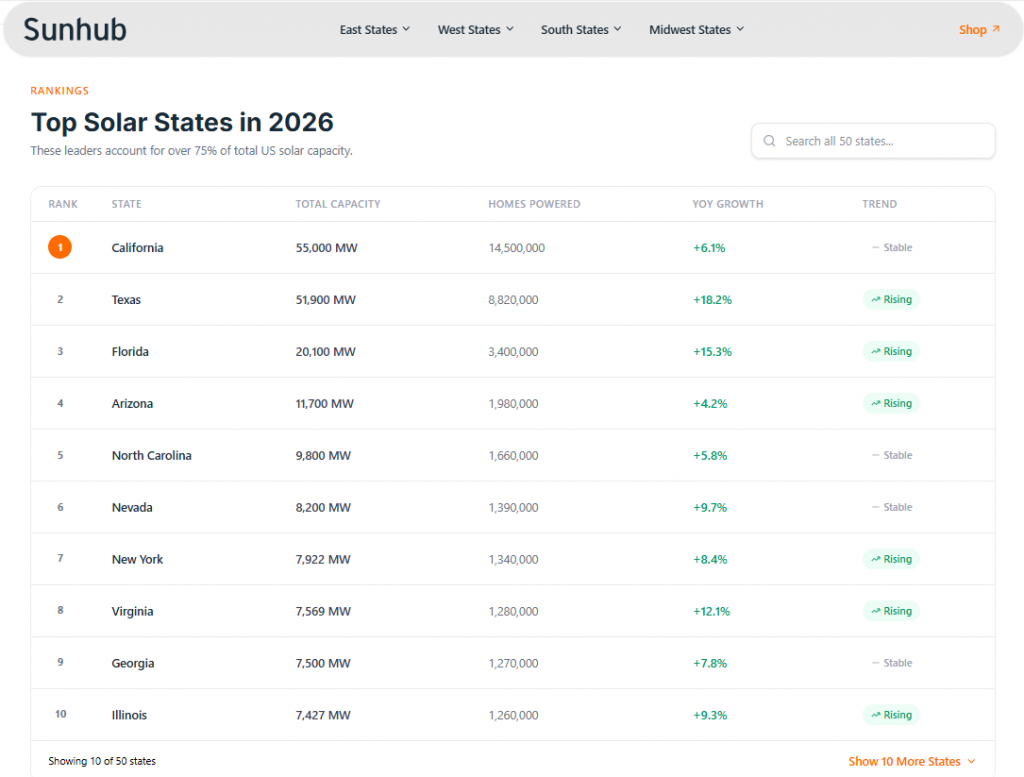
Explore U.S. Solar State Rankings
Compare solar rankings, installed capacity, growth trends, and market performance across all 50 states. Discover regional insights to support smarter procurement and expansion decisions.
How solar monitoring works
Most modern solar monitoring systems combine hardware and software components.
Data collection
Sensors, inverters, and monitoring devices continuously gather information about:
- Power generation
- Voltage
- Current
- Energy consumption
- Battery charge levels
Data transmission
Collected information is sent to cloud-based platforms or local monitoring systems for analysis.
Performance analysis
Monitoring software compares actual system performance against expected production levels and historical trends.
Alerts and reporting
When performance issues occur, monitoring systems can generate notifications that help owners address problems before they become costly failures.
Why solar monitoring matters
Many solar owners assume that if the lights are on, the system is working correctly. However, solar systems can experience performance losses without obvious warning signs.
Early fault detection
One of the most valuable benefits of solar monitoring is identifying problems before they significantly affect system output.
Common issues include:
- Inverter malfunctions
- Wiring faults
- Panel degradation
- Shading problems
- Battery performance issues
According to Energy Toolbase, undetected faults can lead to reduced energy production, increased maintenance costs, and shortened equipment lifespan. Real-time monitoring helps identify these issues before they escalate.
Maximizing energy production
Monitoring systems allow owners to verify that solar panels are generating electricity as expected.
When production drops unexpectedly, corrective action can be taken quickly, helping maximize energy yield throughout the system’s life.
Protecting return on investment
Solar systems are long-term investments.
Monitoring helps ensure that equipment continues operating efficiently, protecting projected savings and financial returns.
What can solar monitoring track?
Modern solar monitoring platforms offer a wide range of performance metrics.
Energy production
The most common feature is tracking electricity generation.
Users can view:
- Daily production
- Monthly production
- Annual production
- Lifetime production
Energy consumption
Advanced systems also track how much electricity a property consumes.
This helps users understand:
- Usage patterns
- Peak demand periods
- Opportunities for energy savings
Battery storage performance
For solar-plus-storage systems, monitoring platforms can display:
- Battery charge levels
- Charging cycles
- Discharge activity
- Backup power availability
System health
Many monitoring platforms continuously evaluate system components and identify abnormal behavior.
Common faults detected through solar monitoring
Monitoring systems can identify a wide range of operational issues.
Inverter failures
Inverters are among the most critical components in a solar energy system.
Monitoring platforms can quickly identify:
- Communication failures
- Power conversion issues
- Unexpected shutdowns
Panel underperformance
Solar panels can lose performance due to:
- Dirt accumulation
- Shading
- Physical damage
- Manufacturing defects
Monitoring systems help pinpoint underperforming arrays or strings. (Energy Toolbase)
Battery issues
Energy storage systems require close monitoring to maintain safe and efficient operation.
Monitoring software can identify:
- Capacity loss
- Charging abnormalities
- State-of-charge issues
Environmental impacts
Weather conditions, debris, and shading can affect solar production.
Monitoring helps distinguish between environmental influences and actual equipment faults.
Solar monitoring and predictive maintenance
Traditional maintenance often relies on responding after equipment fails.
Solar monitoring supports a more proactive approach known as predictive maintenance.
Predictive maintenance uses performance data to:
- Identify trends
- Detect abnormalities
- Schedule maintenance before failures occur
Research shows that data-driven fault detection can improve reliability, reduce downtime, and lower long-term maintenance costs.
Artificial intelligence and solar monitoring
Artificial intelligence (AI) is increasingly being integrated into solar monitoring platforms.
AI-powered monitoring systems can:
- Analyze large datasets
- Predict equipment failures
- Identify performance anomalies
- Improve energy forecasting
Recent research has shown that AI-driven monitoring can significantly improve fault detection accuracy compared to traditional monitoring methods.
Solar monitoring for commercial and utility-scale projects
Large solar installations often rely heavily on advanced monitoring systems.
Commercial and utility-scale operators use monitoring to:
- Manage multiple sites
- Track asset performance
- Meet contractual performance guarantees
- Improve operational efficiency
Monitoring is particularly important for projects with battery storage because it provides visibility into both generation and storage performance.
Choosing a solar monitoring system
When evaluating solar monitoring platforms, consider the following features:
Real-time data access
Look for systems that provide live performance information.
Mobile and web dashboards
Remote access allows users to monitor systems from anywhere.
Automated alerts
Notifications help identify issues immediately.
Battery monitoring support
If your system includes storage, battery monitoring capabilities are essential.
Historical reporting
Long-term performance tracking helps identify trends and evaluate system health.
The future of solar monitoring
Several innovations are shaping the future of solar monitoring.
AI-powered analytics
Machine learning algorithms will continue improving fault detection and forecasting capabilities.
IoT integration
Internet of Things (IoT) devices are enabling more detailed monitoring at the panel, string, and component level. (IJRASET)
Digital twins
Some advanced systems now use digital models of solar installations to predict performance and simulate maintenance scenarios.
Automated diagnostics
Future monitoring platforms may automatically identify, classify, and prioritize maintenance issues without human intervention.
Conclusion
Solar monitoring has become an essential part of modern solar energy systems. By providing real-time visibility into system performance, monitoring platforms help owners maximize energy production, detect faults early, and protect long-term investments.
Whether managing a residential rooftop system, a commercial installation, or a utility-scale solar farm, effective monitoring provides the data needed to optimize performance and reduce operational risk.
As solar technology continues to evolve, advanced monitoring solutions powered by AI, IoT, and predictive analytics will play an increasingly important role in improving the efficiency and reliability of solar energy systems.
FAQs
What is solar monitoring?
Solar monitoring is the process of tracking and analyzing the performance of a solar energy system in real time.
Why is solar monitoring important?
It helps detect faults, maximize energy production, improve maintenance planning, and protect system performance.
What can a solar monitoring system track?
Most systems track energy production, energy consumption, battery performance, and equipment health.
Can solar monitoring detect equipment failures?
Yes. Modern monitoring platforms can identify inverter faults, panel underperformance, battery issues, and other operational problems.
Does solar monitoring work with battery storage systems?
Yes. Many monitoring platforms provide detailed battery performance data, including charging, discharging, and state-of-charge information.
Sources
- Energy Toolbase — Detecting faults with energy storage and solar monitoring (Energy Toolbase)
- National Renewable Energy Laboratory (NREL) — Best Practices for Operation and Maintenance of Photovoltaic and Energy Storage Systems (NLR)
- International Energy Agency (IEA) — Solar PV market and performance research
https://www.iea.org/energy-system/renewables/solar-pv - MDPI Applied Sciences — AIoT for solar energy monitoring and fault detection (MDPI)
- NREL — Solar research and performance analysis
https://www.nrel.gov/solar/