

California remains one of the most attractive states for residential solar, but finding the best solar deals in California requires more than choosing the lowest advertised price. Homeowners must compare equipment quality, warranties, financing terms, battery options, installer experience, and projected savings under California’s current Solar Billing Plan.
As of July 2026, an average residential solar installation in California costs approximately $2.46 per watt. A typical 8.95-kW system costs around $21,988 before incentives, although quoted prices commonly range from about $18,690 to $25,286. Actual costs vary by location, roof condition, equipment, permitting requirements, and whether battery storage is included.
This guide explains how homeowners can identify the best California solar deals, compare quotes accurately, and avoid offers that appear inexpensive but provide poor long-term value.
What Is Considered a Good Solar Deal in California?
A strong solar deal delivers competitive pricing without sacrificing system performance, installation quality, or consumer protection.
When comparing proposals, homeowners should evaluate:
- Total installed cost
- Price per watt
- Estimated annual production
- Panel and inverter brands
- Workmanship and equipment warranties
- Financing fees and interest rates
- Battery capacity and usable energy
- Installer licensing and experience
- Utility interconnection support
Price per watt is useful because it allows homeowners to compare differently sized systems. Based on California’s July 2026 average of $2.46 per watt, a quote substantially above the local market should include a clear reason, such as premium equipment, complicated roof work, electrical upgrades, or battery storage.
A quote below the market average is not automatically the best option. Extremely low pricing may reflect lower-quality equipment, limited warranty coverage, subcontracted labor, unrealistic production estimates, or fees that are not included in the initial proposal.
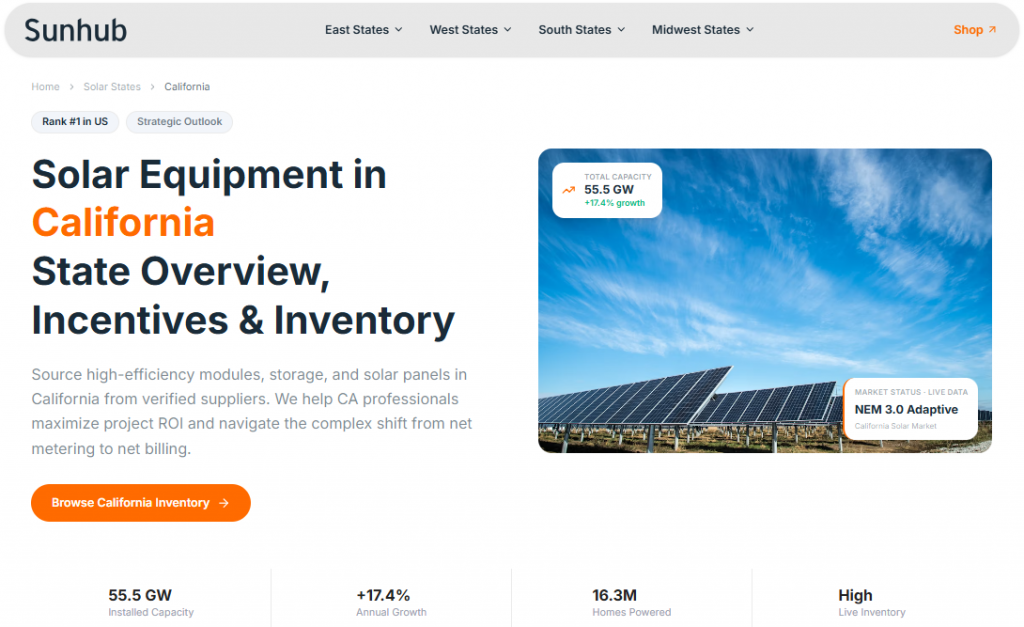
Explore California’s Solar Market
View California’s solar ranking, installed capacity, annual growth trends, market performance, and popular solar products and brands. Use these insights to support smarter procurement and expansion decisions in the state.
Average California Solar Prices in 2026
Solar costs differ considerably across California. Local labor rates, permitting fees, roof characteristics, system size, and utility requirements can all affect the final price.
Recent EnergySage data showed approximate installed prices of:
| California Market | Average Installed Price |
|---|---|
| Statewide average | $2.46 per watt |
| Pacific Palisades | $2.34 per watt |
| Victorville | $2.43 per watt |
| Newark | $2.51 per watt |
| San Diego | $2.53 per watt |
| Santa Clara | $2.55 per watt |
California Solar Prices by Market
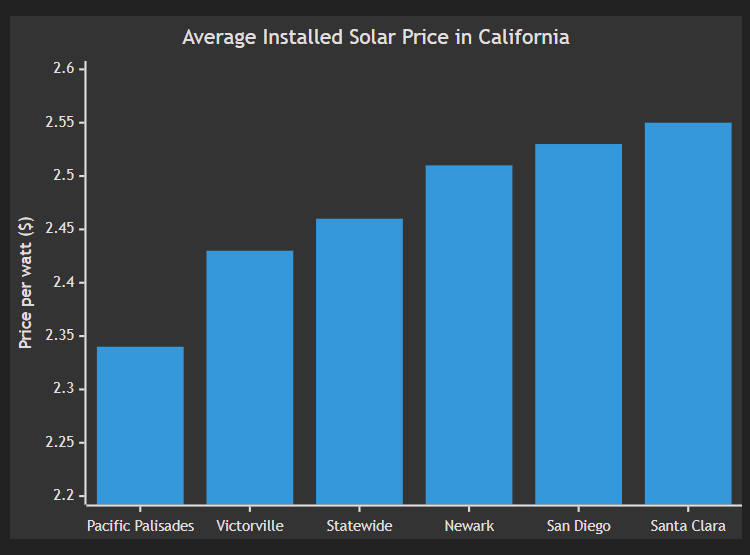
These figures illustrate why homeowners should compare local proposals rather than relying only on statewide averages.
System size also affects total cost. Larger systems cost more overall but may have a lower price per watt because fixed design, permitting, and labor expenses are distributed across more panels.
Compare Multiple Solar Quotes
The most reliable way to find the best solar deals in California is to request multiple quotes using the same basic project requirements.
Each installer should receive:
- The same recent utility bills
- The same battery preference
- The same ownership or financing preference
- Information about future electric vehicles or appliances
- Details about planned roof or electrical work
Homeowners should compare each proposal’s expected annual kilowatt-hour production, not merely the number of panels. Two systems with similar capacity can produce different amounts of electricity because of panel efficiency, roof orientation, shading, inverter selection, and design quality.
Production guarantees should also be reviewed carefully. A high estimate can make projected savings look more attractive, but it does not necessarily mean the system will perform as promised.
Understand California’s Solar Billing Plan
Most new customers of Pacific Gas and Electric, Southern California Edison, and San Diego Gas & Electric receive service under California’s Net Billing Tariff, commonly called the Solar Billing Plan or NEM 3.0.
Under this structure, solar electricity used immediately in the home offsets electricity that would otherwise be purchased from the utility. Excess power sent to the grid earns credits based on its estimated value to the electrical system rather than the full retail electricity rate.
Because exported energy generally has a lower value than electricity consumed onsite, the economics of a California solar installation increasingly depend on:
- Matching solar production with household demand
- Shifting appliance use into daylight hours
- Avoiding unnecessary system oversizing
- Using battery storage to increase self-consumption
The California Public Utilities Commission advises consumers that most savings come from directly using solar energy in the home, while export credits provide a smaller additional benefit.
Consider Solar-Plus-Storage Deals
A battery can store excess midday solar generation and make that electricity available during evening peak-rate periods or outages.
When comparing battery packages, review:
- Usable storage capacity
- Continuous and peak power
- Round-trip efficiency
- Backup capabilities
- Battery warranty
- Expected cycle life
- Installation and permitting costs
- Whether the battery can charge from the grid
- Compatibility with the solar inverter
The cheapest battery is not necessarily the best value. A system should be sized around the homeowner’s goals, whether those involve bill savings, whole-home backup, essential-load backup, or participation in a utility program.
Eligible customers may also receive battery incentives through California’s Self-Generation Incentive Program. Availability and incentive levels depend on factors such as utility territory, income qualification, medical needs, wildfire exposure, and program funding.
Explore California’s Solar Market
View California’s solar ranking, installed capacity, annual growth trends, market performance, and popular solar products and brands. Use these insights to support smarter procurement and expansion decisions in the state.
Check Which Incentives Remain Available
California homeowners should be cautious about outdated marketing that still advertises a federal 30% residential solar tax credit for new 2026 purchases.
The Internal Revenue Service states that the Residential Clean Energy Credit applied at 30% for qualifying expenditures from 2022 through 2025. Under the 2025 federal legislation, the credit is not allowed for residential clean-energy expenditures made after December 31, 2025.
However, homeowners may still find value through:
- California battery incentive programs
- Local utility or municipal programs
- Income-qualified solar programs
- Manufacturer or installer promotions
- Lease or power-purchase agreement structures
- The state’s active solar property-tax exclusion
California’s active solar energy system exclusion is currently scheduled to sunset on January 1, 2027. Qualifying systems installed while the exclusion applies generally do not increase the property’s assessed value solely because solar was added.
Program eligibility can change, so homeowners should confirm current terms directly with the appropriate agency or utility before signing a contract.
Compare Cash, Loans, Leases, and PPAs
The financing structure can affect the true cost of a solar system more than the advertised panel price.
Cash Purchase
Paying cash generally provides the simplest ownership structure and avoids interest and dealer fees. However, it requires a substantial upfront investment.
Solar Loan
A loan spreads the cost over time, but homeowners should compare the cash price with the financed price. Low-interest solar loans can include significant dealer fees that increase the system’s total cost.
Solar Lease
With a lease, a third party owns the system and the homeowner makes scheduled payments. The contract should be checked for annual escalators, maintenance responsibilities, transfer conditions, and buyout terms.
Power-Purchase Agreement
Under a PPA, the homeowner pays for the electricity generated by the system rather than purchasing the equipment. The initial rate may be lower than utility electricity, but escalation clauses can affect long-term savings.
The best structure depends on available cash, tax circumstances, financing costs, homeownership plans, and preferred responsibility for system maintenance.
Watch for Misleading Solar Offers
Homeowners should be cautious when an installer claims solar is completely free or guarantees that utility bills will disappear.
California’s consumer guidance warns that solar is rarely free and that customers usually continue receiving utility bills after installation.
Warning signs include:
- High-pressure same-day sales tactics
- Unexplained financing fees
- Promises of guaranteed government checks
- Missing equipment model numbers
- Verbal promises excluded from the contract
- Unrealistic electricity escalation assumptions
- Vague warranty or maintenance terms
- Claims that a system eliminates every utility charge
Before signing, homeowners should review the complete contract, confirm the contractor’s license, understand cancellation rights, and verify that projected savings are based on realistic assumptions.
Conclusion
Finding the best solar deals in California requires comparing total value rather than chasing the lowest advertised price. A competitive proposal should combine reasonable cost per watt, dependable equipment, realistic energy-production estimates, clear warranties, and financing terms that support long-term savings.
Under California’s Solar Billing Plan, system design and self-consumption are especially important. Homeowners should compare several installers, evaluate whether storage supports their energy goals, verify every available incentive, and read the full contract before committing.
The strongest solar deal is one that fits the property, electricity usage, budget, and long-term plans, not simply the proposal with the smallest initial number.
FAQs
How Much Do Solar Panels Cost in California in 2026?
As of July 2026, California solar systems average approximately $2.46 per watt. A typical 8.95-kW system costs about $21,988 before available incentives.
How Many Solar Quotes Should I Compare?
Homeowners should generally compare at least three detailed proposals. Each quote should use similar system requirements so pricing, production, equipment, and warranties can be evaluated fairly.
Is There Still a 30% Residential Solar Tax Credit in 2026?
No. The IRS states that the 30% Residential Clean Energy Credit applied to qualifying expenditures from 2022 through 2025 and is not available for expenditures made after December 31, 2025.
Is a Solar Battery Worth Adding in California?
A battery may improve self-consumption, reduce electricity purchases during expensive evening periods, and provide backup power. Its value depends on utility rates, household usage, equipment cost, and available incentives.
What Is the Best Way to Pay for Solar?
Cash ownership often produces the lowest lifetime cost, but loans, leases, and PPAs may reduce upfront expenses. Homeowners should compare the total contract cost, not only the monthly payment.
Sources
Sources include the California Public Utilities Commission, “Net Energy Metering and Net Billing” and “California Solar Consumer Protection Guide”; California State Board of Equalization, “Active Solar Energy System Exclusion”; Internal Revenue Service, “Home Energy Tax Credits” and “Federal Energy Credit Changes Under Public Law 119-21”; and EnergySage data on average installed solar prices in California.