

Sourcing solar equipment has become a critical part of successful project development. Whether you’re an installer purchasing equipment for a commercial rooftop, an EPC building a utility-scale project, or a distributor replenishing inventory, procurement decisions can influence project cost, construction schedules, system performance, and long-term reliability.
Sourcing solar equipment involves considerably more than purchasing panels.
The U.S. Department of Energy (DOE) notes that photovoltaic systems depend on an extensive manufacturing ecosystem encompassing modules, inverters, wiring, combiner boxes, racking, tracking systems, and numerous module-level components.
For buyers, this means effective sourcing requires a structured approach: define the project requirements, establish equipment specifications, evaluate suppliers, confirm certifications and compatibility, compare total costs, coordinate logistics, and verify equipment when it arrives.
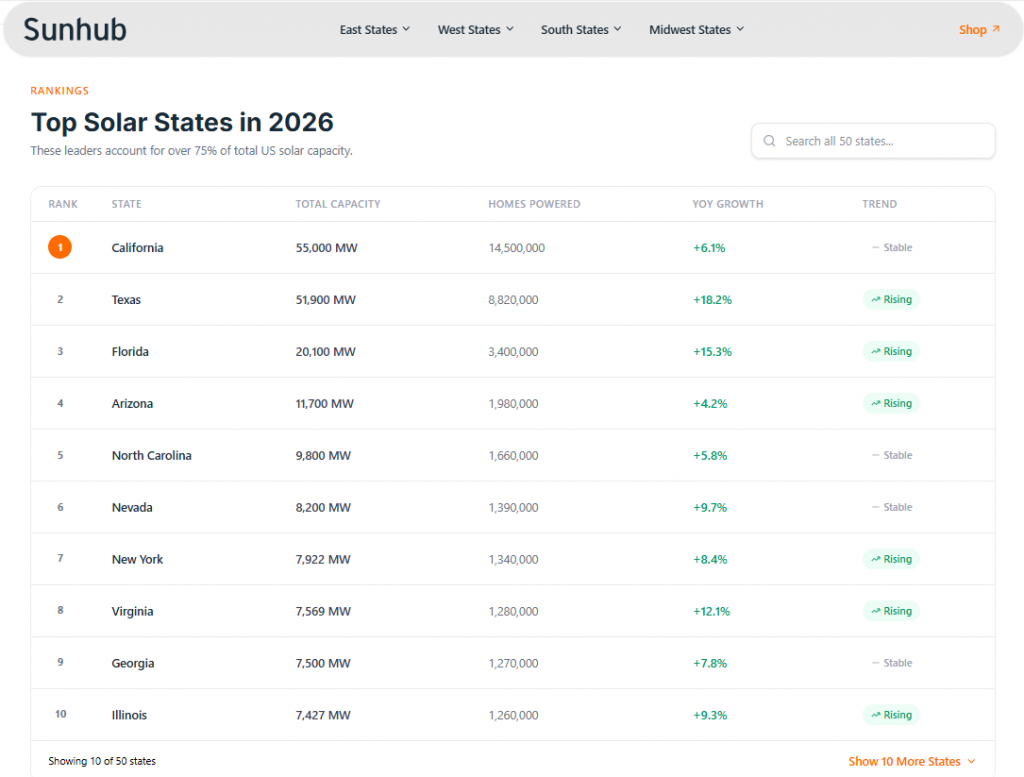
Explore U.S. Solar State Rankings
Compare solar rankings, installed capacity, growth trends, and market performance across all 50 states. Discover regional insights to support smarter procurement and expansion decisions.
Here is how to approach sourcing solar equipment in 2026.
1. Define the Project Before Sourcing Equipment
The procurement process should begin with the project requirements, not with whichever equipment happens to have the lowest price.
Before requesting quotes, buyers should establish basic parameters such as:
- Project capacity
- Residential, commercial, or utility-scale application
- Roof- or ground-mounted configuration
- Electrical design
- Module requirements
- Inverter architecture
- Racking requirements
- Battery-storage requirements
- Interconnection specifications
- Construction schedule
- Delivery location
Equipment requirements can vary significantly between projects.
For example, a large ground-mounted installation may prioritize high-wattage modules and utility-scale inverter architecture, while a commercial rooftop project may face strict space, weight, fire-code, and electrical-design constraints.
Creating a detailed bill of materials (BOM) or equipment specification before approaching suppliers makes quotes easier to compare.
2. Determine Exactly What Equipment You Need
Solar procurement extends far beyond modules.
DOE identifies multiple manufactured components across a photovoltaic system, including modules, racking, wiring, power electronics, and monitoring equipment.
Depending on the project, buyers may need to source:
Solar modules: The primary electricity-generating component.
Inverters: Equipment that converts DC electricity from the PV array into AC electricity suitable for the electrical system or grid.
Racking or trackers: Structural systems that secure and position modules.
Electrical balance-of-system equipment: Wiring, connectors, combiner boxes, disconnects, switchgear, transformers, and other electrical components.
Battery storage: Energy-storage equipment where required by the project.
Monitoring equipment: Hardware and software used to track system performance.
Procurement teams should evaluate these products as parts of one system rather than unrelated purchases.
A low-priced module provides little value if it creates compatibility issues with the project’s racking, inverter, electrical design, or approved engineering package.
3. Establish Technical Specifications Before Requesting Quotes
Once the equipment categories are established, buyers should define acceptable specifications.
For solar modules, these might include:
- Module wattage
- Dimensions
- Efficiency
- Cell technology
- Temperature coefficient
- Degradation warranty
- Product warranty
- Connector type
- Mechanical loading
- Required certifications
For inverters, specifications could include:
- AC output
- Maximum DC input
- MPPT operating range
- DC-to-AC ratio
- Efficiency
- Monitoring compatibility
- Grid requirements
- Safety certifications
- Warranty
Inverter compliance is especially important for grid-connected projects. UL Solutions identifies UL 1741 as a standard covering inverters, converters, controllers, and interconnection system equipment used with distributed energy resources.
Creating these specifications before collecting quotes helps procurement teams compare equivalent products rather than evaluating equipment that only appears similar.
4. Evaluate the Supplier, Not Just the Product
When sourcing solar equipment, product specifications are only part of the purchasing decision.
The supplier matters too.
Buyers should investigate:
- Business history
- Product authorization
- Equipment availability
- Warranty support
- Documentation
- Shipping capabilities
- Return procedures
- Customer support
- Financial stability
- References or previous projects
For large purchases, buyers may also want to confirm where inventory is physically located and whether the supplier actually controls the stock being offered.
This becomes especially important when equipment is required by a specific construction date.
A competitive quote means little if the equipment is unavailable when the project needs it.
5. Compare More Than the Price Per Watt
Solar modules are frequently compared using price per watt, but the lowest price per watt does not necessarily represent the lowest project cost.
Procurement teams should calculate the total delivered cost.
That can include:
Equipment price + freight + insurance + duties + warehousing + handling + financing costs + potential replacement or delay costs.
A slightly cheaper module, for example, may have dimensions that require more racking or increase installation labor. Another supplier might offer a lower equipment price but charge substantially more for transportation.
Procurement should therefore be evaluated within the economics of the complete project.
6. Pay Attention to Manufacturing Origin
Where solar equipment and its components are manufactured has become increasingly relevant to U.S. procurement.
DOE describes the solar supply chain as global and notes that trade measures, tariffs, duties, tax policy, and domestic-manufacturing initiatives can affect U.S. solar manufacturing and sourcing.
Manufacturing origin may matter for:
- Import duties
- Tariffs
- Customs requirements
- Project eligibility requirements
- Domestic-content calculations
- Supply-chain risk
- Delivery timelines
Importantly, the country where a finished module is assembled does not necessarily identify the origin of every component inside it.
For crystalline-silicon modules, the upstream supply chain can include polysilicon, ingots, wafers, cells, glass, encapsulants, backsheets, junction boxes, and frames before final module assembly.
For projects with specific sourcing or domestic-content requirements, procurement teams may therefore need documentation extending deeper into the supply chain.
7. Verify Certifications and Documentation
Before issuing a purchase order, buyers should confirm that the proposed equipment meets the technical and regulatory requirements applicable to the project.
Depending on the product and jurisdiction, documentation may include:
- Product data sheets
- Safety certifications
- Installation manuals
- Warranty documentation
- Test reports
- Country-of-origin information
- Serial-number records
- Interconnection documentation
These records can matter during engineering, permitting, interconnection, installation, and future warranty claims.
Documentation should therefore be treated as part of the product, not paperwork to chase after equipment has already arrived.
8. Consider Equipment Compatibility
Solar components must work together.
Module electrical characteristics must align with inverter operating ranges. Modules must physically integrate with the selected mounting system. Inverters must satisfy applicable grid requirements. Battery systems must be compatible with the project’s power electronics and controls.
Substituting equipment after engineering has been completed can create problems.
A replacement module with different dimensions may affect racking layouts. A different inverter could change string sizing or electrical calculations. Even connector compatibility can become an installation issue.
For that reason, procurement teams should coordinate closely with engineering before approving substitutions.
9. Build Alternatives Into the Procurement Strategy
Solar equipment availability can change between project design and construction.
One way to reduce that risk is to establish approved alternatives early.
Instead of specifying only one acceptable module or inverter, engineering teams can identify equivalent products that satisfy the project’s technical requirements.
This gives procurement teams greater flexibility if:
- Inventory disappears
- Manufacturing schedules change
- Shipping is delayed
- Pricing changes
- A product is discontinued
Supplier diversification can provide similar protection.
The goal isn’t to constantly switch manufacturers. It is to avoid placing the entire project schedule at risk because one product or supplier becomes unavailable.
The National Laboratory of the Rockies continues to track supply-and-demand swings, manufacturing locations, material availability, domestic content, and broader resilience across the solar supply chain, illustrating how procurement conditions can shift throughout the market.
10. Plan Logistics Before Placing the Order
Solar equipment can involve substantial freight.
A large project may require multiple truckloads or shipping containers of modules, inverters, racking, batteries, and electrical equipment.
Before finalizing an order, confirm:
- Shipping method
- Freight responsibility
- Delivery dates
- Delivery location
- Site access
- Unloading requirements
- Storage capacity
- Insurance
- Damage procedures
Delivery timing should align with the construction schedule.
Receiving equipment too late can delay construction, but receiving it months too early can create additional warehousing costs and expose products to unnecessary handling or storage risks.
11. Inspect Equipment When It Arrives
Procurement doesn’t end when the purchase order is issued.
Equipment should be inspected when delivered. This final stage of sourcing solar equipment confirms the order is complete.
Teams should check:
- Quantities
- Model numbers
- Packaging condition
- Visible damage
- Serial numbers where required
- Pallet condition
- Documentation
- Accessories and components
Any damage or discrepancies should be documented promptly according to supplier and freight-provider procedures.
Discovering missing or damaged equipment when installers are already onsite can be significantly more expensive than identifying the problem during receiving.
12. Think About Long-Term Replacement Availability
Solar installations are long-term assets.
When sourcing equipment, consider what happens years after construction.
Can replacement modules be sourced if one is damaged? Will the manufacturer support the inverter throughout the warranty period? Are replacement parts available? How are warranty claims processed?
Exact module models may eventually be discontinued as manufacturers introduce newer products.
Maintaining detailed equipment records, including model numbers, specifications, serial numbers, warranties, and supplier information, can make future operations and maintenance considerably easier.
Why Solar Equipment Sourcing Is Changing
The U.S. solar supply chain continues to evolve.
DOE tracks domestic manufacturing across modules and components, while recent national-laboratory analysis examines PV modules, battery technologies, structural and electrical balance-of-system equipment, manufacturing costs, domestic content, and installation trends.
That changing landscape gives buyers more variables to consider.
Price will always matter, but modern solar procurement increasingly involves balancing:
Cost + availability + quality + compliance + compatibility + logistics + supply-chain risk.
The best sourcing decision is therefore not necessarily the cheapest product. It is the equipment package most capable of reaching the project site on time, meeting engineering requirements, and performing as expected throughout the project.
Conclusion
Sourcing solar equipment successfully requires much more than finding panels at the lowest price per watt.
A strong procurement process starts with clearly defined project requirements and technical specifications. Buyers then need to evaluate suppliers, verify certifications and manufacturing information, compare total delivered costs, confirm equipment compatibility, plan logistics, and inspect products when they arrive.
Supply-chain diversification and approved equipment alternatives can also help projects adapt when availability changes.
For installers, EPCs, developers, and distributors, better procurement ultimately means reducing uncertainty.
When sourcing solar equipment is integrated with engineering and project scheduling from the beginning, solar businesses can make more informed purchasing decisions, reduce avoidable delays, and keep projects moving from design through installation.
Explore more solar procurement resources on Sunhub Blog.https://www.sunhub.com/blog/solar-business/
Frequently Asked Questions
What does sourcing solar equipment mean?
Sourcing solar equipment is the process of identifying, evaluating, purchasing, and coordinating delivery of the components required for a solar installation. This can include modules, inverters, racking, batteries, electrical balance-of-system equipment, and monitoring technology.
What should buyers look for when sourcing solar panels?
Buyers should evaluate wattage, dimensions, efficiency, degradation, temperature performance, warranty coverage, certifications, manufacturer support, supplier reliability, inventory, and total delivered cost.
Is price per watt the most important factor?
No. Price per watt is useful for comparing modules, but procurement teams should also consider freight, tariffs or duties where applicable, compatibility, warranties, lead times, installation requirements, and the financial impact of project delays.
Why does country of origin matter when sourcing solar equipment?
Manufacturing origin can affect trade requirements, tariffs, customs, domestic-content considerations, documentation, and supply-chain risk. Because solar modules have multi-stage supply chains, buyers may need more information than the location of final module assembly.
What solar equipment needs to be sourced for a project?
Most projects require solar modules, inverters, mounting or racking equipment, wiring, connectors, protection equipment, monitoring technology, and other balance-of-system components. Some projects also require battery storage, transformers, or switchgear.
Sources
U.S. Department of Energy — Solar Manufacturing
U.S. Department of Energy — Solar Photovoltaic Manufacturing Basics
U.S. Department of Energy — Overview of Trade and Policy Measures for U.S. Solar Manufacturing
U.S. Department of Energy — Solar Photovoltaics Supply Chain Review
National Laboratory of the Rockies — Solar Supply Chain and Industry Analysis
National Laboratory of the Rockies — Annual Supply Chain for Photovoltaics in the United States
UL Solutions — PV Inverter and BESS Converter Certification