
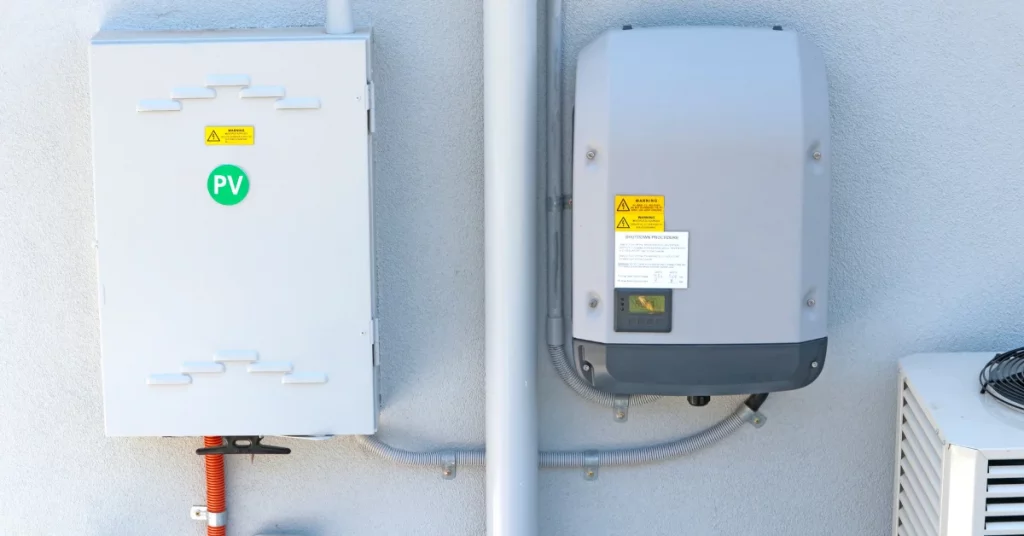
Inverters are one of the most important components of a solar photovoltaic (PV) system. Solar panels generate direct current (DC) electricity, while electrical grids and most equipment operate using alternating current (AC). The inverter performs the essential job of converting that DC electricity into usable AC electricity.
For commercial and utility-scale projects, two common approaches are central and string inverter architectures. Both perform the same fundamental conversion, but they differ considerably in how power is collected, converted, monitored, and managed across a solar installation.
Understanding the string inverter vs central inverter comparison can help developers, EPCs, installers, and other solar professionals evaluate system design, maintenance requirements, project conditions, and long-term operating considerations.
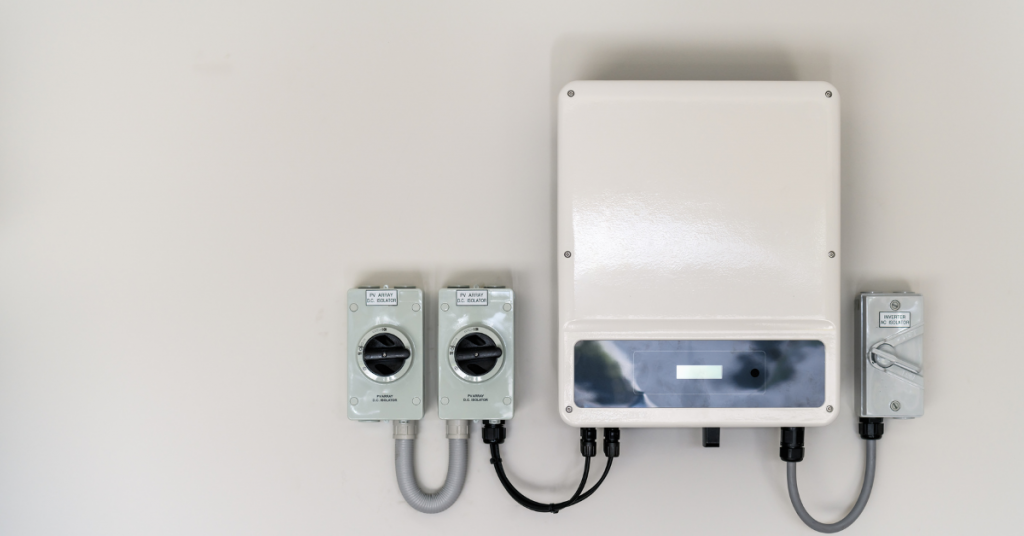
Table of Contents
What is a string inverter?
A string inverter converts electricity from a group, or “string,” of interconnected solar panels. Rather than directing a large portion of a solar plant’s DC electricity to one conversion point, multiple string inverters can be distributed throughout the array.
The U.S. Department of Energy (DOE) explains that string inverters connect a set of panels to an inverter, which then converts the electricity produced by that string into AC power.
In larger commercial and utility-scale installations, numerous string inverters can operate together. This creates a more distributed power-conversion architecture.
One important characteristic of this design is multiple maximum power point tracking (MPPT). MPPT allows an inverter to continuously adjust electrical operating conditions to extract as much available power as possible from the connected PV array. A distributed architecture can provide more granular control across different portions of a large solar installation.

Explore U.S. Solar State Rankings
Compare solar rankings, installed capacity, growth trends, and market performance across all 50 states. Discover regional insights to support smarter procurement and expansion decisions.
What is a central inverter?
A central inverter takes a more consolidated approach.
Instead of installing many smaller inverters throughout the array, numerous PV strings are combined and their DC electricity is routed toward a much larger inverter. Central inverter systems therefore concentrate power conversion into fewer locations.
Central inverters have historically been widely associated with utility-scale solar installations because their high power ratings allow large amounts of PV capacity to be served by relatively few inverter units. NREL research identifies both central and string inverters as principal components used in U.S. utility and commercial and industrial standalone PV installations.
A central architecture typically also incorporates equipment such as DC combiner boxes, switchgear, transformers, and other balance-of-system components required to collect and deliver electricity to the grid.
String inverter vs central inverter at a glance
| Factor | String inverter | Central inverter |
|---|---|---|
| Architecture | Distributed across the PV system | Centralized conversion points |
| Power conversion | Smaller portions of the array per inverter | Large sections of the array per inverter |
| Number of inverter units | Generally higher | Generally lower |
| MPPT | More distributed MPPT capability | MPPT covers larger aggregated sections |
| Failure impact | Failure generally affects a smaller portion of system capacity | Individual inverter failure can affect a larger block of capacity |
| Maintenance | Individual units can often be isolated or replaced | May require specialized servicing of larger equipment |
| Site flexibility | Well suited to complex layouts and varying array conditions | Often suited to large, relatively uniform arrays |
| DC collection | Can reduce reliance on centralized DC collection | Typically requires substantial DC collection infrastructure |
| Equipment footprint | Equipment distributed throughout the site | Larger equipment concentrated at designated locations |
| Common applications | Commercial and increasingly utility-scale PV | Large commercial and utility-scale PV |

Browse current solar inverter inventory on Sunhub when comparing equipment for an upcoming project.
These characteristics are general rather than absolute. Modern inverter designs continue to evolve, and actual system architecture depends on equipment specifications, site conditions, electrical design, grid requirements, and project economics.
Performance and energy yield
The string inverter vs central inverter decision affects how each architecture responds to variations across a solar array.
Solar panels rarely operate under perfectly identical conditions. Differences can result from shading, soiling, module characteristics, terrain, orientation, temperature, and degradation.
With string inverters, smaller sections of the array can operate independently through separate inverter inputs and MPPT channels. As a result, performance variations in one part of the installation may have less influence on other sections.
Central inverters aggregate significantly larger amounts of PV capacity. This can be highly effective on large, uniform sites but provides less distributed power conversion than a string-based architecture.
The difference can become particularly relevant for sites with irregular terrain, multiple orientations, localized shading, or other sources of electrical mismatch.
Reliability and system availability
Reliability is another important consideration when comparing string inverter vs central inverter configurations.
A string-based installation distributes conversion among numerous inverter units. If one inverter becomes unavailable, only the capacity connected to that particular unit is typically affected while the remaining inverters continue operating.
A central inverter handles significantly more capacity. Consequently, an outage involving one central inverter can temporarily remove a larger portion of the plant’s generating capacity.
However, the comparison should not be reduced simply to the number of possible failure points.
NREL notes that inverter reliability and availability should be evaluated through total cost of ownership, including component costs, labor, downtime, replacement requirements, and the financial effects of lost production.
Project owners should therefore consider expected availability across the entire system rather than evaluating inverter purchase price or individual component reliability alone.
Installation and balance-of-system requirements
The string inverter vs central inverter choice also changes the balance of system (BOS).
Central inverter installations typically collect DC electricity from many strings before sending it to the inverter. This can require DC combiner boxes, extensive DC cabling, and associated protection equipment.
String inverter architectures move the DC-to-AC conversion closer to the solar array. The DOE has noted that utility-scale string architectures can eliminate certain combiner-box requirements and potentially improve some operations and maintenance characteristics.
However, string systems require more individual inverter units and can increase other installation requirements, including AC collection equipment and field installation work.
For that reason, evaluating BOS cost means considering the complete electrical architecture rather than simply comparing inverter prices.
Operations and maintenance
Operations and maintenance strategies are central to any string inverter vs central inverter comparison.
String inverters are comparatively compact and modular. Individual units can generally be serviced or replaced without taking a large portion of the solar plant offline. Their distributed nature can also make it easier to identify performance issues affecting smaller portions of an array.
Central inverters are substantially larger pieces of equipment. Fewer units need to be managed, but maintenance can require technicians familiar with the specific equipment and procedures.
There is therefore a tradeoff between maintaining many smaller devices and maintaining fewer, larger pieces of equipment.
Monitoring capabilities also matter. Modern inverter systems can incorporate digital communications, AC and DC performance monitoring, grid-support functionality, ground-fault protection, and other advanced features.
Grid support capabilities
Grid-support capabilities are another part of the string inverter vs central inverter assessment. Modern solar inverters do considerably more than convert DC electricity into AC.
According to the DOE, advanced inverters can provide or absorb reactive power and perform other functions that help solar installations interact with the electric grid.
Depending on the equipment and project requirements, inverter functionality can include voltage regulation, frequency response, reactive power management, communications, monitoring, and other grid-support services.
For utility-scale developers, these capabilities are increasingly important because projects must satisfy interconnection agreements and applicable grid requirements.
Rather than assuming one architecture inherently provides better grid support, developers should evaluate the specifications and certifications of the individual inverter platform.
Cost considerations
The economics of string inverter vs central inverter systems extend far beyond equipment price.
A complete financial assessment can include:
- Inverter acquisition cost
- DC and AC cabling
- Combiner equipment
- Transformers and switchgear
- Installation labor
- Site preparation
- Monitoring equipment
- Preventive maintenance
- Replacement components
- Technician requirements
- possible downtime and lost generation
This is why total cost of ownership is generally more useful than simply comparing the purchase price of two inverter models.
An architecture with a lower upfront inverter cost does not automatically produce the lowest lifetime project cost. Similarly, a more expensive initial design may offer operational or energy-production benefits that influence long-term economics.
When does a string inverter make sense?
String inverter architectures can be particularly useful when a solar project requires greater modularity.
Projects with irregular layouts, uneven terrain, multiple array orientations, localized shading, or significant mismatch between different portions of an installation may benefit from having power conversion and MPPT distributed throughout the system.
String architectures can also be attractive where developers value redundancy. Losing one unit generally removes a comparatively small amount of capacity rather than an entire large conversion block.
The development of higher-capacity string equipment has also expanded its possible utility-scale applications. The DOE, for example, has supported research and development involving string inverter designs in the hundreds-of-kilowatts range specifically for utility-scale PV plants.
When does a central inverter make sense?
Central inverters remain relevant for large projects where substantial amounts of solar capacity can be efficiently aggregated.
A large, relatively uniform site can be well suited to centralized conversion, particularly when the electrical design, installation strategy, and maintenance program are built around large power-conversion stations.
Using fewer high-capacity units can also simplify certain aspects of equipment management and concentrate inverter infrastructure into defined areas of a solar plant.
Ultimately, however, project size alone should not determine inverter architecture.
Choosing between string and central inverters
There is no universal answer to the string inverter vs central inverter question. Both architectures are used in large solar installations, and the appropriate approach depends on project-specific requirements.
Developers and EPC teams should consider site layout, system capacity, terrain, shading, module configuration, electrical architecture, interconnection requirements, labor availability, maintenance strategy, equipment availability, expected downtime, and total lifetime cost.
As inverter technology develops, the boundary between traditional string and central applications is also becoming less rigid. Higher-power string inverters are extending distributed architectures into larger projects, while central inverters continue to provide high-capacity conversion for utility-scale installations.
In the string inverter vs central inverter comparison, the most effective architecture is the one that fits the technical and economic requirements of the complete PV system, not simply the inverter with the lowest upfront price.
Frequently asked questions
What is the main difference between a string inverter and a central inverter?
The primary difference is how solar power is aggregated and converted. String inverters convert electricity from smaller groups of modules using multiple distributed inverter units, while central inverters aggregate electricity from much larger sections of a solar plant and convert it using fewer, higher-capacity units.
Are string inverters used for utility-scale solar?
Yes. Although string inverters have long been associated with residential and commercial installations, higher-capacity string inverter technology is also used and being developed specifically for utility-scale PV applications.
Are central inverters only used for large solar farms?
Central inverters are primarily associated with large commercial and utility-scale applications because they can process substantial amounts of power through a single conversion point. Actual suitability depends on the project’s capacity and electrical architecture.
Which inverter architecture is easier to maintain?
The maintenance requirements are different rather than universally easier for one architecture. String systems have more individual devices but allow modular replacement, while central systems have fewer but substantially larger units. Maintenance accessibility, spare-parts strategy, technician availability, warranties, and expected downtime should all be considered.
Which is better: string inverter or central inverter?
Neither architecture is inherently better for every project. String inverters can offer greater modularity, redundancy, and distributed MPPT, while central inverters can consolidate power conversion and suit large, uniform installations. The appropriate choice depends on site conditions, system design, grid requirements, BOS costs, and long-term O&M strategy.
Sources
- U.S. Department of Energy, Solar Integration: Inverters and Grid Services Basics
- National Renewable Energy Laboratory, Inverters: A Pivotal Role in PV Generated Electricity
- National Renewable Energy Laboratory, 2024 Photovoltaic Inverter Reliability Workshop Summary Report
- U.S. Department of Energy, Solar Systems Integration Basics