
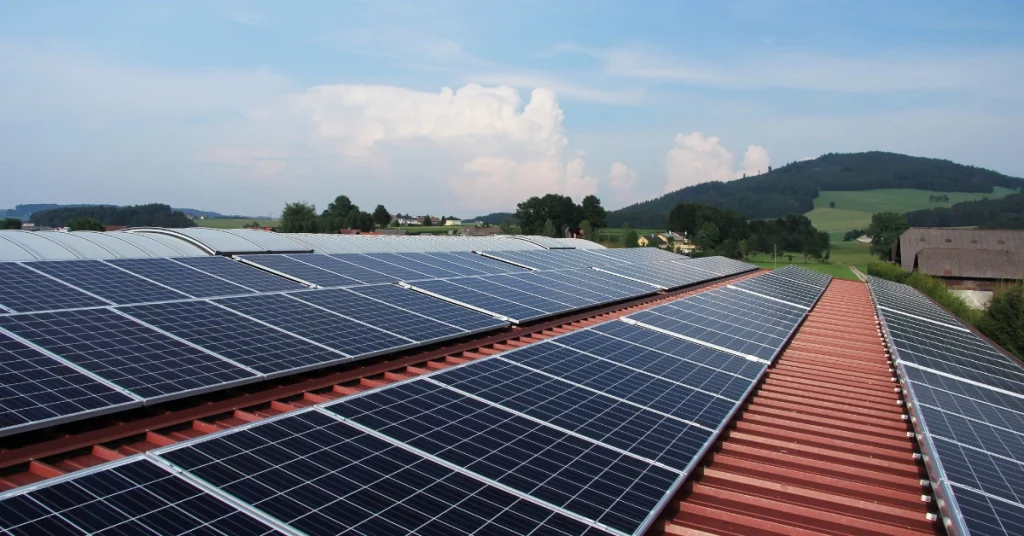
The U.S. solar market is preparing for another major change in equipment pricing after the Trump administration established new tariffs and minimum import prices for polysilicon and downstream products, including solar wafers, cells, and modules.
Under a presidential proclamation signed August 6, 2026, imported solar modules covered by the measure will face a minimum import price of $0.38 per watt, while solar cells will carry a minimum price of $0.22/W. The administration also established minimum prices for polysilicon and silicon ingots and wafers. The new measures are scheduled to take effect on December 4, 2026.
For U.S. solar buyers, developers, distributors, and installers, the policy introduces a new consideration when evaluating module prices and planning procurement for projects extending into late 2026 and beyond.
What the New Section 232 Solar Trade Measures Do
The action follows a Commerce Department investigation under Section 232 of the Trade Expansion Act of 1962, which allows the federal government to adjust imports when they are determined to threaten national security.
According to the proclamation, the Commerce Department concluded that polysilicon and its derivative products were entering the United States in quantities and under circumstances that threatened to impair national security. The administration connected the issue to both the semiconductor and solar supply chains.
The resulting policy combines two major trade mechanisms:
- A minimum import price (MIP) for covered polysilicon and derivative products
- An additional 15% ad valorem Section 232 tariff on specified downstream products, subject to country-specific provisions
Both are scheduled to apply to covered goods entered for consumption, or withdrawn from warehouse for consumption, beginning at 12:01 a.m. Eastern Time on December 4, 2026.
New Minimum Import Prices for Solar Products
The proclamation establishes the following initial minimum import prices:
| Product | Minimum import price |
| Polysilicon | $21/kg |
| Polysilicon ingots and wafers | $100/kg |
| Solar cells | $0.22/W |
| Solar modules | $0.38/W |
These figures come directly from the presidential proclamation. The Secretary of Commerce is also authorized to adjust the minimum prices over time to reflect market conditions or other factors affecting the products’ fair-market value.
For solar procurement teams, the $0.38/W module level is particularly significant because it establishes a regulatory floor affecting covered imported modules rather than simply adding a conventional percentage tariff to their declared value.
How the Minimum Import Price Works
The policy is more complicated than simply prohibiting solar modules from being imported below $0.38/W.
Under the proclamation, U.S. Customs and Border Protection will allow importers to submit documentation certifying that the first arm’s-length U.S. sale of the covered merchandise, or applicable downstream products made from it, will occur at or above the relevant minimum import price. Certain fixed-term contracts entered into before the proclamation was signed are also addressed in the rules.
If the entered value is below the minimum import price but the required documentation is submitted, the merchandise becomes subject to a specific tariff equal to the difference between the entered value and the applicable minimum.
If an importer fails to submit the required documentation, the proclamation states that the merchandise will be subject to a specific tariff equal to the applicable minimum import price.
The distinction is important for buyers: $0.38/W should not simply be interpreted as a universal retail or delivered price for every imported solar module.
Freight, other applicable tariffs and duties, supplier margins, warehousing, financing, domestic transportation, and other costs can still affect the final price paid by a project.
A 15% Tariff Is Also Being Introduced
The minimum import price is only one part of the policy.
The proclamation also establishes an additional 15% ad valorem tariff on imports of polysilicon ingots and specified downstream polysilicon derivatives, effective December 4. The duties generally apply in addition to other applicable duties and charges unless the proclamation provides otherwise.
There are important country-specific provisions.
For products from Japan, South Korea, Taiwan, Switzerland, Liechtenstein, and European Union member states, the proclamation provides that the combined additional Section 232 tariff and applicable Column 1 HTSUS duty will equal 15%.
For products from the United Kingdom, the applicable additional tariff under this measure is 10%.
The administration also gave the Commerce Department authority to modify how the measures apply to trading partners that establish substantially equivalent minimum import prices.
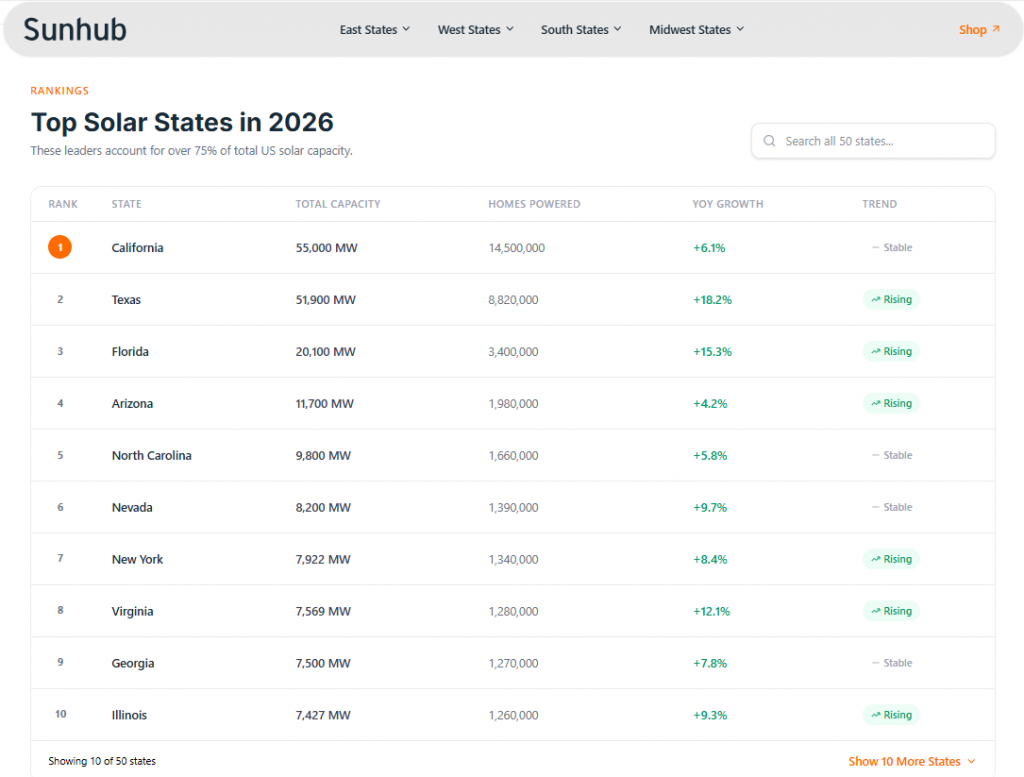
Explore U.S. Solar State Rankings
Compare solar rankings, installed capacity, growth trends, and market performance across all 50 states. Discover regional insights to support smarter procurement and expansion decisions.
Why the Administration Introduced the Measures
The administration says the policy is intended to strengthen domestic production across the polysilicon supply chain.
Polysilicon sits near the beginning of the crystalline-silicon solar manufacturing chain:
Polysilicon → ingot → wafer → solar cell → solar module
It is also a critical raw material for semiconductor manufacturing.
According to the Commerce Department findings summarized in the proclamation, the U.S. share of global polysilicon production capacity declined from approximately 50% in 2005 to less than 2% in 2024. The administration also reported that global polysilicon production increased by more than 270% from 2020 and inventories reached a record 400,000 metric tons by the end of 2024.
The proclamation states that the U.S. remains almost entirely dependent on imports for solar ingots, wafers, and cells.
The administration argues that establishing minimum prices and tariffs will provide U.S. producers with a commercially viable market and encourage additional domestic investment.
Why Solar and Semiconductor Manufacturing Are Connected
Although the policy has substantial implications for solar, its rationale extends beyond the energy sector.
Polysilicon is also used to produce semiconductors.
The proclamation states that semiconductor-grade polysilicon accounts for only about 2.4% of global polysilicon production, meaning the much larger solar-grade polysilicon market can influence the economics of maintaining polysilicon manufacturing capacity overall.
The administration’s position is that a commercially viable solar-grade polysilicon industry helps support the manufacturing scale required to maintain semiconductor-grade production as well.
This connection between the solar and semiconductor industries was a central part of the government’s national-security justification for the Section 232 action.
See our related news article here.
What the $0.38/W Floor Could Mean for Solar Module Buyers
The most immediate consideration for buyers is pricing.
If covered imported modules would otherwise be sold below the minimum established by the policy, the MIP mechanism could reduce the availability of extremely low-priced imported equipment after implementation.
Reuters reported that the measures could benefit domestic manufacturers while potentially increasing costs for solar developers and other purchasers that rely on imported products.
However, the minimum import price should not be treated as a prediction that all U.S. modules will cost exactly $0.38/W.
Module pricing varies according to:
- Manufacturer
- Technology
- Wattage
- Efficiency
- Order volume
- Country of origin
- Existing trade duties
- Domestic versus imported production
- Freight and logistics
- Contract structure
- Inventory location
- Supply and demand
The new policy establishes another pricing constraint within that broader market.
Existing Inventory Could Become More Important
The December 4 implementation date creates a transition period.
Equipment already located within the United States may have different commercial dynamics from future imports subject to the new measures, depending on when and how it entered the country.
That could make inventory location and import status increasingly important questions during procurement.
Buyers evaluating late-2026 and 2027 projects may want to confirm:
- Whether modules are already warehoused domestically
- When future inventory is expected to enter the United States
- Which trade measures apply
- Whether quoted pricing includes applicable duties
- How long pricing is valid
- Who bears tariff-related changes under the contract
A quote that looks competitive today may have different economics if delivery requires importing modules after the new measures take effect.
Contract Timing Matters
The proclamation contains a provision for certain merchandise connected to fixed-term contracts entered into before the proclamation was signed.
Specifically, importers may submit documentation establishing that the first arm’s-length sale is pursuant to fixed terms in a contract entered into before August 6, 2026.
Whether a specific transaction qualifies depends on the actual contract and import circumstances.
Buyers should therefore avoid assuming that an older purchase order automatically exempts equipment from the new rules. Importers and procurement teams dealing with affected shipments should verify treatment based on the implementing requirements and, where necessary, obtain appropriate customs or trade advice.
The Measures Can Stack With Other Trade Costs
Another important detail for solar procurement is that Section 232 does not necessarily operate in isolation.
The proclamation states that its duties generally apply in addition to other duties, taxes, fees, exactions, and charges, except where otherwise specified.
Solar products entering the United States can already be affected by different trade measures depending on product type and origin.
That makes landed-cost calculations increasingly important.
Instead of evaluating a module exclusively by its factory or headline price, procurement teams should determine the complete cost of getting compliant equipment to the project site.
Domestic Solar Manufacturing Could Gain Additional Protection
The policy is explicitly designed to encourage domestic manufacturing.
In addition to tariffs and minimum import prices, the proclamation authorizes the Commerce Secretary to establish incentives for companies investing in the construction, expansion, or refurbishment of U.S. facilities producing polysilicon and its derivatives.
Reuters reported that U.S. solar manufacturers welcomed the action as support for domestic production and investment, while the measures also raised concerns about higher costs for downstream solar development.
Those two effects are not mutually exclusive.
Trade protection can improve the competitive position of domestic manufacturing while also increasing input costs for buyers that previously sourced cheaper imported equipment. How large either effect becomes will depend on domestic manufacturing capacity, global pricing, exemptions or trade arrangements, and how suppliers respond after implementation.
What Solar Buyers Should Do Before December 4
The new policy makes procurement planning particularly important during the remainder of 2026.
Solar buyers should review upcoming projects and identify equipment expected to be imported after December 4.
For each order, it may be useful to confirm the product’s country of origin, current location, expected import date, applicable tariff treatment, contractual allocation of tariff risk, and total landed cost.
Buyers should also compare multiple supply channels rather than assuming today’s module price will remain available after implementation.
For larger projects, procurement teams may need to model several equipment scenarios, including domestic modules, imported modules, existing U.S. inventory, and alternative suppliers, to understand how the new trade measures affect project economics.
What Happens Next?
The new Section 232 measures are scheduled to become effective on December 4, 2026, 120 days after the proclamation was signed.
The policy may also continue evolving.
The Commerce Secretary has authority to adjust the minimum import prices as market conditions change. The administration can modify treatment for trading partners that establish substantially equivalent import measures, and Commerce is directed to continue monitoring imports.
The proclamation also specifically instructs Commerce to watch for companies stockpiling covered products before implementation and authorizes coordinated action with Customs and Border Protection where such behavior is identified.
That makes the December implementation date important, but it does not necessarily mean the rules established in August will remain unchanged indefinitely.
Conclusion
The new Section 232 action represents a significant change to the economics of imported solar equipment in the United States.
Beginning December 4, 2026, the policy establishes minimum import prices of $21/kg for polysilicon, $100/kg for polysilicon ingots and wafers, $0.22/W for solar cells, and $0.38/W for solar modules. Covered downstream products are also subject to an additional 15% tariff, with specific treatment for certain trading partners.
For solar buyers, the biggest takeaway is that procurement decisions can no longer be evaluated using headline module prices alone.
Country of origin, import timing, existing inventory, tariff exposure, contract structure, and total landed cost will all become increasingly important as the December 4 implementation date approaches.
The policy is intended to strengthen domestic polysilicon and downstream manufacturing. Its eventual effect on U.S. module prices and project costs, however, will depend on how manufacturers, importers, developers, and trading partners respond once the new framework takes effect.
Sources
White House — Adjusting Imports of Polysilicon and its Derivatives into the United States
White House — Fact Sheet on Polysilicon and Derivative Tariffs
Reuters — Trump unveils trade actions to compete with China on solar and chips