
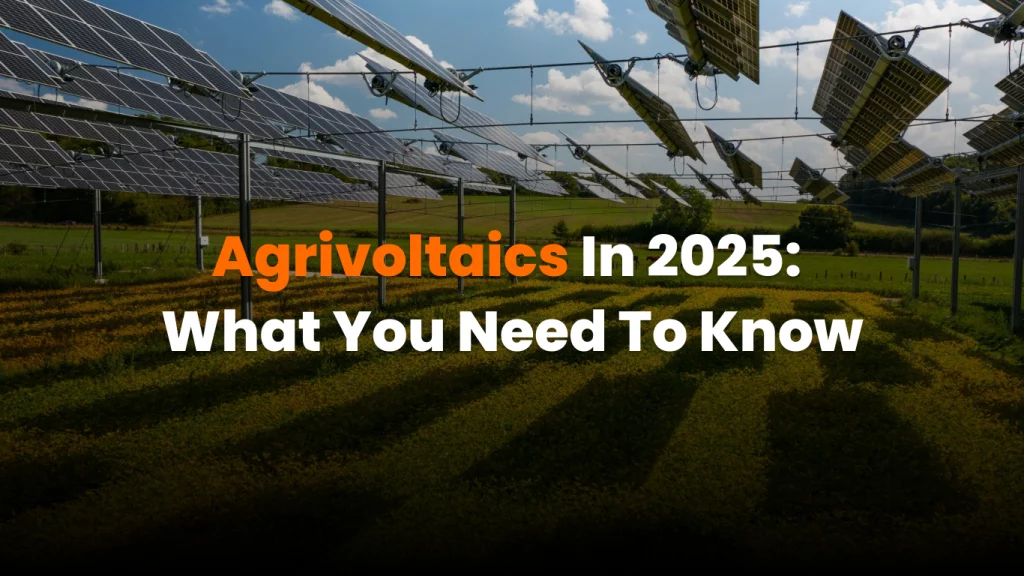
Agrivoltaics is moving beyond the experimental stage and becoming a more practical part of modern farming and solar development. As pressure increases around land use, energy demand, and unpredictable weather conditions, more developers and farmers are looking at Agri-PV as a way to generate electricity without taking farmland out of production. Instead of choosing between agriculture and solar, the model allows both to work together on the same land.
This follow-up takes a closer look at how agrivoltaics is developing in 2025, including global adoption trends, crop research, financing approaches, and digital farming technologies that are helping projects move beyond small pilot installations.
Global adoption: Agrivoltaics surpasses 18 GW worldwide
The global Agri-PV market grew from 14 GW in 2024 to an estimated 18.4 GW by mid-2025, based on recent updates from SolarPower Europe and PV Magazine. Much of this increase still comes from pilot projects expanding into larger deployments, though several countries are now approving commercial-scale systems across agricultural land. Activity has been especially strong in Southern Europe, East Asia, and parts of the United States.
Deployment momentum by region
Italy
Italy introduced a €1.7 billion program through its National Recovery and Resilience Plan to support around 2 GW of Agri-PV development. The goal is to expand renewable energy generation while allowing farmland to remain productive.
South Korea
South Korea approved a new Agri-PV ordinance that allows rice paddies and orchard farms to install solar systems without facing land-use conversion penalties. The policy is expected to make agrivoltaic projects easier for farmers to adopt.
India
India added more than 600 MW of Agri-PV through its KUSUM program, which supports solar-powered irrigation and the use of underutilized land for renewable energy projects.
United States
Although Agri-PV still makes up a small portion of the overall U.S. solar market, interest is growing steadily. In Q2 2025, California approved legislation supporting dual-use solar zoning across more than 20,000 acres of farmland in the Central Valley. Many see this as an important step toward broader Agri-PV adoption in the country.


Research spotlight: Expanding beyond leafy greens
Early agrivoltaic research focused heavily on crops such as lettuce and spinach because they perform well under partial shade. More recent field studies, however, are testing a wider range of crops under solar arrays.
A 2024 MIT-Lincoln Laboratory study reported that crops including chili peppers, strawberries, and eggplant recorded yield improvements of up to 17 percent under moderate panel shading.
Corn and soybeans, which were previously viewed as difficult crops for Agri-PV systems, have also shown encouraging results in high-clearance vertical solar setups. Researchers found yield reductions remained below 3 percent while soil moisture retention improved.
Native grasses and pollinator habitats are also becoming more common beneath fixed-tilt solar systems because they support biodiversity while reducing vegetation maintenance requirements.
Developers are increasingly adjusting panel height and orientation based on the light requirements of different crops. Research suggests that partial shading can sometimes reduce heat stress and water loss during extreme weather conditions, helping crops remain more stable during heatwaves.
Digital tools helping projects scale
Building larger Agri-PV systems requires more than available land and solar modules. Developers are now relying more heavily on digital agriculture tools to improve project planning and performance.
Panel layout software is becoming more advanced, with systems now factoring in seasonal sunlight changes, terrain conditions, and crop growth cycles. Some companies are also using vegetation index data to model how crops may respond under different panel configurations.
Drone-based multispectral imaging is also being used to monitor plant health beneath solar arrays. Farmers can track chlorophyll levels, irrigation conditions, and signs of crop stress more efficiently than before.
In trial farms across Spain and Arizona, smart irrigation systems paired with shade analysis reportedly reduced water consumption by as much as 35 percent.
These technologies are helping developers and farmers design systems that support both agricultural productivity and energy generation more effectively.
Financing models gaining traction
Project costs remain one of the biggest obstacles for Agri-PV adoption. Elevated mounting systems and tracking structures can increase upfront project expenses significantly, which creates challenges for smaller farms.
At the same time, new financing structures are beginning to emerge.
France recently introduced a pilot incentive program where subsidy levels are tied to both electricity generation and measurable crop performance improvements.
In India and Italy, several Agri-PV projects are being financed through green bond issuances backed by ESG-focused investors.
Developers in Colorado and Japan are also testing crop-sharing power purchase agreements, where farmers receive reduced lease costs in exchange for a share of solar project revenue.
These financing approaches are helping spread risk more evenly while making agrivoltaic systems more accessible for smaller agricultural operations.
Policy frameworks continue evolving
Government policy remains one of the biggest drivers behind Agri-PV expansion. Europe continues to lead in regulatory development, though North America and Asia are beginning to accelerate as well.
The European Union introduced a new Agri-PV certification framework under the Common Agricultural Policy, allowing dual-use farms to access both agricultural and energy-related incentives.
China added Agri-PV to its five-year rural electrification roadmap and plans to support 10 GW of capacity by 2030.
In the United States, the USDA and Department of Energy announced new collaboration grants in July 2025 focused on testing Agri-PV systems on conservation and tribal lands.
Industry observers believe that standardizing land-use regulations, crop coverage rules, and water management requirements will play an important role in moving Agri-PV beyond pilot projects into wider deployment.
Outlook: Commercial portfolios beginning to grow
As financing, policy support, and crop performance data continue improving, more developers are starting to include Agri-PV in long-term commercial project pipelines. Some industry analysts compare the trend to the early growth phase of residential solar during the 2010s, when projects gradually shifted from niche installations to mainstream investments.
Companies including BayWa r.e., NextEra Energy, and Engie are reportedly evaluating or adding agrivoltaic projects to future development plans.
There is also growing interest in cooperative ownership models where rural communities jointly own farmland and solar infrastructure, creating new local revenue opportunities tied to renewable energy.
Conclusion
Agrivoltaics is entering a more mature stage of development in 2025. What was once viewed mainly as a research concept is gradually becoming a practical option for improving land use, supporting agricultural resilience, and expanding renewable energy generation at the same time.
For farmers, developers, policymakers, and investors, the next few years will likely play an important role in determining how quickly Agri-PV moves into broader commercial adoption. As technology improves and financing becomes more accessible, more large-scale projects are expected to move forward.