
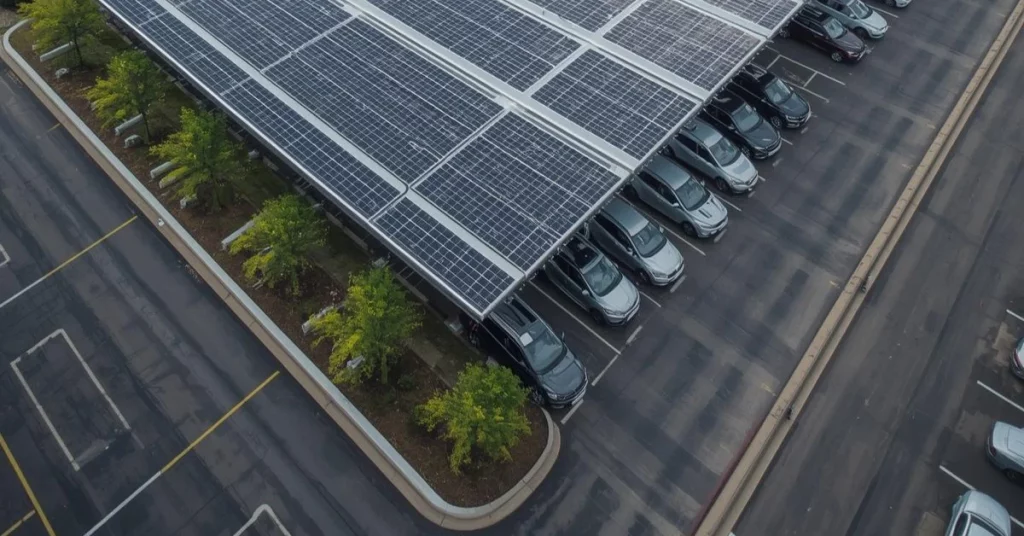
For businesses with parking lots, warehouses, or campus-style offices, solar panel installations often focus on rooftops or ground-mounted arrays. But there is an increasingly popular alternative that offers unique advantages: commercial solar carport structures. These solar canopies, built over parking spaces, generate clean power while giving you shaded parking, potential energy savings, and flexibility to integrate storage or EV charging.
Here’s a full breakdown of how commercial solar carports work, why they make sense for many businesses, and what factors you should consider if you decide to go this route.
what are commercial solar carports
A commercial solar carport (also called a solar parking canopy) is a steel- or metal-framed structure built over a parking lot or a garage deck, with photovoltaic (PV) solar panels mounted on top. Instead of occupying rooftop or unused land space, carports reuse parking areas, turning underutilized real estate into clean-energy generating assets.
Because the carport is elevated, it provides shelter and shade for vehicles beneath. Meanwhile, the solar panels convert sunlight into electricity, which can power your building, lighting, or other equipment.
When combined with energy storage or EV charging infrastructure, a carport becomes a hub of sustainable operations, producing, storing, and using clean power efficiently.
Why businesses are increasingly choosing solar carports
Commercial Solar Carport Structures: An Innovative Solution
Commercial solar carports are a compelling choice for several reasons, saving costs, increasing efficiency, and supporting environmental and corporate-responsibility goals. Here are the main advantages:
Dual land use and efficient space utilization
Large, flat parking lots often sit idle for much of the day. By installing a solar carport, you repurpose that idle space for energy generation, without needing additional land.
This is especially beneficial for properties with limited roof space or restrictions that make rooftop solar difficult. Carports offer flexible design and can be engineered for optimal panel orientation and tilt.
Energy cost savings and financial return
By generating electricity onsite, a solar carport can reduce reliance on grid energy, lowering utility bills. For commercial operations with high daytime energy use, this can translate into substantial savings over time.
In certain cases where energy production exceeds demand, surplus electricity can feed back to the grid (depending on local regulation), providing additional credits or revenue.
Because the structure serves two functions, shelter and energy generation, the return on investment can be stronger than a simple canopy or plain parking lot.
Vehicle protection and convenience
Solar carports do more than provide energy; they shield parked vehicles from sun, rain, hail, and snow. This protects vehicles, keeps them cooler (especially in hot climates), and extends their lifespan.
For companies with fleets, or for employees and customers who drive, shaded parking is a tangible perk.
Alignment with sustainability and brand image
Installing visible green infrastructure signals corporate commitment to sustainability. For many firms, especially in retail, hospitality, or corporate campuses, solar carports enhance brand image, support ESG (environmental, social, governance) goals, and appeal to customers, renters, or employees who value eco-friendly business practices.
Flexibility for EV charging and energy storage
One of the compelling advantages of solar carports is the potential to integrate EV charging stations directly under the canopy. With solar power feeding the chargers, businesses can offer green charging for employees, customers, or fleet vehicles, reducing operational costs and emissions.
Pairing the carport with a battery energy storage system (BESS) lets you store excess solar energy produced during the day. This stored energy can be used at night, during peak-demand hours, or during outages, boosting resilience and smoothing energy costs.
Potential drawbacks and challenges
While solar carports offer many benefits, they come with trade-offs and considerations. It’s important to weigh these carefully during planning:
Higher initial cost and structural complexity
Because carports require freestanding structures, foundations, and sometimes custom engineering (especially for large spans or heavy loads), the upfront cost tends to be higher than simple rooftop or ground-mounted solar.
Permitting, structural design approvals, load calculations (for wind, snow, seismic), and compliance with building codes add complexity versus simpler rooftop installations.
Space, clearance, and layout requirements
Not every parking lot is suited for a solar carport. You need adequate space, proper alignment, and vehicle clearance. Uneven terrain or irregular lot layout can make installation difficult or expensive.
Large-scale commercial carports also require careful planning to ensure that parking flow, drainage, and lighting are maintained even after installation.
Generation may not cover entire load
If your business has very high energy demand (e.g. manufacturing, heavy machinery, data centers), a carport system alone may not fully meet energy needs. Solar generation depends on sunlight; cloudy days or seasonal variation can reduce output.
Some businesses eventually pair carports with rooftop solar, ground arrays or grid energy, using the carport as part of a diversified energy strategy rather than the sole source.
Maintenance and engineering considerations
Because solar carports carry structural loads, require wiring and sometimes energy storage or EV infrastructure, maintenance and safety inspections are more involved than for simple rooftop panels. Structural inspections, clearance checks, and electrical safety become more important.
If EV charging and battery storage are used, additional planning for battery management, charger maintenance, and possibly monitoring equipment is needed.
Practical considerations if you plan to install a solar carport
If you’re evaluating solar carport structures for your property, here are key factors and planning steps to follow:
- Assess parking lot layout and sun exposure — Ensure your lot has enough space, proper orientation, and minimal shading for optimal solar yield.
- Engineer for structural load and safety — Hire structural and electrical engineers to verify the foundation, load-bearing capacity, wind and weather resistance, drainage, and vehicle clearance.
- Estimate energy needs and sizing — Calculate daily and peak electricity demands; size the carport system (and batteries, if used) accordingly so that it meaningfully reduces grid energy use.
- Plan for integration with EV charging or storage — If you intend to support EVs or time-shift solar generation, design accordingly for wiring, chargers, safe battery installation, and load management systems.
- Evaluate financial incentives, payback, and ROI — Consider local tax credits, rebates, net-metering or export credit programs, and long-term savings. Compare upfront cost vs. expected energy savings over the system’s lifespan (often 25–30 years).
- Consider maintenance and safety over time — Schedule periodic structural inspections and panel/electrical maintenance. Ensure warranties and service plans are clear before installation.
Who benefits most from commercial solar carports
Commercial solar carports are especially attractive for:
- Retail centers, shopping malls, supermarkets — high daytime load, large parking lots, and strong visibility.
- Corporate offices and business parks — providing shaded parking for employees while generating power for operations.
- Warehouses, distribution centers, light-industrial facilities — large roof or parking space area, daytime energy consumption, and potential to power forklifts or EV fleet charging.
- Universities, hospitals, institutions with large campuses — combine sustainability goals, daytime energy demand, and parking infrastructure.
- Municipalities, public facilities, parking garages — appeal to sustainability mandates, public image, and potential to power street lights or public EV charging.
Wrap up: Solar carport, a smart blend of infrastructure and clean energy
Commercial solar carport structures represent a powerful convergence: practical infrastructure and renewable energy generation in one. They transform idle parking lots into energy assets, deliver tangible cost savings, provide vehicle protection, support EV adoption, and signal a commitment to sustainability and innovation.
They are not without complexity: higher installation cost, structural and permitting considerations, maintenance needs, and careful design required for optimal yield. But for many businesses and institutions, solar carports offer a compelling, long-term advantage.
If you run a business with parking space, regular daytime energy use, or fleet/EV needs, evaluating a solar carport might turn your parking lot from wasted asphalt into a productive, clean-energy asset.
Sources
- Commercial solar carports & energy storage: what you need to know (powerflex.com)
- Solar carport systems 2025: ultimate guide & professional solutions (bymea.com)
- Advantages of solar carports for businesses and commercial areas (Harvest Green Developments)
- Solar carport structures cost, design & benefits overview (topbestsolar.com)
- The many benefits of commercial solar carports (energy savings, environmental benefit, EV integration) (Huston Solar)