
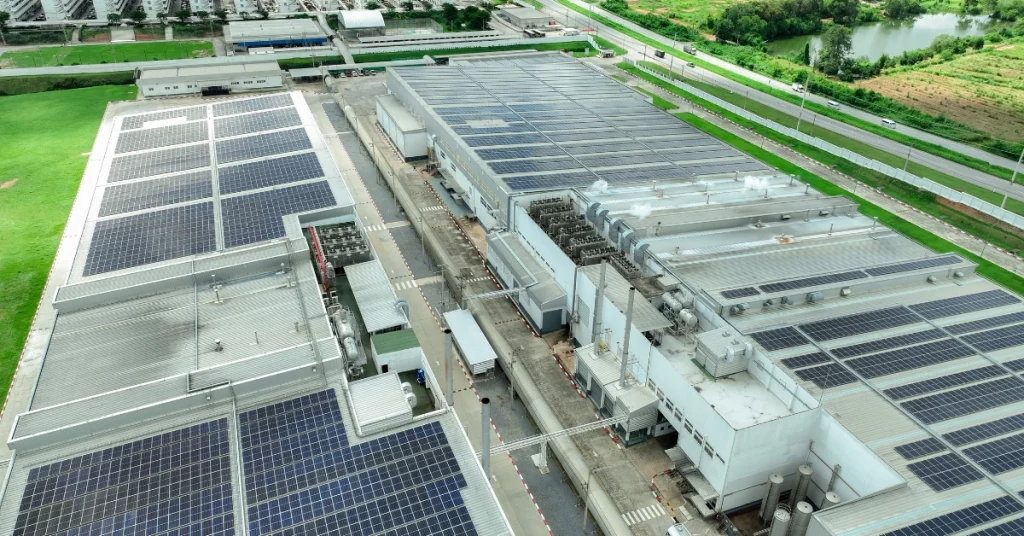
As commercial solar adoption continues to grow across the United States, businesses are investing in high-quality equipment to maximize energy production, improve operational efficiency, and reduce long-term electricity costs. Whether you’re designing a rooftop installation for a warehouse, a ground-mounted array for a manufacturing facility, or a multi-site commercial portfolio, choosing the right commercial solar equipment is essential to project success.
Unlike residential systems, commercial solar projects often require larger equipment volumes, more complex electrical designs, and careful coordination between suppliers, installers, and project managers. From photovoltaic modules and inverters to mounting systems and energy storage, every component plays a role in system performance and reliability.
This guide explains the essential commercial solar equipment used in today’s projects, key considerations when selecting products, and how businesses can simplify procurement through modern RFQ platforms.
What is commercial solar equipment?
Commercial solar equipment refers to the components used in photovoltaic (PV) systems designed for businesses, industrial facilities, schools, government buildings, agricultural operations, and other commercial properties.
A typical commercial solar installation includes:
- Solar panels
- Solar inverters
- Mounting and racking systems
- Battery energy storage (optional)
- Monitoring systems
- DC and AC electrical equipment
- Wiring and connectors
- Balance-of-system (BOS) components
According to the U.S. Department of Energy (DOE), commercial photovoltaic systems convert sunlight into electricity using interconnected solar modules, inverters, and supporting electrical infrastructure. (The Department of Energy’s Energy.gov)
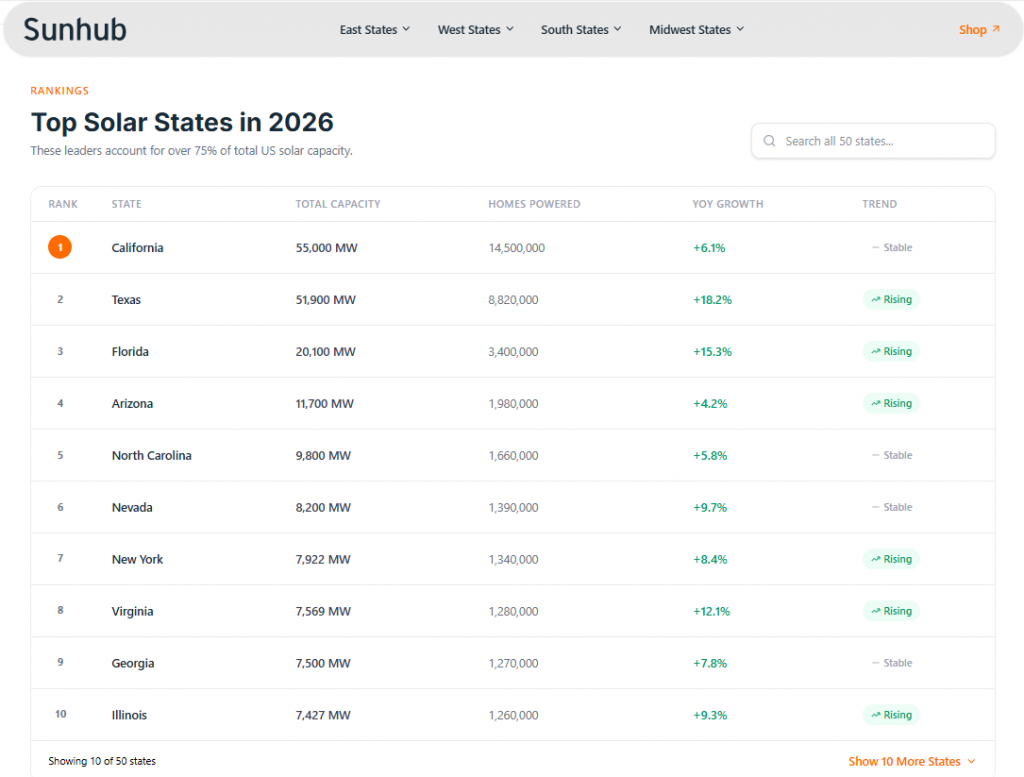
Explore U.S. Solar State Rankings
Compare solar rankings, installed capacity, growth trends, and market performance across all 50 states. Discover regional insights to support smarter procurement and expansion decisions.
Solar panels: the foundation of every commercial system
Solar panels are the primary power-generating component of a commercial PV system.
Most commercial projects today use high-efficiency monocrystalline modules because they provide:
- Higher energy production
- Better space utilization
- Longer performance warranties
- Improved long-term reliability
Leading manufacturers commonly used in commercial installations include:
- Canadian Solar
- LONGi Solar
- JinkoSolar
- Trina Solar
- JA Solar
- Qcells
- First Solar
- REC Group
Rather than selecting panels based solely on wattage, project developers should compare:
- Module efficiency
- Temperature coefficient
- Product warranty
- Performance warranty
- Annual degradation rate
- Third-party certifications
Commercial solar inverters
Solar panels generate direct current (DC) electricity, which must be converted into alternating current (AC) before powering commercial facilities.
Commercial systems typically use:
String inverters
String inverters remain the most common solution for commercial rooftops because they offer:
- High efficiency
- Lower installation costs
- Simplified maintenance
- Proven reliability
Central inverters
Large commercial and utility-scale projects often use central inverters capable of managing significantly higher power capacities.
Microinverters
Although less common in large commercial projects, microinverters may be appropriate for installations with complex roof layouts or partial shading.
Mounting systems
Mounting equipment secures solar panels while ensuring structural integrity throughout the system’s lifespan.
Commercial projects commonly use:
- Ballasted rooftop systems
- Attached rooftop racking
- Ground-mounted structures
- Carport mounting systems
- Single-axis tracking systems
- Fixed-tilt utility structures
Mounting systems should be engineered to withstand local wind, snow, and seismic conditions while complying with applicable building codes.
Battery energy storage
Battery storage is becoming increasingly common in commercial solar projects.
Commercial batteries allow businesses to:
- Store excess solar generation
- Reduce peak demand charges
- Improve energy resilience
- Provide backup power
- Participate in demand response programs
When selecting battery systems, businesses should compare:
- Usable capacity
- Continuous power output
- Round-trip efficiency
- Warranty
- Cycle life
- Scalability
Monitoring and energy management
Modern commercial solar systems include monitoring platforms that provide real-time visibility into system performance.
Monitoring software can help operators:
- Track energy production
- Detect equipment faults
- Monitor inverter performance
- Analyze energy consumption
- Schedule preventative maintenance
According to the DOE, monitoring plays an important role in maintaining system performance and long-term reliability. (The Department of Energy’s Energy.gov)
Choosing commercial solar equipment
Selecting commercial equipment involves balancing performance, reliability, and total project cost.
Important evaluation criteria include:
- Equipment certifications
- Manufacturer reputation
- Warranty coverage
- Technical support
- Long-term availability
- Compatibility between system components
- Total lifecycle cost
Rather than selecting products solely on purchase price, commercial buyers should evaluate long-term performance and maintenance requirements.
Simplifying procurement with RFQs
Commercial projects often require equipment from multiple manufacturers and suppliers.
Instead of requesting quotes individually, many businesses now use centralized Request for Quote (RFQ) platforms to streamline procurement.
An RFQ allows buyers to:
- Request multiple supplier quotes
- Compare pricing
- Review equipment availability
- Evaluate delivery schedules
- Simplify purchasing
Businesses looking to streamline procurement can submit commercial equipment requests through Sunhub’s RFQ platform. The platform enables buyers to compare supplier responses, review commercial pricing, and manage procurement through a centralized workflow.
Best practices for commercial procurement
Before purchasing commercial solar equipment, businesses should:
- Verify equipment certifications
- Review manufacturer warranties
- Compare multiple supplier quotes
- Confirm inventory availability
- Review shipping timelines
- Ensure compatibility between all system components
- Evaluate long-term supplier support
The National Renewable Energy Laboratory (NREL) recommends standardized procurement practices and quality management to improve commercial PV project reliability and reduce lifecycle costs. (Research Hub)
The future of commercial solar equipment
Commercial solar technology continues to evolve rapidly.
Recent industry trends include:
- Higher-efficiency N-type modules
- TOPCon and HJT cell technologies
- Larger-format commercial panels
- Smarter energy management systems
- Increased battery integration
- AI-assisted monitoring and predictive maintenance
As equipment becomes more efficient and procurement becomes increasingly digital, businesses can deploy larger, more reliable solar systems with improved long-term performance.
Conclusion
Choosing the right commercial solar equipment is essential for maximizing project performance, reliability, and return on investment. Every component, from solar panels and inverters to mounting systems and batteries, contributes to overall system efficiency and long-term operating costs.
Successful commercial projects require more than quality equipment; they also depend on efficient procurement. By comparing certified products, evaluating warranties, and using centralized RFQ platforms, businesses can simplify sourcing while improving purchasing decisions. As commercial solar continues to expand, investing in proven equipment and streamlined procurement processes will remain critical to project success.
Frequently Asked Questions
What is commercial solar equipment?
Commercial solar equipment includes solar panels, inverters, mounting systems, batteries, monitoring platforms, electrical components, and other equipment used in business and industrial solar installations.
What types of solar panels are commonly used in commercial projects?
Most commercial systems use high-efficiency monocrystalline modules from manufacturers such as Canadian Solar, LONGi, JinkoSolar, Trina Solar, JA Solar, and Qcells.
Why are commercial inverters important?
Inverters convert the DC electricity produced by solar panels into usable AC electricity while optimizing system performance and monitoring energy production.
How can businesses simplify commercial solar procurement?
Many businesses use centralized RFQ platforms to compare supplier quotes, evaluate equipment availability, and streamline purchasing. Commercial equipment requests can be submitted through RFQ.
What should businesses compare besides equipment price?
Businesses should evaluate certifications, warranties, efficiency, degradation rates, supplier reliability, inventory availability, technical support, and total lifecycle cost.
Sources
- U.S. Department of Energy – Photovoltaics Overview: (The Department of Energy’s Energy.gov)
- National Renewable Energy Laboratory (NREL) – Commercial & Industrial Solar Installation Best Practices (Research Hub)
- U.S. General Services Administration – Photovoltaic Guidance (U.S. General Services Administration)
- National Renewable Energy Laboratory – Solar Technology Cost Analysis (nrel.gov)