
EXW vs DDP solar panels is a comparison of delivery obligations, risk and total landed costs. Importing solar panels involves more than negotiating equipment prices. International buyers must also account for freight, customs clearance, import duties, insurance, and delivery arrangements.
Two shipping terms frequently encountered in international solar procurement are EXW (Ex Works) and DDP (Delivered Duty Paid).
Understanding EXW vs DDP solar panels is essential for distributors, installers, EPC contractors, and developers comparing overseas suppliers.
Although EXW quotations may appear cheaper, they place considerably more logistical responsibility on the buyer. DDP offers a more comprehensive delivery arrangement, but the additional services are generally reflected in the price.
Table of Contents
What Does EXW Mean for Solar Panels?
EXW, or Ex Works, is an Incoterms® 2020 rule under which the seller makes goods available at a specified location, such as a factory or warehouse.
Under EXW, the buyer generally assumes responsibility for arranging transportation, loading, export clearance, international freight, import procedures, and final delivery.
The seller’s obligation is fulfilled when the goods are placed at the buyer’s disposal at the named location, not loaded onto the collecting vehicle.
For solar panel buyers, EXW provides greater control over freight arrangements but requires substantial coordination.
Advantages of EXW
- Greater control over logistics providers and shipping routes.
- Ability to negotiate freight rates independently.
- Clear separation between equipment pricing and transportation costs.
However, EXW can be challenging for international buyers because export clearance may require assistance from the seller or a locally established party.
For cross-border shipments, FCA (Free Carrier) may sometimes be more practical.
What Does DDP Mean for Solar Panels?
DDP, or Delivered Duty Paid, places extensive responsibility on the seller.
Under Incoterms® 2020, the seller arranges transportation to the named destination, completes export and import clearance, and pays applicable import duties and taxes.
The seller bears transportation risk until the goods are placed at the buyer’s disposal at the named destination, ready for unloading.
The buyer is generally responsible for unloading unless the contract specifies otherwise.
For solar importers, DDP can simplify procurement because the seller coordinates most international shipping activities.
However, the seller must be legally and operationally capable of handling import clearance in the destination country.
EXW vs DDP Solar Panels: Key Differences
| Factor | EXW (Ex Works) | DDP (Delivered Duty Paid) |
|---|---|---|
| Seller’s primary obligation | Make goods available at named location | Deliver goods to named destination |
| Loading at origin | Buyer’s responsibility | Seller’s responsibility |
| Export clearance | Buyer’s responsibility | Seller’s responsibility |
| International freight | Buyer arranges and pays | Seller arranges and pays |
| Import clearance | Buyer’s responsibility | Seller’s responsibility |
| Import duties and taxes | Buyer pays | Seller pays |
| Transportation risk | Transfers at origin | Transfers at destination |
| Unloading at destination | Buyer | Buyer, unless otherwise agreed |
| Logistics control | Primarily buyer | Primarily seller |
These responsibilities apply under the standard Incoterms® 2020 rules. The sales contract may establish additional obligations or services.
EXW vs. DDP Solar Panel Shipping Costs
For EXW vs DDP solar panels, the main financial difference is how transportation and import expenses are allocated.
An EXW quotation typically excludes most logistics costs, while a DDP quotation includes delivery-related obligations through the named destination.
Consider a hypothetical shipment of solar panels imported into the United States.
| Cost component | EXW arrangement | DDP arrangement |
|---|---|---|
| Equipment price | $50,000 | Included |
| Origin handling and export logistics | $1,200 | Included |
| International freight | $4,500 | Included |
| Import duties and taxes | $6,000 | Included |
| Customs brokerage and destination delivery | $2,300 | Included |
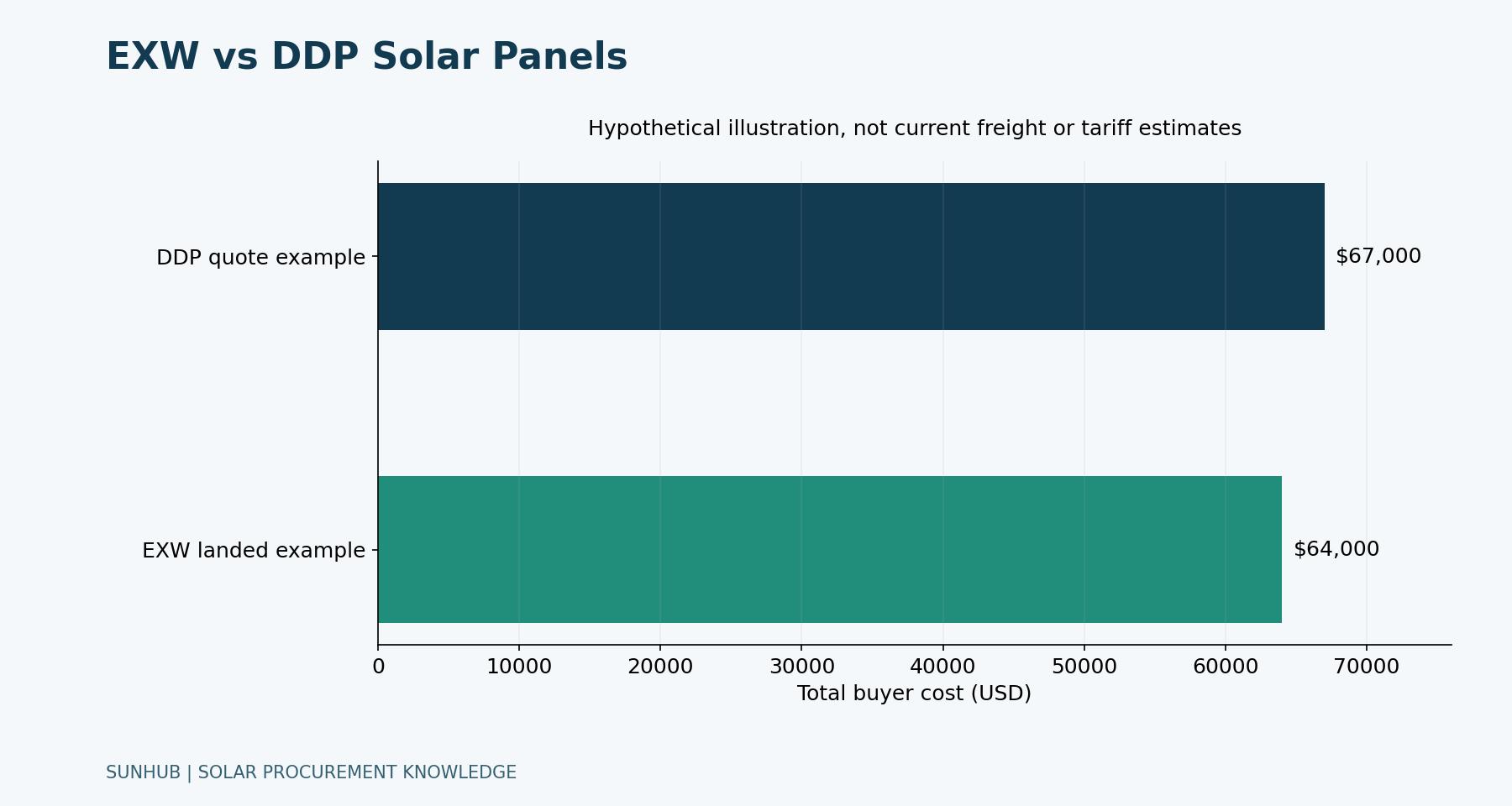
| Total buyer cost | $64,000 | $67,000 |
In this illustration, the EXW arrangement totals $64,000, while the supplier quotes $67,000 for DDP delivery.
The DDP premium may reflect logistics coordination, risk, financing costs, or the seller’s commercial margin.
These figures are illustrative, not current freight or tariff estimates.
Buyers should compare the total landed cost, rather than equipment prices alone.
Customs and Tariff Considerations for Solar Imports
Solar panels imported into the United States may be subject to tariffs, trade remedies, and customs documentation requirements.
Depending on product origin and classification, these may include antidumping and countervailing duties, Section 301 tariffs, or other applicable measures.
Importers must also consider requirements under the Uyghur Forced Labor Prevention Act (UFLPA).
Choosing DDP does not eliminate these legal requirements.
The contract should clearly identify which party will serve as the importer of record, who will provide origin and traceability documentation, and how unexpected duties or customs delays will be handled.
Under U.S. customs law, the importer of record retains applicable compliance responsibilities even when logistics tasks are delegated to a broker or another service provider.
Which Shipping Term Is Better for Solar Panel Buyers?
The better option depends on purchasing volume, logistics capabilities, and the destination market.
EXW may be suitable when:
- The buyer has an experienced international freight team.
- The buyer maintains relationships with freight forwarders and customs brokers.
- Multiple supplier shipments need to be consolidated.
- The buyer wants direct control over transportation arrangements.
DDP may be suitable when:
- The buyer prefers a more comprehensive delivered-price quotation.
- The supplier can legally complete import formalities.
- The buyer has limited experience coordinating international freight.
- Predictable delivery arrangements are a procurement priority.
For solar businesses evaluating international sourcing, Sunhub’s solar procurement and fulfillment services provide an additional resource for coordinating equipment purchasing and logistics requirements.


Common Mistakes When Comparing EXW and DDP
One common mistake is assuming that EXW represents the final equipment acquisition cost.
Freight, customs duties, insurance, handling, and inland transportation can substantially increase the final expense.
Another mistake is assuming that DDP automatically covers unloading, installation, or every possible destination charge.
The contract must identify the named delivery location and clarify any additional services.
Buyers should also avoid accepting DDP terms without confirming that the seller can lawfully complete customs clearance and satisfy destination-country import requirements.
Conclusion
The choice between EXW vs DDP solar panels affects procurement costs, logistics control, customs responsibilities, and transportation risk.
EXW offers buyers greater control but requires them to manage nearly the entire shipping process.
DDP transfers most delivery obligations to the seller, potentially simplifying procurement at a higher quoted price.
For solar distributors, EPC contractors, and project developers, the most reliable approach is to compare total landed costs, confirm customs responsibilities, and define delivery terms clearly before finalizing a purchase agreement.
Frequently Asked Questions
Is EXW cheaper than DDP for solar panels?
EXW usually has a lower initial quotation because transportation and import expenses are excluded. However, the final landed cost may be higher or lower depending on freight rates and logistics arrangements.
Does DDP include import duties on solar panels?
Yes. Under standard DDP terms, the seller is responsible for applicable import duties and taxes.
Who pays for unloading under DDP?
The buyer generally handles unloading at the named destination unless the contract specifies otherwise.
Is EXW suitable for importing solar panels into the United States?
It can be, but buyers must manage export logistics, international transportation, customs clearance, and applicable compliance requirements. FCA may be more practical for some cross-border shipments.
For more equipment procurement and logistics guides, explore the Sunhub solar blog.