

Foreign Entity of Concern (FEOC) restrictions are changing how U.S. solar developers, manufacturers, and equipment buyers evaluate their supply chains. With new federal tax-credit restrictions taking effect, the origin of solar components and the ownership structure of suppliers can influence project eligibility for valuable incentives.
Understanding FEOC compliance in solar is essential for companies sourcing photovoltaic modules, inverters, batteries, and other equipment.
The rules extend beyond where products are manufactured. They also address foreign ownership, control, and material assistance from certain entities.
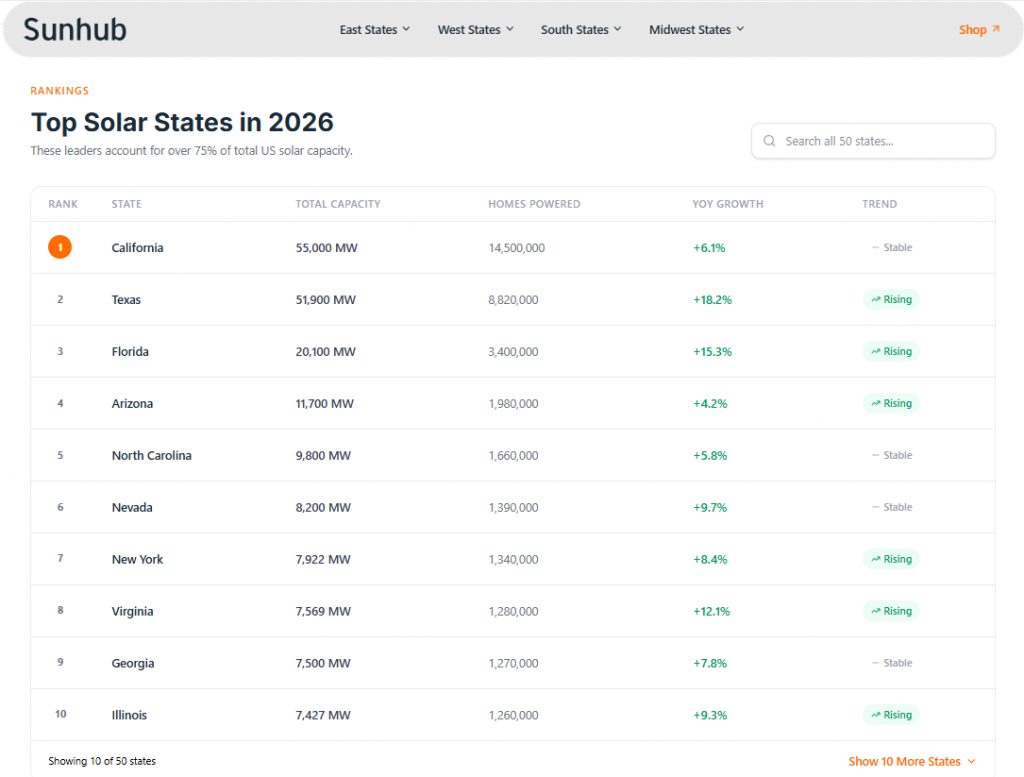
Explore U.S. Solar State Rankings
Compare solar rankings, installed capacity, growth trends, and market performance across all 50 states. Discover regional insights to support smarter procurement and expansion decisions.
Table of Contents
What Is FEOC Compliance in Solar?
FEOC stands for Foreign Entity of Concern, a term used in federal laws addressing national security and supply-chain risks.
Under the clean-energy tax-credit provisions enacted in July 2025, the Internal Revenue Code uses the broader term prohibited foreign entity (PFE).
PFEs include specified foreign entities and foreign-influenced entities that meet statutory ownership, control, or other criteria.
For solar projects, compliance generally involves determining whether a taxpayer or supplier falls within prohibited categories and whether a project receives disqualifying material assistance from PFEs.
The IRS issued Notice 2026-15 in February 2026 to provide interim guidance on these restrictions.
How FEOC Rules Affect Solar Tax Credits
The restrictions affect several federal clean-energy incentives, including:
| Tax credit | Section | FEOC-related consideration |
|---|---|---|
| Clean electricity production credit | 45Y | Restrictions on PFE status and material assistance |
| Clean electricity investment credit | 48E | Restrictions on PFE status and material assistance |
| Advanced manufacturing production credit | 45X | Restrictions involving eligible components and PFEs |
For qualifying facilities and energy storage technologies beginning construction after December 31, 2025, material assistance from a PFE can disqualify a project from applicable credits.
Certain restrictions also apply to eligible components sold during taxable years beginning after July 4, 2025.
These requirements are particularly important for solar developers relying on federal incentives in their financial models.
Separately, legislation enacted in 2025 accelerated the termination of Sections 45Y and 48E for many wind and solar facilities. Developers must evaluate those deadlines independently of FEOC compliance.

What Makes a Solar Supplier a Prohibited Foreign Entity?
Supplier compliance cannot be determined solely by the country printed on a product label.
The statutory framework examines several factors, including:
- Ownership by specified foreign entities
- Voting rights and corporate control
- Board representation
- Certain debt and financial relationships
- Contractual arrangements that create prohibited control
- Other criteria established under federal law
This means a manufacturer operating in the United States is not automatically compliant simply because its factory is located domestically.
Similarly, sourcing a component from a particular country does not, by itself, establish every element of the applicable PFE analysis.
Buyers must assess the actual legal entity, ownership structure, and relevant supply-chain relationships.
Understanding the Material Assistance Cost Ratio
One of the most important concepts in FEOC compliance is the material assistance cost ratio (MACR).
MACR measures the proportion of qualifying costs attributable to products or components that are not sourced from prohibited foreign entities.
For qualifying clean electricity facilities and energy storage technologies, the simplified calculation is:
MACR (%) = (Total applicable direct costs − PFE-attributable direct costs) ÷ Total applicable direct costs × 100
Consider a hypothetical solar project with:
- Total applicable manufactured-product costs: $1,000,000
- Applicable costs attributable to PFEs: $300,000
- Remaining applicable costs: $700,000
The calculation is:
($1,000,000 − $300,000) ÷ $1,000,000 × 100 = 70%
The project’s MACR would be 70%.
Whether that result satisfies the requirements depends on the applicable credit, project type, construction year, and statutory threshold.
The IRS provides interim safe-harbor methods and examples in Notice 2026-15. Actual calculations must follow those rules rather than relying solely on this simplified illustration.
Why Solar Supply-Chain Transparency Matters
Solar equipment supply chains often involve multiple countries and manufacturers.
A solar module may incorporate cells, wafers, glass, frames, and other components sourced from different suppliers.
Inverters and battery systems can involve similarly complex manufacturing arrangements.
As a result, evaluating only the final assembly location may provide an incomplete picture of compliance.
Developers and procurement teams should request relevant supplier documentation, including manufacturing locations, component sourcing information, ownership disclosures, and applicable cost data.
Independent verification and contractual protections may also help reduce procurement risk.
How to Approach FEOC-Compliant Solar Procurement
Solar buyers can improve their compliance processes by incorporating supplier due diligence into procurement planning.
| Procurement stage | Recommended action |
|---|---|
| Supplier qualification | Review ownership and control information |
| Product evaluation | Identify manufacturers and component origins |
| Contract negotiation | Request appropriate compliance representations |
| Cost assessment | Determine applicable MACR requirements |
| Documentation | Retain supporting records and certifications |
| Final review | Verify tax-credit eligibility with qualified advisers |
Documentation should be collected before purchasing decisions become difficult or expensive to reverse.
Solar businesses seeking procurement and supply-chain support can explore Sunhub’s business services when planning equipment sourcing and project purchasing.
However, sourcing through a marketplace or service provider does not independently establish FEOC compliance. Buyers remain responsible for confirming the eligibility of their particular equipment and projects.
FEOC Compliance vs. Domestic Content Requirements
FEOC compliance and domestic content requirements are related to supply-chain decisions, but they are not interchangeable.
FEOC/PFE restrictions determine whether certain foreign-entity relationships or material assistance disqualify applicable tax credits.
Domestic content requirements establish criteria for obtaining an additional tax-credit bonus based on qualifying U.S.-produced materials and components.
A project may satisfy domestic content requirements but still require a separate PFE analysis.
Likewise, equipment that does not qualify for a domestic content bonus is not automatically disqualified under FEOC rules.
Developers should evaluate each requirement independently.
What Solar Developers Should Watch in 2026
The regulatory framework continues to evolve.
Notice 2026-15 provides interim rules and safe harbors while Treasury and the IRS develop further regulations and guidance.
Developers should monitor updates affecting supplier classifications, material assistance calculations, documentation, and applicable safe-harbor methods.
Tax-credit eligibility should also be assessed alongside construction-start rules and other statutory deadlines.
Given the financial consequences of disqualification, legal and tax professionals should review project-specific compliance strategies.
Conclusion
FEOC compliance in solar has become an important consideration for U.S. renewable energy procurement and tax-credit planning.
The restrictions extend beyond manufacturing location to include supplier ownership, control, and material assistance from prohibited foreign entities.
For developers, manufacturers, and equipment buyers, effective compliance requires transparent supply chains, accurate cost documentation, supplier due diligence, and an understanding of applicable IRS requirements.
As federal guidance evolves, integrating these checks into procurement decisions can help reduce financial risk and support more reliable solar project development.
Frequently Asked Questions
What does FEOC mean in solar?
FEOC means Foreign Entity of Concern. In the context of certain clean-energy tax credits, the law applies restrictions involving prohibited foreign entities and material assistance from those entities.
Are all Chinese-made solar panels automatically disqualified?
Not solely because of a country-of-origin label. Eligibility depends on the applicable statutory rules, entity relationships, sourcing details, and material assistance calculations.
What is the material assistance cost ratio?
MACR measures the qualifying share of applicable costs after excluding costs attributable to prohibited foreign entities, calculated under the relevant statutory and IRS rules.
Is FEOC compliance the same as domestic content compliance?
No. FEOC rules address prohibited foreign-entity relationships and material assistance, while domestic content requirements concern eligibility for additional incentives tied to U.S.-produced equipment.
For related procurement planning, read Sunhub’s guide to sourcing solar equipment.
Sources
- Internal Revenue Service : Notice 2026-15: Prohibited Foreign Entity Guidance
- Internal Revenue Service : Treasury and IRS Guidance on Material Assistance from PFEs
- U.S. Department of Energy : Foreign Entity of Concern Interpretive Guidance
- U.S. House of Representatives : Internal Revenue Code Section 48E
- Intertek CEA : Achieving FEOC Compliance: What Every U.S. Solar Buyer Should Know