
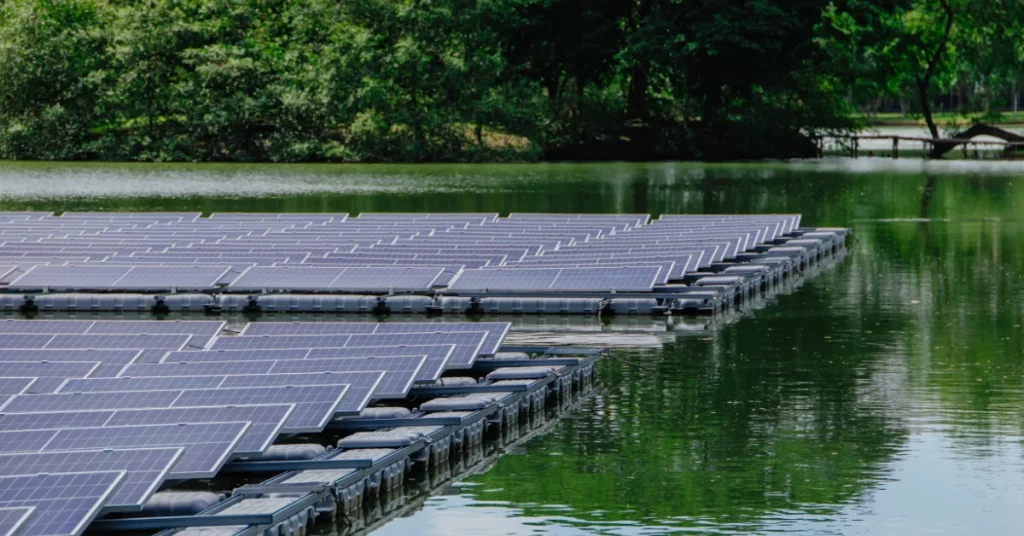
Floating solar, also called floating photovoltaics (FPV) or “floatovoltaics”, refers to a solar power system where photovoltaic panels are installed on structures that float on bodies of water instead of being mounted on land or rooftops. These systems use buoyant platforms (often made of plastic or metal floats) to support solar panels on lakes, reservoirs, ponds, or other calm water surfaces.
Floating solar is an innovative approach to renewable energy that addresses several challenges associated with traditional solar systems, especially scarcity of land and competition with agricultural or urban uses. As global demand for clean energy increases, floating solar is gaining attention as a strategic solution for regions with limited land availability and extensive water resources.
Why floating solar matters
The importance of floating solar lies in its ability to expand where solar power can be generated. Instead of using farmland, forests, or open fields, FPV systems take advantage of underused water surfaces like reservoirs or industrial ponds. This helps preserve valuable land for other purposes, including agriculture, housing, and conservation, while still producing clean electricity.
Additionally, the interaction between solar panels and water surfaces brings a range of technical and environmental benefits. For example, the natural cooling effect of water often improves solar panel efficiency compared with land-mounted arrays. Panels kept cooler by the water beneath them can operate more effectively, converting more sunlight into usable electricity.
Floating solar’s ability to generate renewable power without competing for land makes it especially attractive for densely populated areas or regions where land costs are high. For nations pursuing aggressive decarbonization goals, FPV systems represent a promising way to scale up solar power production without facing social or economic barriers tied to land use.
How floating solar works
Floating solar systems begin with platforms or floats that support arrays of photovoltaic (PV) modules on the surface of a water body. These floats are anchored to keep the system stable as water levels change. Cables run from the panels to inverters and electrical infrastructure on land, where the DC electricity produced by the panels is converted to usable AC power and fed into the grid or local loads.
Water surfaces serve several functions that benefit floating solar systems:
- Cooling effect: Water naturally absorbs and dissipates heat, keeping floating solar panels cooler than their land-based counterparts. Cooler operating temperatures can increase efficiency by 5%–15% compared with traditional arrays.
- Reduced land use: FPV systems utilize water surfaces that would otherwise remain unused for power production.
- Water conservation: By shading water bodies, floating solar helps slow evaporation, which can be a significant benefit in drought-prone regions or arid climates.


Benefits of floating solar
Floating solar offers a range of advantages that make it attractive for utilities, governments, and clean energy developers alike:
Land preservation
Because floating solar doesn’t require land acquisition, it avoids conflicts over land use. This is especially useful in urban or agricultural regions where open land is scarce or valuable.
Higher panel efficiency
Panels mounted over water benefit from natural cooling, which slows heat buildup and can improve electrical output compared with ground-mounted systems. Research suggests water cooling can boost efficiency by 5%–15%.
Water conservation
Floating solar arrays shade water surfaces, reducing evaporation, a key advantage for reservoirs or irrigation ponds in water-stressed regions. This makes FPV especially useful where water storage is critical.
Modular and scalable
Systems can be installed in small increments or scaled up to cover larger reservoirs, making FPV flexible for a range of project sizes.
Synergy with hydropower
Floating solar can complement hydropower when installed on dam reservoirs. By producing power from sunlight during daytime hours, floating solar extends the utility of existing infrastructure and can reduce reliance on water releases for electricity generation.
Floating solar potential in the United States
Although floating solar represents only a small piece of the U.S. solar market today, recent studies suggest the potential is enormous. According to research from the U.S. Department of Energy’s National Renewable Energy Laboratory (NREL), federally managed reservoirs could support enough floating solar installations to generate up to 1,476 terawatt-hours of electricity annually, enough to power about 100 million homes per year.
Even under conservative estimates, this potential equals more than half of the solar capacity needed for a fully carbon-free U.S. grid by 2050.
Despite the high potential, most U.S. floating solar projects today are still small. Examples include arrays at wastewater treatment plants, reservoirs in New York, and installations on lakes in North Carolina and California. The largest U.S. floating solar system, at a water treatment plant in New Jersey, is about 8.9 MW, considerably smaller than many international projects.
Challenges to wider adoption
Although floating solar presents compelling benefits, some challenges slow its adoption:
- Cost: FPV systems are typically more expensive to install upfront than ground-mounted arrays due to specialized floats, anchoring systems, and underwater cabling.
- Water body suitability: Not all water bodies are ideal; strong currents, waves, or ice can damage structures.
- Environmental considerations: Understanding impacts on aquatic ecosystems remains an active area of research.
What’s next for floating solar?
Floating solar’s rapid global growth, with deployments expanding in Asia, Europe, and beyond, shows how versatile this technology can be. As policies, investment, and research evolve, FPV systems are expected to play a significant role in renewable energy portfolios, especially where land scarcity or water management goals are priorities.
In the United States, the push toward cleaner energy sources and decarbonization goals could accelerate floating solar development, especially on federally managed reservoirs and in collaboration with existing hydropower infrastructure.
Conclusion
Floating solar is a promising, innovative twist on traditional solar power. By harnessing underused water surfaces, this technology expands where clean energy can be deployed, improves panel performance, reduces land competition, and helps conserve water. Although challenges remain, especially around cost and environmental impacts, floating solar’s massive potential in countries like the United States could help power millions of homes and bring us closer to renewable energy goals.