
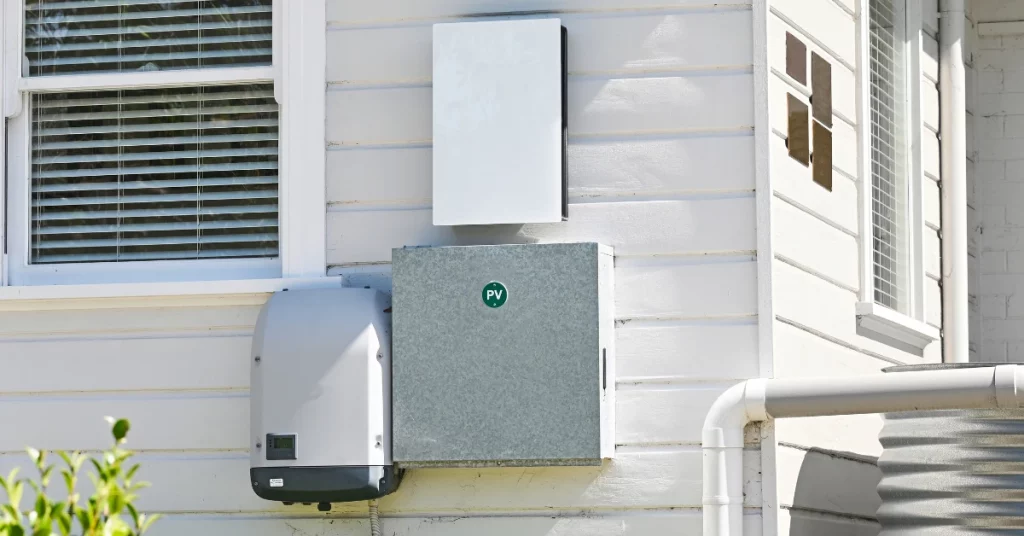
As solar power, wind energy, and battery storage become increasingly important to electricity generation, maintaining grid stability requires more advanced technology. One important development is the grid-forming inverter, which can help establish and maintain the voltage and frequency needed for reliable electricity supply.
Unlike conventional grid-following inverters, grid-forming inverters can operate without relying on an existing grid voltage waveform. This makes them particularly valuable for microgrids, energy storage systems, and applications requiring improved resilience during power outages.
According to the U.S. Department of Energy (DOE), grid-forming technology could enable renewable energy systems to support grid restoration and reduce dependence on conventional generators.
Table of Contents
What Is a Grid-Forming Inverter?
A grid-forming inverter is a power electronic device capable of establishing and regulating AC voltage and frequency.
Traditional power grids rely heavily on synchronous generators, such as those used in conventional power plants, to establish grid frequency and provide stability.
Grid-forming inverters perform some of these functions electronically through advanced control systems.
They can establish a voltage waveform, respond to changes in electricity demand, and coordinate with other generation or storage resources.
DOE identifies grid-forming inverters as an important technology for supporting electricity networks with increasing amounts of inverter-based renewable generation.
Grid-Forming vs. Grid-Following Inverters
The primary difference between these technologies is how they interact with the electrical grid.
A grid-following inverter synchronizes its output with an existing grid voltage and frequency. A grid-forming inverter can establish and regulate those electrical conditions itself.
| Feature | Grid-forming inverter | Grid-following inverter |
|---|---|---|
| Operating principle | Establishes voltage and frequency | Synchronizes with existing grid conditions |
| Grid dependency | Can operate without an external grid reference | Generally requires an established grid reference |
| Frequency control | Can actively establish and regulate frequency | Can adjust output in response to frequency changes |
| Black-start capability | Possible with suitable equipment and energy supply | Generally cannot independently black-start a grid |
| Islanded operation | Can support independently operating microgrids | Requires another grid-forming source |
| Typical applications | Battery storage, microgrids, grid stabilization | Conventional grid-connected solar and wind systems |
| Main advantage | Improved system stability and resilience | Established, widely deployed grid-connected technology |
Both technologies remain useful. In fact, DOE describes how a network of solar systems could use some inverters in grid-forming mode while others operate in grid-following mode.
How Grid-Forming Inverters Support Frequency Control
Grid frequency reflects the balance between electricity generation and consumption.
In the United States, the nominal grid frequency is 60 hertz (Hz). When electricity demand exceeds available generation, frequency can decrease. When generation exceeds demand, frequency can increase.
Grid-forming inverters use advanced controls to help maintain stable frequency during these changes.
For example, a grid-forming battery inverter may increase its power output when demand rises, provided sufficient stored energy and inverter capacity are available.
Unlike conventional synchronous generators, inverters do not inherently provide mechanical inertia from rotating machinery. However, appropriately designed grid-forming controls can provide fast frequency responses and emulate certain stabilizing behaviors.
DOE identifies frequency regulation and voltage control as central research priorities for grid-forming technology.
What Is Black Start?
Black start refers to restoring electricity generation and grid operation after a widespread outage without relying on an already energized external grid.
Traditionally, grid restoration begins with designated generating units capable of starting independently. These resources gradually energize additional equipment and restore electricity supply.
Grid-forming inverters introduce another potential approach.
When paired with suitable energy resources, particularly batteries, they can establish the voltage and frequency needed to energize an isolated electrical network.
Additional generators, solar arrays, and electrical loads can then be connected in a controlled sequence.
DOE identifies black-start capability as a major opportunity for grid-forming technology, particularly for renewable-powered microgrids.
However, not every grid-forming inverter automatically provides black-start capability. Successful restoration also requires adequate energy, compatible controls, protection equipment, and an engineered startup sequence.
Grid-Forming Inverters and Battery Storage
Battery energy storage systems are among the most promising applications for grid-forming inverters.
Unlike solar panels, which depend on available sunlight, batteries can supply stored electricity when generation is unavailable.
When combined with grid-forming controls, battery systems can support:
- Frequency regulation: Adjusting power output to help maintain system frequency.
- Voltage support: Regulating voltage during changing operating conditions.
- Black start: Establishing an electrical network after an outage.
- Microgrid operation: Supporting local electricity supply when disconnected from the main grid.
- Renewable integration: Helping coordinate variable solar and wind generation.
DOE’s microgrid research identifies grid-forming controls as important for maintaining voltage and frequency in systems operating without an external voltage source.
For solar-plus-storage projects, this capability can improve resilience, although actual backup performance depends on battery capacity, power ratings, system design, and operating conditions.
Applications of Grid-Forming Inverters
Grid-forming technology has several potential applications across the energy industry.
Microgrids
Microgrids can disconnect from the main electricity network and operate independently.
Grid-forming inverters help establish the electrical conditions needed for solar, batteries, and other distributed energy resources to supply local loads.
Commercial and industrial facilities
Facilities requiring reliable electricity may use grid-forming battery systems as part of a microgrid or backup-power architecture.
Applications can include critical infrastructure, industrial operations, and facilities where outages create significant operational risks.
Utility-scale energy storage
Large battery installations equipped with grid-forming controls can provide voltage and frequency support and potentially contribute to grid restoration.
DOE-supported research is examining how these resources can operate reliably alongside conventional generators and other inverter-based resources.
What to Consider When Selecting an Inverter
Grid-forming capability should be evaluated alongside the electrical and operational requirements of the project.
Important considerations include inverter power rating, compatible battery systems, operating modes, black-start functionality, frequency and voltage controls, protection requirements, and compliance with applicable interconnection standards.
Buyers should also distinguish between an inverter that provides advanced grid-support functions and one specifically designed for grid-forming operation.
Solar professionals can explore solar inverters available through Sunhub when sourcing equipment for residential, commercial, and utility-scale projects.
Manufacturer documentation should confirm whether a particular model supports grid-forming operation and which system configurations are required.
Conclusion
Grid-forming inverters represent an important advancement in solar and energy storage technology.
While grid-following inverters depend on an established electrical reference, grid-forming inverters can establish and regulate voltage and frequency, making them valuable for microgrids, battery storage, and potential black-start applications.
As electricity networks incorporate more renewable generation, these capabilities can help improve reliability, flexibility, and resilience.
However, grid-forming functionality alone does not guarantee backup power or black-start performance. Successful deployment requires compatible equipment, sufficient energy resources, appropriate protection systems, and coordinated engineering.
For solar developers, EPCs, and equipment buyers, understanding the difference between grid-forming and grid-following technology is increasingly important when planning future-ready energy systems.
Frequently Asked Questions
What is the main difference between grid-forming and grid-following inverters?
Grid-forming inverters can establish voltage and frequency, while grid-following inverters synchronize with an existing electrical grid.
Can a grid-forming inverter operate during a power outage?
Yes, when designed for islanded operation and supported by suitable energy resources, protection equipment, and controls. Not every grid-forming inverter automatically provides backup power.
Do grid-forming inverters require batteries?
No. Grid-forming controls can be applied to different inverter-based resources, including solar and wind. However, batteries are particularly useful because they can supply controllable power when renewable generation fluctuates.
Can grid-forming inverters restart the grid?
They can support black-start operations when the system is specifically engineered for that function and has sufficient available energy.
Sources
- U.S. Department of Energy : Powering On with Grid-Forming Inverters
- U.S. Department of Energy : Solar Integration: Inverters and Grid Services Basics
- U.S. Department of Energy : UNIFI Consortium
- U.S. Department of Energy : Advanced Microgrid Control and Protection
- National Renewable Energy Laboratory : Technical Roadmap Guides Research Direction for Grid-Forming Inverters