
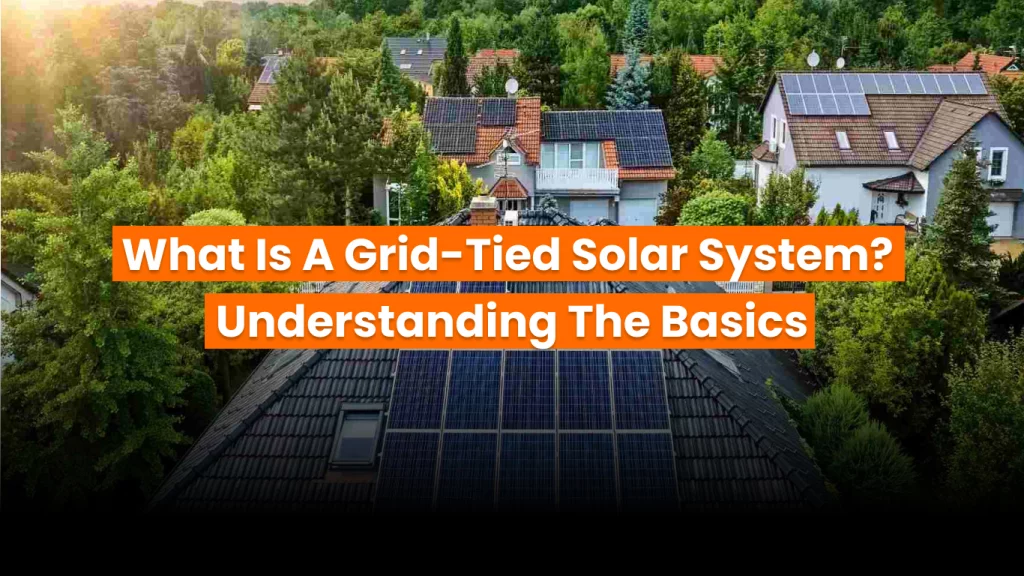
A grid-tied solar system, also known as an on-grid system, is one of the most common types of residential solar setups in the United States. These systems connect directly to both your home and the local utility grid. During the day, solar panels generate electricity that powers your home first. If your system produces more energy than you need, the extra electricity is sent back to the grid through net metering programs. At night or during lower production periods, your home automatically pulls electricity from the grid when needed.
Unlike off-grid systems, grid-tied setups usually do not require batteries. That keeps installation simpler, lowers overall costs, and reduces maintenance requirements for homeowners.
How Grid-Tied Solar Systems Work
The process itself is fairly straightforward. Solar panels generate direct current (DC) electricity from sunlight. A solar inverter then converts that power into alternating current (AC), which is the type of electricity your home uses. The inverter also synchronizes the system with the local utility grid.
When your system produces more electricity than your home is using, the excess power is exported to the utility grid. If solar production drops, such as during cloudy weather or nighttime hours, electricity is automatically imported from the grid without interruption.
Net metering allows this two-way exchange to happen. Homeowners receive utility credits for the extra energy they export, and those credits can later offset electricity usage from the grid. Over time, this can significantly reduce monthly electricity costs.
Why Homeowners Choose Grid-Tied Solar
One of the main reasons homeowners choose grid-tied systems is affordability. Since batteries are not included in most setups, equipment and installation costs stay lower compared to hybrid or off-grid systems. Standard installations typically include solar panels, an inverter, mounting equipment, and labor.
Another advantage is flexibility. Homeowners can still rely on the utility grid whenever solar production is not enough to cover household demand. In areas with favorable net metering policies, sending extra electricity back to the grid can also help improve long-term savings.
One important limitation, however, is that standard grid-tied systems usually shut down during a blackout for safety reasons unless battery storage and backup equipment are installed.
2025 Pricing Overview
According to EcoFlow’s 2025 pricing estimates, residential grid-tied systems in the U.S. generally range between $8,000 and $26,000 before incentives, depending on system size and equipment selection. After applying the 30 percent federal Residential Clean Energy Credit, estimated costs fall closer to:
- 3 kW system: around $5,600 to $7,000 after incentives
- 6 kW system: around $10,500 to $12,600 after incentives
- 10 kW system: around $15,400 to $18,200 after incentives
Hoymiles and other industry sources report similar ranges. Smaller residential systems can cost under $10,000 after incentives, while larger installations may exceed $25,000 before credits are applied.
What Affects the Cost?
Several factors influence the final price of a grid-tied solar system.
System Size
Larger systems require more panels, higher inverter capacity, and additional labor, which increases overall costs.
Solar Panel Type
Monocrystalline panels generally cost more than other panel types, though they also offer higher efficiency and better space utilization.
Inverter Selection
Homeowners can choose between string inverters and microinverters. Microinverters typically cost more per watt but can improve performance on roofs with shading or multiple panel orientations.
Labor and Location
Permit costs, labor rates, and roof complexity vary depending on region and installation conditions. These factors can affect the total project price significantly.
Additional Features
Monitoring systems, upgraded mounting hardware, and wiring for future battery expansion can also increase installation costs.
Industry estimates suggest that labor, permitting, and mounting hardware usually account for around 20 to 25 percent of total system costs, while solar panels and inverters make up most of the remaining expense.
Example: 6 kW Residential System
A typical 6 kW residential grid-tied system may cost between $15,000 and $18,000 before incentives. After the 30 percent federal tax credit, homeowners could expect costs closer to $10,500 to $12,600.
For many average-sized homes, this system size can offset a large portion of annual electricity usage, especially in states with strong net metering policies.
Pros and Limitations
Advantages
- Lower upfront cost compared to hybrid or off-grid systems
- Potential utility savings through net metering
- Simpler installation and maintenance
- Clean energy generation without onsite emissions
Limitations
- No backup power during outages without batteries
- Net metering policies vary by utility and state
- Limited energy storage capability in standard systems
Future Upgrade Options
Installing a grid-tied system today does not prevent homeowners from adding batteries later. Many modern inverters support future battery integration and time-of-use optimization features. Some systems also include smart monitoring and export management tools that help homeowners better control how energy is used or exported back to the grid.
Summary
For homeowners looking for a relatively affordable way to switch to solar, grid-tied systems remain one of the most practical options available. They offer lower installation costs, access to net metering savings, and the flexibility to expand later if battery storage becomes necessary.
While these systems do rely on the utility grid and usually do not provide backup power during outages, they still offer strong long-term value for many households.
Final Thoughts
Grid-tied solar systems continue to be one of the most popular residential solar solutions because they balance affordability, simplicity, and long-term savings. Homeowners can lower electricity bills through solar generation and net metering while still keeping access to grid electricity when needed.
With federal incentives currently available through 2032, many homeowners are using this period to invest in solar energy systems that can provide decades of electricity savings. Before installing a system, it is important to review local utility policies, estimate energy usage, and consider whether future battery storage may be part of the long-term plan.