
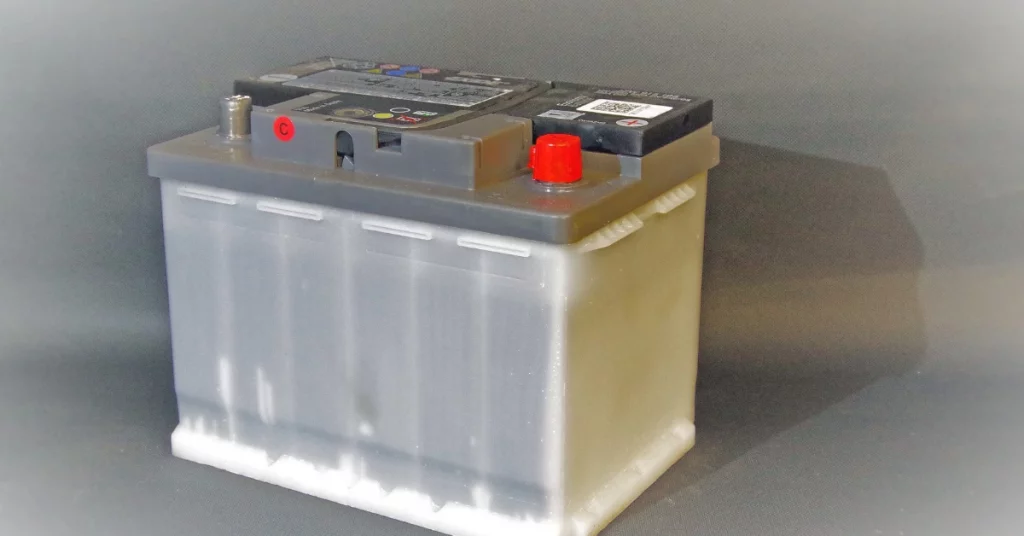
When comparing solar batteries, the advertised storage capacity does not always represent the electricity available for everyday use. A battery may have a nameplate rating of 15 kWh but provide less usable energy because of operating limits, reserve settings, and system losses.
Understanding solar battery usable capacity is essential for accurately estimating backup duration, comparing storage products, and planning solar-plus-storage installations.
For installers, EPCs, and equipment buyers, the distinction between total and usable capacity can directly affect system sizing and long-term performance.
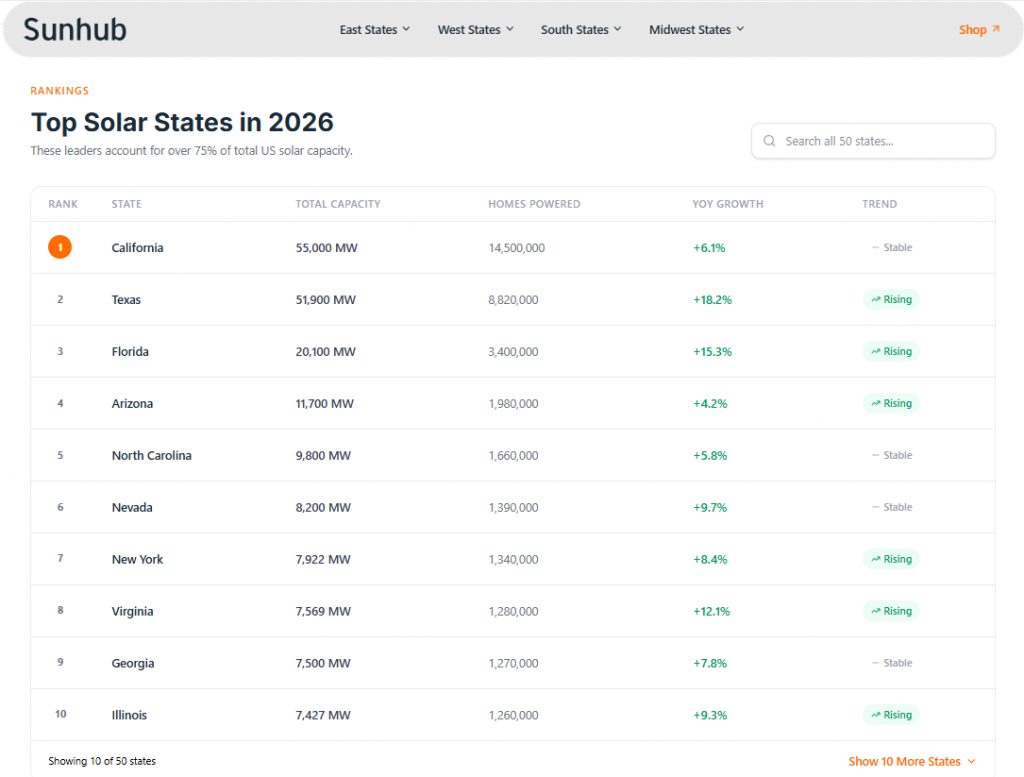
Explore U.S. Solar State Rankings
Compare solar rankings, installed capacity, growth trends, and market performance across all 50 states. Discover regional insights to support smarter procurement and expansion decisions.
Table of Contents
What Is Solar Battery Usable Capacity?
Solar battery usable capacity is the amount of stored electricity available for use within the battery manufacturer’s permitted operating range.
It is measured in kilowatt-hours (kWh), which represent energy rather than instantaneous power.
A battery’s capacity specifications generally distinguish between two measurements:
- Nameplate or nominal capacity: The manufacturer’s rated energy capacity under specified conditions.
- Usable capacity: The portion of that energy accessible within the battery’s permitted operating limits.
For example, a battery with 15 kWh of nominal capacity and 13.5 kWh of usable capacity allows access to 90% of its rated energy.
The remaining capacity may be restricted by the battery management system to protect the cells and maintain safe operation.
Nameplate vs. Usable Battery Capacity
Nameplate capacity and usable capacity serve different purposes when evaluating solar storage.
| Feature | Nameplate capacity | Usable capacity |
|---|---|---|
| Definition | Rated total energy capacity | Energy available within operating limits |
| Measurement | kWh | kWh |
| Includes inaccessible energy? | May include protected capacity | No |
| Used for backup planning? | Less directly useful | Yes |
| Affected by discharge limits? | Not directly | Yes |
| Changes with degradation? | Original rating remains fixed | Actual available capacity declines |
For practical system sizing, solar battery usable capacity is generally the more relevant specification.
However, buyers should verify whether a manufacturer’s usable-energy rating is measured at the battery’s DC terminals or includes AC conversion losses.



How Depth of Discharge Affects Usable Capacity
Depth of discharge (DoD) measures the percentage of a battery’s capacity that has been discharged.
A higher permitted DoD generally allows more of the stored energy to be used.
The simplified calculation is:
Usable capacity (kWh) = Nominal capacity (kWh) × Permitted DoD
Consider a 15 kWh battery with a maximum permitted DoD of 90%.
15 kWh × 0.90 = 13.5 kWh
The battery provides approximately 13.5 kWh of usable energy before additional discharge-side losses.
| Nominal capacity | Permitted DoD | Calculated usable capacity |
|---|---|---|
| 10 kWh | 80% | 8 kWh |
| 10 kWh | 90% | 9 kWh |
| 10 kWh | 95% | 9.5 kWh |
| 15 kWh | 90% | 13.5 kWh |
| 20 kWh | 95% | 19 kWh |
These calculations assume the permitted DoD is defined relative to the stated nominal capacity. Manufacturers may use different rating conventions, so published usable-energy specifications should take precedence.
Modern lithium-ion batteries often permit relatively deep discharge, but the exact limit depends on chemistry, battery design, and manufacturer requirements.
How Battery Reserve Settings Affect Available Energy
Battery reserve settings determine how much stored energy is held back for a specific purpose, particularly backup power.
For example, a solar battery may be configured to maintain a minimum 20% state of charge (SoC) for emergencies.
If the battery has 13.5 kWh of usable capacity and the reserve is set to 20% of that capacity:
13.5 kWh × 0.20 = 2.7 kWh reserved
The remaining energy available for routine use is:
13.5 kWh − 2.7 kWh = 10.8 kWh
This means the battery can have 13.5 kWh of manufacturer-rated usable capacity while providing only 10.8 kWh for daily electricity savings under the selected reserve setting.
Reserve settings do not necessarily reduce the battery’s physical usable capacity. Instead, they determine how much of that capacity is allocated to different operating purposes.
A higher backup reserve can improve outage preparedness but leaves less energy available for daily self-consumption or time-of-use optimization.
Usable Capacity vs. Actual Delivered Energy
Even when a battery has a published usable capacity of 10 kWh, the amount of AC electricity delivered to a building may be lower.
This is because battery systems experience losses through:
- Inverter power conversion
- Battery discharge processes
- Control electronics
- Heating and cooling equipment
- Other auxiliary loads
For example, if a battery provides 10 kWh of usable DC energy and the discharge path operates at an assumed 95% efficiency:
10 kWh × 0.95 = 9.5 kWh
Approximately 9.5 kWh would reach the AC load under those simplified conditions.
This distinction matters when estimating backup duration or comparing batteries with different inverter configurations.
Round-trip efficiency should not be substituted directly for discharge efficiency because it includes losses during both charging and discharging.
How Usable Capacity Affects Backup Duration
Backup duration depends on solar battery usable capacity, electrical demand, and system efficiency.
The basic formula is:
Backup duration (hours) = Delivered energy (kWh) ÷ Average load (kW)
For example, a battery delivering 9.5 kWh to a building with an average critical load of 1.9 kW could theoretically provide:
9.5 kWh ÷ 1.9 kW = 5 hours
Actual runtime may vary because of changing loads, temperature, battery condition, and auxiliary consumption.
The inverter must also have sufficient continuous and surge power capacity to operate the connected equipment.
How Battery Warranties Affect Usable Capacity
Solar batteries gradually lose storage capacity through aging and repeated charging and discharging.
Manufacturers commonly provide warranties specifying how much capacity the battery should retain after a defined period or amount of use.
Important warranty provisions include:
Capacity retention: The minimum percentage of specified initial capacity guaranteed at the warranty endpoint.
Warranty duration: The number of years covered.
Energy throughput: The total amount of energy permitted under certain warranty conditions.
Cycle limits: The number of charge-discharge cycles covered, where applicable.
Operating conditions: Temperature, installation, and usage requirements that must be followed.
For example, consider a battery initially rated at 13.5 kWh usable capacity with a hypothetical warranty guaranteeing 70% retention.
13.5 kWh × 0.70 = 9.45 kWh
At the warranty threshold, the battery could have approximately 9.45 kWh of remaining usable capacity under the warranty’s specified test conditions.
This is not a prediction of actual degradation. A battery may retain more capacity, and warranty coverage depends on the manufacturer’s specific terms.
How to Compare Solar Batteries
When evaluating solar battery usable capacity, buyers should compare more than advertised kWh ratings.
Important specifications include nominal energy, usable energy, permitted DoD, continuous power, inverter efficiency, reserve controls, cycle life, and warranty conditions.
Solar professionals can explore solar batteries available through Sunhub when sourcing storage equipment for residential and commercial installations.
Comparing usable capacity under consistent measurement conditions helps avoid misleading conclusions based on nameplate ratings alone.
Conclusion
Solar battery usable capacity determines how much stored electricity is accessible for practical use.
Unlike nameplate capacity, usable capacity accounts for manufacturer-defined operating limits, including permitted depth of discharge.
Reserve settings can further reduce the energy available for daily use, while inverter losses and auxiliary consumption affect the electricity ultimately delivered to connected loads.
Battery degradation and warranty limits also influence long-term performance.
For accurate solar storage sizing, buyers should prioritize manufacturer-rated usable capacity, understand reserve settings, and review warranty terms rather than relying solely on advertised kWh ratings.
Frequently Asked Questions
Is usable battery capacity the same as nominal capacity?
No. Nominal capacity represents rated stored energy, while usable capacity reflects the portion available within permitted operating limits.
Does a 100% depth of discharge mean every battery cell is completely drained?
Not necessarily. Manufacturers may define 100% DoD relative to an internally protected operating window rather than the cells’ absolute electrochemical limits.
Does increasing the backup reserve reduce battery capacity?
It reduces the energy available for routine use but does not necessarily change the battery’s manufacturer-rated usable capacity.
Does usable battery capacity decrease over time?
Yes. Batteries gradually lose energy-storage capability through aging and cycling. The rate depends on chemistry, temperature, usage, and operating conditions.