
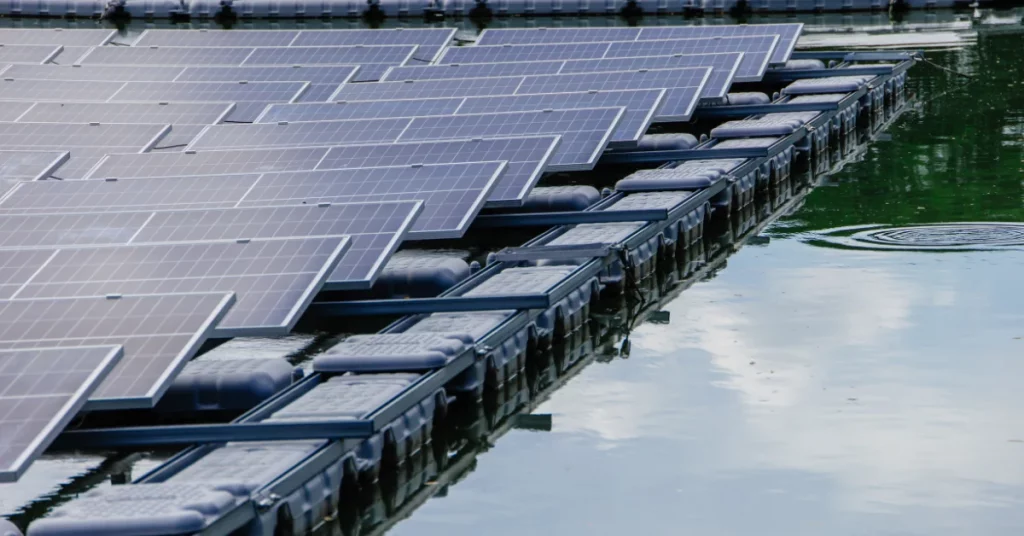
Floating solar photovoltaic systems are emerging as an exciting frontier in renewable energy. Instead of installing solar panels on rooftops or the ground, floating solar systems place panels on bodies of water such as reservoirs, lakes, wastewater ponds, and irrigation basins. This approach offers unique advantages, especially in regions where land is scarce or expensive. In this article you’ll learn how floating solar works, why it matters, what benefits it offers, and who the leading solar floating PV suppliers are in 2026.
What is floating solar and why the interest in 2026
Floating solar, also called floating PV or floatovoltaics, refers to solar energy systems mounted on water rather than on land. A floating platform supports photovoltaic panels and related electrical equipment, with cables and mooring systems anchoring the structure safely in place.
Interest in floating solar has grown rapidly as the technology improves and the economics become more favorable. Because it uses water surfaces that would otherwise go unused, floating solar helps address land constraints while delivering clean energy and additional auxiliary benefits such as water conservation and improved panel performance.
How floating solar systems work
At a basic level, a floating solar system involves the same solar PV modules used in rooftop or ground-based installations, but mounted on buoyant structures. These systems include:
- Solar modules — photovoltaic cells that convert sunlight into direct current (DC) electricity.
- Floating platforms — buoyant structures, often made of corrosion-resistant polymers such as HDPE, that support the panels.
- Mooring and anchoring systems — secure the floating array to the base of the water body or shore.
- Waterproof power conversion equipment — inverters and combiner boxes adapted for near-water operation.
- Cabling and grid interface — transmit electricity to shore and into the local grid or facility.
Floating PV systems can be designed for small ponds or utility-scale reservoirs and integrated with storage or other grid assets depending on project needs.
Why floating solar is gaining traction
Floating solar has several meaningful advantages that make it attractive both economically and environmentally:
Better solar panel performance
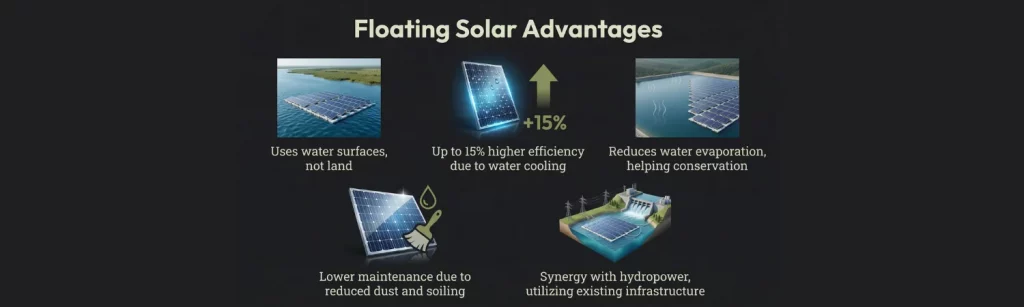
Water naturally cools solar panels, which helps maintain lower operating temperatures. High temperatures can reduce panel efficiency, so floating systems often produce more electricity compared with identical systems on land. Some studies show efficiency improvements up to about 10-15 percent.
Land savings and dual-use areas
By installing photovoltaic systems on water, developers avoid occupying scarce land that might otherwise be used for agriculture, housing, or conservation. This “dual-use” approach maximizes overall space productivity without disrupting existing land functions.
Water conservation
Floating panels shade the water surface and significantly reduce evaporation. This is especially important in dry climates or places facing water scarcity, as lower evaporation helps preserve valuable freshwater resources.
Reduced soiling and maintenance
Systems on water avoid soil-borne dust and dirt that accumulate on land-based solar panels. This means floatovoltaics often require less frequent cleaning, which lowers maintenance costs and preserves output.
Flexible site options
Floating PV can leverage water bodies that are otherwise unsuitable for energy generation, such as industrial ponds, irrigation reservoirs, closed mines, and water treatment lagoons. This flexibility opens up renewable energy potential in unexpected places.
Challenges to floating solar adoption
Despite these advantages, floating solar still has challenges to resolve:
Installation cost and complexity
Floating platforms, specialized mooring systems, and water-ready electrical components add complexity to installation. These systems often have a higher initial capital cost, sometimes 10-25 percent above ground-mounted systems, though long-term energy gains can offset this.
Environmental and regulatory concerns
Because floating systems sit directly on water bodies, developers must assess impacts on aquatic ecosystems, water quality, and usage rights. Custom environmental studies and permitting are typically required before installation.
Technical lifecycle unknowns
Floating PV technology has matured, but large-scale systems have not been in operation as long as ground systems. Questions about long-term reliability, corrosion control, and anchor durability remain active areas of ongoing study.
Commercial and utility cases for floating solar
Floating PV systems are not just a theoretical idea, they are now powering grids and commercial operations around the world:
- In Portugal, a floating solar installation at the Alto Rabagão reservoir illustrates how water-based PV can contribute to a nation’s renewable portfolio.
- Utility-scale floating arrays in Asia are being deployed on dams and reservoirs, sometimes integrated with hydropower to maximize generation and grid stability.
- Projects from developers are incorporating floating PV into corporate sustainability strategies or municipal energy plans where land is an expensive constraint.
These projects demonstrate the real-world viability of floating solar for both utility and commercial clients.
Top solar floating PV suppliers in 2026
The global floating solar industry is growing rapidly, and several suppliers now lead large projects, technology development, and supply chains. Major names to know include:
1. Sungrow Power Supply Co., Ltd.
A major global solar company with expertise in inverters and floating PV solutions. Sungrow’s systems have been used in large floating installations including past record-setting arrays.
2. Ciel & Terre International S.A.S.
A pioneer focused on floating solar technology with its patented Hydrelio floating systems widely used for reservoirs and utility projects.
3. Trina Solar Limited
Global PV module manufacturer now actively supplying high-efficiency modules for floating installations in many regions. (Research and Markets)
4. Kyocera Corporation
Long-established solar manufacturer whose modules are used in many PV applications, including water-based systems.
5. Sharp Corporation
Major solar provider with floating PV modules optimized for aquatic environments.
6. Canadian Solar Inc.
International supplier involved in both modules and hybrid application designs for multi-use floating solar plants.
7. JA Solar Technology Co., Ltd.
Large PV manufacturer with growing presence in floating solar through global deployments.
8. Hanwha Q CELLS Co., Ltd.
Another major solar module supplier with products suitable for floating PV deployment as part of larger renewable ecosystems.
9. Ocean Sun AS
Norwegian supplier specialized in floating solar platforms and marine-grade systems.
10. BayWa r.e. renewable energy GmbH
European firm with experience deploying floating PV farms and integrating them into commercial renewable portfolios.
These suppliers range from complete system developers to module makers and platform innovators, reflecting the diversity of the floating solar ecosystem in 2026.
Concluding thoughts on floating solar PV
As of 2026, floating solar PV systems are more than a niche innovation. They offer tangible advantages in efficiency, land use, and water conservation while addressing key global challenges like climate change and water scarcity. With an expanding list of capable suppliers and mature technology, floating solar represents a compelling option for utilities, commercial developers, and energy planners, particularly where land constraints limit traditional solar deployments.
Whether part of a commercial portfolio or integrated with other renewables, floating solar opens a new chapter in how we generate and deploy clean power, making room for creativity, sustainability, and resilient energy infrastructure.
Sources:
Floating solar advantages and considerations. (ratedpower.com)
Floating solar PV system operations and components. (bymea.com)
Floating solar market suppliers and trends. (Research and Markets)
Floating solar PV projects and implementations. (List.Solar)