
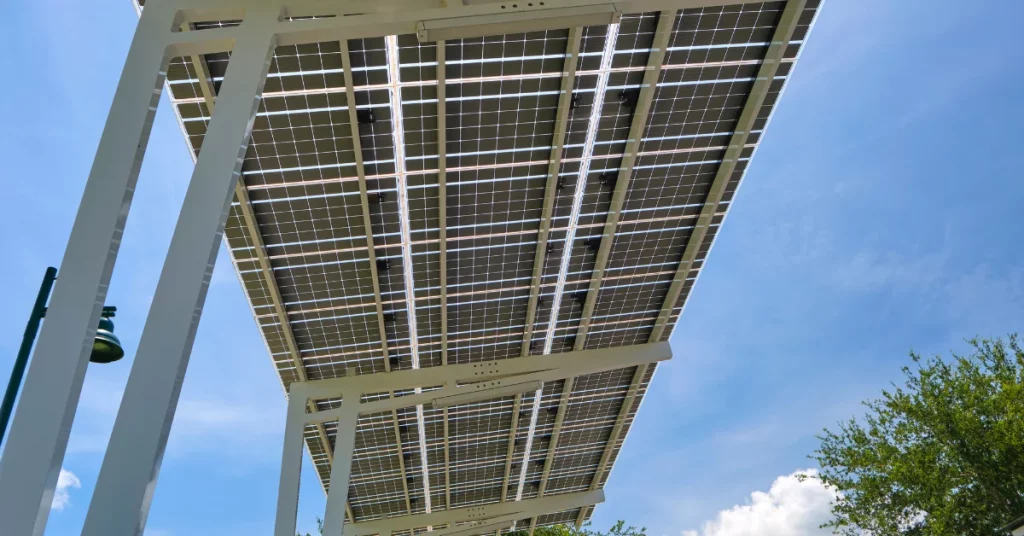
As we look back on 2025 from early 2026, solar net metering policies emerged as one of the most dynamic and consequential areas of energy policy in the United States. Net metering shapes how solar owners get credit for the power they send back to the grid. For project owners, utilities, developers, and especially commercial solar carport structures, understanding these policies was essential to financial planning, system design, and long-term returns.
This article looks at how net metering evolved in 2025, why it mattered, what major trends took shape, and what 2026 may hold for commercial solar.
What net metering is and why it matters
Net metering is a billing mechanism that credits solar energy system owners for the electricity they add to the grid. It works like this: when your solar array (such as a commercial solar carport structure) produces more electricity than your facilities use at that moment, the excess flows onto the grid and lowers your future electricity bills. Essentially, the utility “meters” both the energy you consume from the grid and the energy you export from your solar system, and you pay only for the net difference.
This system can dramatically improve the economics of a solar installation by improving payback and increasing cash flows, especially for commercial systems that have large peak daytime loads. These credits can reduce demand charges and energy costs, which are significant for businesses with high daytime power use.
Net metering also interacts with broader policies like community solar programs, virtual net metering, and net billing tariffs, all of which became more prominent in 2025.
2025: states in motion on net metering
State regulators and legislatures were exceptionally active on net metering policy throughout 2025. According to state solar policy tracking by the North Carolina Clean Energy Technology Center, virtually every state and U.S. territory took action on solar policy, and net metering was consistently a top focus. In the first quarter of 2025 alone:
- 47 states, the District of Columbia, and Puerto Rico took some distributed solar policy action.
- The most common policy area was net metering and its successors.
- Policy changes included iterative revisions and expansions of system size limits for non-residential net metering.
As the year progressed, similar patterns continued. Reports from the second and third quarters of 2025 also found dozens of actions each quarter focused on net metering and related rate design issues.
This activity reflected several motivations:
- Utilities and regulators were reassessing the value of solar exports and considering how to compensate producers fairly while maintaining grid cost recovery.
- States continued to balance incentives for solar deployment with utility rate design issues such as minimum charges or time-of-use pricing.
- There was a drive to expand net metering access for commercial and community solar projects, including large distributed systems like solar carports.
Net metering successor tariffs and transitions
One of the most significant developments in 2025 was the increasing shift from traditional net metering toward “net billing” or net metering successor tariffs in multiple jurisdictions.
A net billing tariff typically compensates solar exports at competitive or avoided-cost wholesale rates rather than full retail value. This type of shift can reduce the financial benefit of exporting energy, a change that utilities and regulators justify as aligning compensation with the actual value of distributed energy resources on the grid.
For example, in Washington state, PacifiCorp proposed a successor tariff that would move away from classic net metering toward a net billing structure that compensates exports on an hourly or avoided cost basis, while grandfathering existing customers into their current programs if installed before the transition date.
In West Virginia, regulators approved net billing programs for major utilities, switching from simple net metering to avoided-cost based compensation.
These transitions matter for commercial solar carport structures because compensation levels and timing of credits directly influence the financial models used to justify investment. A lower per-kWh export credit means the relative value of self-consumed solar energy increases. Projects that maximize on-site usage or pair solar with storage often fare better under net billing schemes.
Broader net metering trends in 2025
Several broader trends emerged across states:
Expanding system size limits
Many states expanded or clarified size limits for net metering or its successors, particularly for non-residential installations like commercial solar carports. This helped larger solar arrays qualify for credits or participate more effectively in net metering programs.
Alternative compensation models
Around one-third of states explored or implemented alternatives to traditional net metering, including value-stack or fixed credit structures that pay for exported energy based on its grid value. These successor mechanisms aim to balance solar incentives with rate design fairness.
Integration with community and virtual net metering
Some states promoted community solar and virtual net metering, which allow multiple users to share solar credits from a single system or from a system located at another site. Such policies can benefit commercial portfolios or campuses with multiple meter points under one owner.
Bedroom bill adjustments
Regulators also considered fixed charges, minimum bills, and other rate design changes that affect how net metering credits impact customer bills, especially for larger commercial customers.
These trends reflect a balancing act: encouraging distributed solar deployment while addressing grid cost responsibilities and ensuring equitable treatment among different customer classes.
Net metering in the most solar-friendly states
In many of the states with the highest cumulative solar installations, net metering policies remained a competitive advantage in 2025. States such as California, Nevada, Colorado, and North Carolina were generally supportive of net metering or newer successor tariffs, often with favorable rollover of credits and larger system limits.
California, long a leader in solar deployment, continued to evolve its policies, with proposals and legislative discussions around revising net metering frameworks to sustain growth while balancing grid impacts. (Industry reporting suggests changes such as Assembly Bill discussions or similar debates emerged in 2025)
Other states in the Sun Belt and Mountain West offered net metering with varying credit structures and limits, benefiting systems that produce surplus energy during midday peaks.
Implications for commercial solar carport structures
Commercial solar carport structures generate significant energy during daytime peak hours, often coinciding with high facility demand. Net metering policies impact such projects in several ways:
1. Revenue and cash flow modeling
The way utilities credit exported energy affects annual revenue. Full retail credits under traditional net metering deliver clear financial value, but successor tariffs with avoided-cost compensation shift emphasis to on-site consumption and storage. Understanding the prevailing policy in your state is crucial to predicting returns on your carport investment.
2. Design and storage decisions
Under policies that reduce export credits, pairing solar with battery storage becomes more valuable because storage allows facilities to use more of the energy they produce instead of exporting it at a lower compensation rate. This strategy preserves value and reduces demand charges.
3. Project eligibility and scale
System size limits determine whether a commercial array qualifies for net metering. Many states expanded these limits in 2025 to include larger non-residential systems, benefiting solar carports that often exceed residential sizes.
4. Community and shared net metering
Policies like virtual net metering can allow corporate campuses or distributed facilities to share a solar carport’s generation credits across multiple meters, increasing the value of centralized solar investments.
For owners and developers, staying informed about policy changes, especially quarterly updates, was essential in 2025 and remains critical as we move into 2026.
Looking toward 2026 and beyond
As solar capacity grows and grid dynamics evolve, net metering policies will continue to be at the forefront of energy policy discussions. Several areas to watch include:
- Continued transitions to successor tariff designs that reflect the changing economics of distributed solar.
- Greater integration of time-of-use (TOU) rates and demand charges into net metering crediting, affecting when and how credits are valued.
- Expansion of shared and community solar crediting to support multi-user commercial setups.
- Regulatory responses to federal policy changes and incentive shifts, which may drive further state action.
For commercial solar carport owners, the lesson from 2025 was clear: net metering policy is not static. Proactive engagement, flexible system design, and strategic use of storage and energy management systems help maximize value as policies evolve.
Final thoughts
The year 2025 was a transformative one for solar net metering policies in the U.S. States took action at an unprecedented rate, adjusting net metering frameworks, successor tariffs, and compensation models. These changes were driven by the dual goals of continuing solar deployment and balancing grid economics, and they had direct implications for large commercial systems like solar carport structures.
Looking ahead, understanding current policies, anticipating future regulatory shifts, and designing solar carport projects with flexibility and resilience will be essential to maximizing financial returns and sustainability impact in 2026 and beyond.
Sources:
NC Clean Energy Technology Center net metering policy actions Q1 2025. (NC Clean Energy Technology Center)
SolarKal 50-state solar policy overview. (SolarKal)
Net metering trend and state actions Q2 2025. (NC Clean Energy Technology Center)
Net metering successor and net billing transitions Q3 2025. (NC Clean Energy Technology Center)
State net metering policy variations. (The Solar Roof Guide)