
Planning a solar installation starts with one deceptively simple question: How much solar do I actually need?
The answer depends on much more than the size of a home or business. Electricity consumption, geographic location, panel wattage, roof orientation, system losses, available installation space, and future energy needs can all influence system size.
That’s where solar panel calculators become useful. Instead of starting with guesswork, these tools can provide an initial estimate of system requirements, expected energy production, or the number of panels needed.
However, not every calculator serves the same purpose. Some focus on quickly sizing a system, while others provide detailed production modeling or help users understand their electricity consumption.
Rather than comparing dozens of tools, we’ve narrowed the field to three useful types of solar calculators, starting with Sunhub’s own solar calculator.
What is a solar panel calculator?
A solar panel calculator is an online tool that uses information about a property, electricity consumption, solar equipment, or location to estimate the requirements or potential performance of a photovoltaic (PV) system.
Depending on the calculator, users may enter information such as:
- Location
- Monthly or annual electricity consumption
- Electricity costs
- Solar panel wattage
- System capacity
- Roof orientation
- Tilt
- System losses
The output might estimate the number of solar panels required, potential system capacity, or annual electricity generation.
Solar calculators are particularly valuable during the early stages of a project. They can help homeowners understand the approximate scale of an installation and give solar professionals a starting point before completing detailed engineering and site assessments.
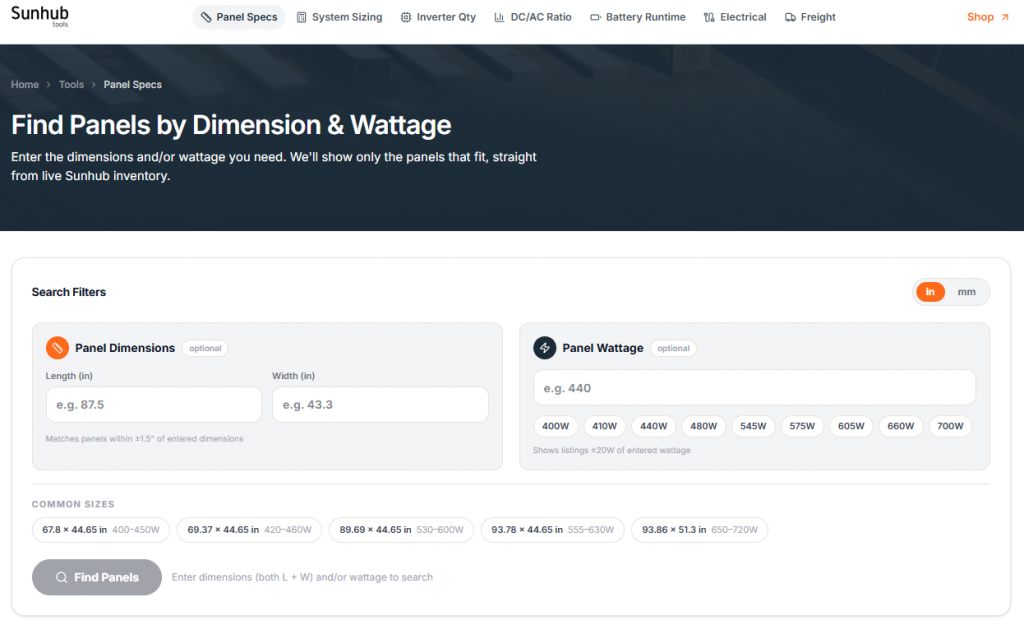
Find Solar Panels by Dimensions & Wattage
Enter your panel dimensions or wattage to find matching solar panels from live Sunhub inventory. Compare options and simplify equipment sourcing.
Here are three types worth knowing.
1. Sunhub solar calculator: Best for getting started with solar sizing
For buyers who want a straightforward starting point Sunhub’s Solar Calculator is designed to simplify the initial solar sizing process.
Sunhub’s calculator is especially relevant for users who are already researching solar equipment and want to move from “I’m interested in solar” to understanding what their project may actually require.
Rather than beginning the purchasing process without any sense of system size, a calculator can help establish an initial benchmark. From there, buyers can evaluate equipment and have more productive conversations with installers, distributors, or suppliers.
This makes Sunhub’s calculator useful during the early planning and equipment-sourcing stages of a solar project.
Why start with Sunhub’s calculator?
Solar system sizing influences almost every purchasing decision that follows.
Understanding approximate system requirements can help determine:
- How much PV capacity may be required
- Approximately how many panels may be needed
- What equipment specifications to explore
- How large the overall project could be
- What questions to ask suppliers or installers
For professionals sourcing equipment, an early estimate can also help establish approximate order quantities before requesting detailed proposals.
The calculator should still be viewed as a planning tool rather than a final system design. Structural requirements, shading, electrical capacity, local codes, interconnection requirements, and actual site conditions need to be evaluated before installation.
2. Solar production calculators: Best for estimating energy generation
The second major category is the solar production calculator.
Rather than focusing primarily on how many panels a project may require, these tools estimate how much electricity a proposed PV system could generate.
One of the best-known examples is PVWatts Calculator. PVWatts estimates the electricity production of grid-connected PV systems and is designed for homeowners, building owners, installers, and manufacturers. (PVWatts)
Users can model factors including:
- System capacity
- Module type
- Array type
- System losses
- Tilt
- Azimuth
- DC-to-AC ratio
- Inverter efficiency
- Ground coverage
- Albedo
- Bifacial modules
PVWatts Version 8 also incorporates updated solar-resource data and improved models for PV modules, inverter performance, and thermal effects. (PVWatts)
Why does location matter?
Two identical solar systems installed in different locations will not necessarily produce the same amount of electricity.
Solar resource, weather, temperature, orientation, shading, and system design influence production.
The U.S. Department of Energy also notes that array orientation and tilt affect energy generation. In the Northern Hemisphere, south-facing modules generally maximize annual output, although the ideal design ultimately depends on the site and electricity-load requirements. (The Department of Energy’s Energy.gov)
Production calculators are therefore useful when comparing different system configurations.
For example, a user could model the same system with different orientations or system sizes and see how estimated annual electricity production changes.
3. Electricity-usage and load calculators: Best for understanding how much energy you need
The third category approaches solar sizing from the opposite direction.
Instead of asking, “How much electricity will these panels produce?” a load calculator asks, “How much electricity do I need to supply?”
This is particularly useful for:
- Off-grid properties
- Battery backup systems
- RVs
- Cabins
- Remote installations
- Homes adding electric vehicles
- Businesses evaluating new electrical loads
A load-based calculation starts by identifying the appliances and equipment that need electricity and estimating how much energy they consume.
For example, refrigerators, lighting, air conditioning, water heaters, computers, machinery, and EV charging can create very different load profiles.
This becomes especially important when battery storage is involved. Designing a system to offset annual grid electricity consumption is different from designing one capable of keeping critical appliances operating during an outage.
Understanding the load first helps determine how much solar generation, and potentially battery capacity, the project needs.
What information should you have before using solar panel calculators?
The quality of a calculator result depends heavily on the quality of the information entered.
One of the most useful starting points is 12 months of electricity consumption in kilowatt-hours (kWh). The reference calculator guide similarly recommends using annual electricity consumption rather than relying only on home size or an estimated monthly bill. (Lee Fondiller Scholarship)
Why?
Two houses with identical floor areas can consume dramatically different amounts of electricity. One household might have an EV, pool pump, electric water heating, and heavy air-conditioning use, while another consumes considerably less.
Users should ideally gather:
- 12 months of electricity usage
- Installation location
- Approximate roof orientation
- Shading information
- Available installation area
- Expected future loads
- Preferred panel wattage, if known
Future consumption matters too. Someone planning to purchase an EV or switch from gas heating to electric equipment may want to model that additional demand rather than sizing solely around historical consumption.
Why different solar calculators give different results
It’s normal for two solar panel calculators to produce slightly different answers.
Calculators can use different assumptions for:
- Weather data
- Solar irradiance
- System losses
- Module efficiency
- Inverter efficiency
- Shading
- Tilt and orientation
- Electricity consumption
Even sophisticated tools have limitations. PVWatts explicitly cautions that its performance predictions contain assumptions and uncertainties and cannot capture every site-specific characteristic. (PVWatts)
That doesn’t make calculators unreliable. It means their results should be treated as estimates for planning and comparison, not construction-ready engineering designs.
From calculator to actual solar project
A calculator should be the beginning of the process, not the end.
A useful workflow is:
Estimate demand → calculate preliminary system size → model expected production → evaluate the site → select equipment → complete engineering and permitting.
After getting an initial estimate, an installer or engineer can assess variables an online tool may not fully capture, including structural limitations, precise shading, electrical service capacity, local fire setbacks, equipment compatibility, and utility interconnection requirements.
This is where solar calculators provide their greatest value: they help buyers enter the next stage of the project better informed.
Conclusion
Solar panel calculators make the early stages of solar planning easier by translating electricity consumption and system assumptions into more useful estimates.
But you don’t need seven different calculators to start planning a project.
Three categories cover most early-stage needs: a straightforward sizing calculator, a detailed production calculator, and a load calculator.
For buyers beginning the process Sunhub’s Solar Calculator provides a practical place to start estimating system requirements. More detailed tools such as PVWatts can then help model expected energy production, while load calculations can clarify how much electricity a home, business, or off-grid system actually needs.
Used together, and followed by professional site assessment and engineering, these tools can turn an initial idea about going solar into a much clearer project plan.
FAQs
What do solar panel calculators tell you?
Depending on the tool, they can estimate system capacity, panel requirements, electricity production, or the amount of solar generation required to meet a particular energy load.
Are solar calculators accurate?
They can provide useful planning estimates, but results depend on inputs and assumptions. They should not replace a professional site assessment or final engineering design. PVWatts itself notes that performance predictions include inherent assumptions and uncertainties. (PVWatts)
What information should I have before using one?
Ideally, gather 12 months of electricity consumption, your location, basic roof orientation and shading information, and any expected future loads such as an EV.
What’s the best solar calculator to start with?
If you’re beginning to determine your solar requirements, Sunhub’s calculator provides a straightforward starting point. Production-modeling tools such as PVWatts can then be used for more detailed performance estimates.
Why do different calculators produce different results?
Different calculators may use different weather datasets, system-loss assumptions, orientation settings, equipment assumptions, and calculation methods. Using consistent inputs makes comparisons more meaningful.
Sources
- PVWatts Calculator — solar PV production modeling.
- U.S. Department of Energy — Solar Photovoltaic System Design Basics — PV design, mounting, tilt, and orientation.
- Lee Fondiller Scholarship, Top 5 Online Calculators to Estimate Your Solar Panel Needs — reference article used for the three-category framing and common calculator questions. (Lee Fondiller Scholarship)