
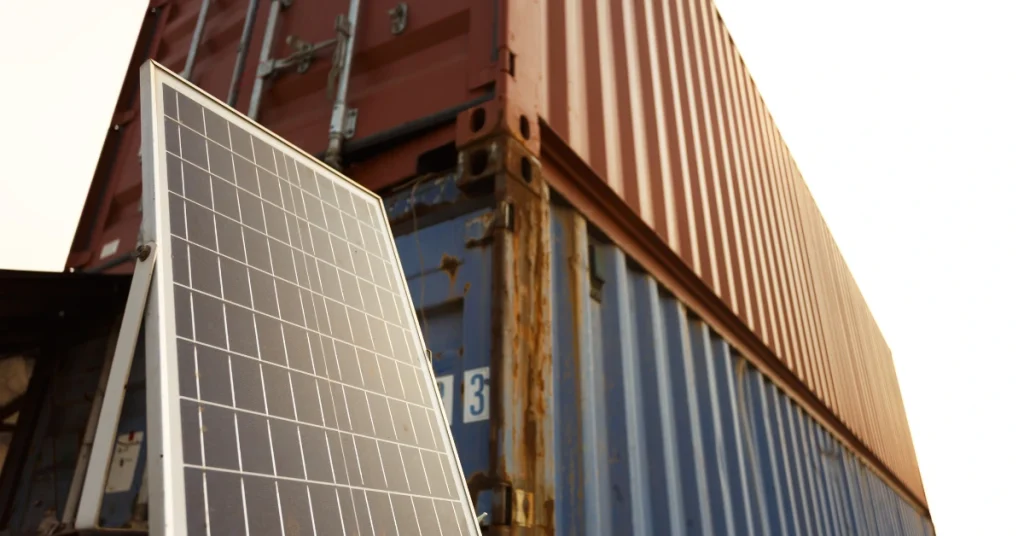
Shipping solar panels in bulk requires careful planning to maximize container space, control freight costs, and prevent damage during transportation. One of the most important logistics considerations is solar panel container capacity, which determines how many photovoltaic (PV) modules can fit inside a standard shipping container.
Container capacity depends on module dimensions, pallet configuration, packaging requirements, and weight restrictions.
For solar distributors, EPC contractors, and project developers, understanding these factors helps improve procurement planning and reduce transportation expenses.
Table of Contents
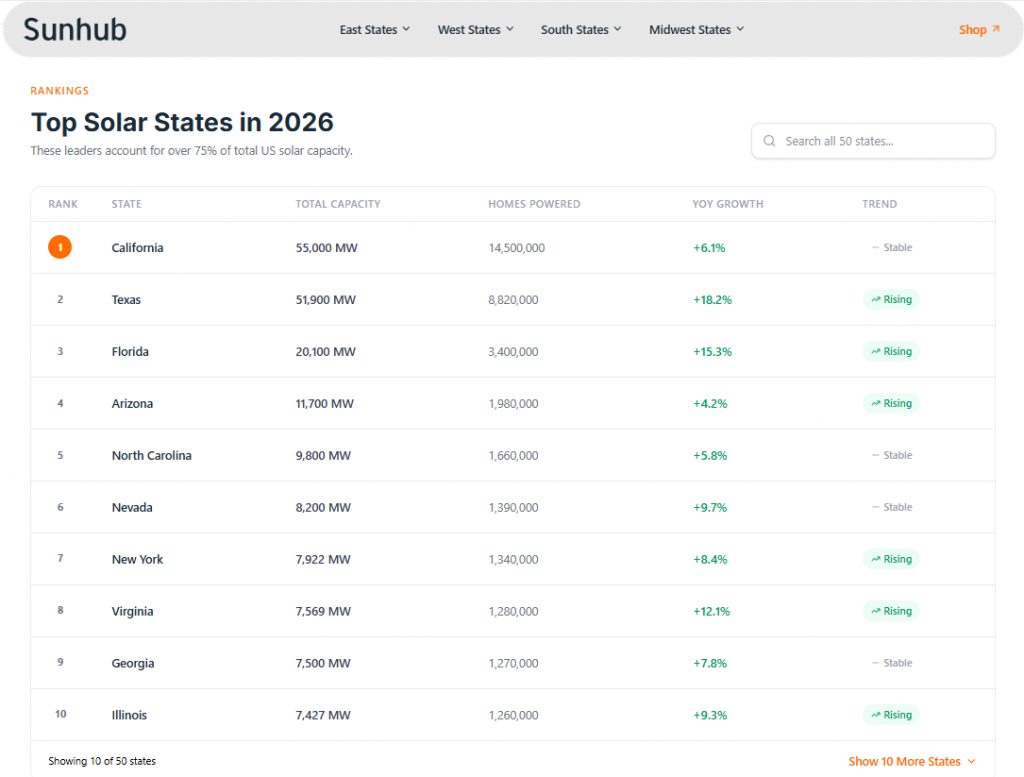
Explore U.S. Solar State Rankings
Compare solar rankings, installed capacity, growth trends, and market performance across all 50 states. Discover regional insights to support smarter procurement and expansion decisions.
What Is Solar Panel Container Capacity?
Solar panel container capacity refers to the number of photovoltaic modules that can be safely loaded into a shipping container.
Solar panels are typically transported in manufacturer-approved cartons or pallets rather than loaded individually.
The total quantity depends on the dimensions and weight of each packaged unit, the container’s internal measurements, and the approved loading arrangement.
Two commonly used shipping container sizes are 20-foot and 40-foot high-cube (40HC) containers.
How Many Solar Panels Fit in a Shipping Container?
The following ranges provide general planning estimates for conventional palletized modules. Actual capacity must be confirmed using manufacturer packing specifications.
| Container type | Illustrative panel capacity | Primary consideration |
|---|---|---|
| 20-foot standard | 200–400 panels | Limited floor space and loading flexibility |
| 40-foot standard | 500–700 panels | Module and pallet dimensions |
| 40-foot high-cube | 600–800 panels | Packaging arrangement and usable height |
These figures are not universal loading limits. Some manufacturers specify quantities outside these ranges, particularly for large-format modules or specialized packaging.
For accurate shipment planning, the supplier’s container-loading diagram should take priority over generalized estimates.
Standard Shipping Container Dimensions
Understanding container dimensions helps determine whether palletized solar modules can fit safely.
| Container type | Approx. internal length | Internal width | Internal height |
|---|---|---|---|
| 20-foot standard | 5.90 m | 2.35 m | 2.39 m |
| 40-foot standard | 12.03 m | 2.35 m | 2.39 m |
| 40-foot high-cube | 12.03 m | 2.35 m | 2.69 m |
A 40HC container provides additional vertical clearance, but that does not automatically mean solar pallets can be double-stacked.
Stacking must comply with manufacturer packaging specifications and safe cargo-handling requirements.
Door opening dimensions and loading equipment clearance must also be considered.
What Affects Solar Panel Container Capacity?
Several factors determine the number of panels that can be transported in one shipment.
Solar panel dimensions
Modern commercial and utility-scale modules are often larger than older residential panels.
A module measuring approximately 2.3 × 1.1 meters requires a different packing arrangement from a smaller module.
Larger dimensions can reduce the number of pallets that fit within the container.
Panels per pallet
Manufacturers specify how many panels can be packaged in each pallet or shipping carton.
For example, a shipment containing 20 pallets with 36 panels per pallet would carry:
20 × 36 = 720 solar panels
However, this calculation is valid only if the complete pallet configuration fits within the container’s space and weight limits.
Packaging orientation
Modules may be packed vertically or in other manufacturer-approved arrangements.
Orientation affects pallet dimensions, handling procedures, and the risk of transport damage.
Weight restrictions
Containers have maximum payload ratings, but road transport and port regulations may impose additional restrictions.
The total shipment weight includes modules, pallets, cartons, securing materials, and other cargo.
How to Calculate Solar Panel Container Capacity
A basic capacity estimate can be calculated using the number of approved pallets and panels per pallet.
Container capacity = Number of pallets × Panels per pallet
Suppose a supplier confirms that a 40HC container can accommodate 18 pallets, with 36 panels per pallet.
The total capacity would be:
18 × 36 = 648 panels
If each module has a rated output of 550W:
648 × 550W = 356,400W
The shipment would contain approximately 356.4 kW of rated DC module capacity.
This is a hypothetical calculation, not a standard capacity for all 550W modules.
The actual loading plan must account for pallet dimensions, cargo weight, securing requirements, and unloading procedures.
Solar Panel Shipping Capacity by Wattage
Module wattage is useful for estimating the total power capacity of a shipment, but it does not independently determine how many panels fit inside a container.
For illustration, consider a shipment of 650 modules.
| Module rating | Total rated DC capacity |
|---|---|
| 400W | 260 kW |
| 450W | 292.5 kW |
| 500W | 325 kW |
| 550W | 357.5 kW |
| 600W | 390 kW |
These figures assume the same number of modules can be loaded in each scenario.
In practice, higher-wattage modules may have larger dimensions, different weights, or different packaging requirements.
How to Reduce Solar Panel Shipping Costs
Improving container utilization can reduce freight cost per module, but maximizing quantity should never compromise cargo safety.
Confirm packaging specifications. Request pallet dimensions, gross weights, and panels-per-pallet information before arranging freight.
Use manufacturer loading diagrams. Approved configurations reduce uncertainty and help prevent loading problems.
Compare shipment sizes. Full-container loads may offer better unit economics than smaller shipments, depending on freight rates and order volume.
Account for unloading requirements. Forklift capacity, site access, and receiving equipment should be planned before delivery.
Inspect shipments on arrival. Check packaging condition and document visible damage before accepting or unpacking cargo.
Solar businesses sourcing solar panels through Sunhub can compare available module specifications and coordinate purchasing decisions around project quantities and delivery requirements.
Common Solar Panel Container Loading Mistakes
Incorrect assumptions about container capacity can lead to higher costs and damaged equipment.
Common mistakes include estimating capacity using panel dimensions without accounting for packaging, assuming all 40HC containers accommodate identical pallet quantities, and overlooking maximum payload restrictions.
Another mistake is treating unused vertical space as permission to stack pallets.
Solar modules are sensitive to mechanical stress, and inappropriate stacking or securing can contribute to glass damage, cell microcracks, and other defects.
Manufacturers’ packaging and handling instructions should always govern loading decisions.
Conclusion
Solar panel container capacity depends on more than container size. Module dimensions, pallet configurations, packaging orientation, and weight restrictions determine how many panels can be transported safely.
A 40-foot high-cube container may accommodate several hundred modules, but the exact quantity varies by product and manufacturer.
For solar distributors, installers, and developers, accurate loading calculations help control freight costs, prevent damage, and support efficient project delivery.
The most reliable approach is to obtain manufacturer-approved loading specifications before finalizing shipment quantities.
Frequently Asked Questions
How many solar panels fit in a 40-foot container?
A 40-foot container may accommodate several hundred panels. The exact number depends on module size, packaging, pallet arrangement, and container type.
How many pallets of solar panels fit in a 40HC container?
There is no universal pallet count. Manufacturers provide loading diagrams based on their specific packaging dimensions and approved configurations.
Can solar panel pallets be double-stacked?
Only when the manufacturer explicitly permits the stacking arrangement and the cargo can be transported safely.
Does higher solar panel wattage reduce container capacity?
Not necessarily. Wattage alone does not determine packing capacity, although higher-output modules may be physically larger.