
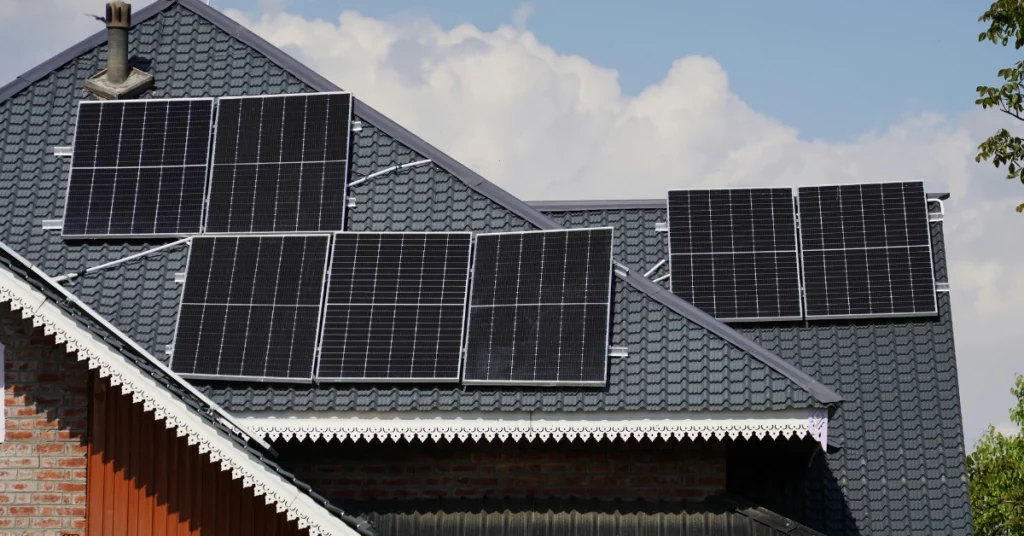
Solar panels are designed to spend decades outdoors, where they can face wind, rain, snow, extreme temperatures, and hail. While most photovoltaic modules can withstand ordinary weather conditions, severe hail can exceed the level of impact covered by standard module certification.
That makes a solar panel hail rating particularly important for projects in hail prone regions.
The U.S. Department of Energy (DOE) notes that PV modules have historically survived most hail events, but very large hail, particularly hail greater than about 1¾ inches (44 mm) in diameter, has caused significant module damage. DOE also identifies severe hail as a major source of insured losses for solar PV systems.
However, simply seeing that a solar panel is “hail certified” does not tell buyers how it will perform during an extreme storm. Standard certification establishes a baseline level of resistance. Enhanced hail testing goes considerably further.
Understanding that distinction can help installers, EPCs, developers, and solar buyers make better equipment and insurance decisions.
Table of Contents
Explore U.S. Solar State Rankings
Compare solar rankings, installed capacity, growth trends, and market performance across all 50 states. Discover regional insights to support smarter procurement and expansion decisions.
What Is a Solar Panel Hail Rating?
A solar panel hail rating describes the impact conditions a PV module has successfully endured during controlled laboratory testing.
Testing typically involves firing manufactured ice balls at specified locations on a module at controlled velocities. The module is then evaluated for physical damage and changes in electrical performance.
One of the most important standards associated with this testing is IEC 61215, which covers design qualification and type approval of terrestrial photovoltaic modules.
DOE specifically recommends checking module hail testing documentation rather than assuming that basic certification provides adequate protection for every location.
That distinction becomes increasingly important as hail size and impact energy increase.
What Is the Standard IEC 61215 Hail Test?
The standard hail test associated with IEC 61215 provides a baseline assessment of module durability.
DOE describes the basic certification test as using 25 mm, approximately 1 inch, diameter ice balls traveling at 23 meters per second, or roughly 51 mph. The module receives 11 impacts at specified locations. To pass the basic hail test described by DOE, the module must remain visually undamaged and experience less than a 5% loss in power.
This test provides a useful minimum qualification.
But there is an important limitation:
A module passing the standard 25 mm hail test has not necessarily demonstrated that it can withstand 40, 50, or 75 mm hailstones.
DOE specifically states that the basic IEC hail certification may be insufficient in severe and very severe hail prone areas.
Standard vs. Enhanced Solar Panel Hail Testing
IEC testing allows larger ice balls to be used at progressively higher velocities.
DOE provides the following test levels:
| Ice ball diameter | Approx. diameter | Ice ball mass | Test velocity | Relative test severity |
|---|---|---|---|---|
| 25 mm | 1.0 in | 7.54 g | 23.0 m/s | Standard/basic certification |
| 35 mm | 1.4 in | 20.7 g | 27.2 m/s | Enhanced |
| 45 mm | 1.8 in | 43.9 g | 30.7 m/s | Enhanced |
| 55 mm | 2.2 in | 80.2 g | 33.9 m/s | Severe impact |
| 65 mm | 2.6 in | 132 g | 36.7 m/s | Very severe impact |
| 76 mm | 3.0 in | 203 g | 39.5 m/s | Extreme test level |

The 25 mm test is the typical baseline used for hail certification. The larger diameter tests are optional.
The difference in severity becomes substantial because larger hailstones are not merely larger, they are dramatically heavier and carry significantly more kinetic energy.
For example, DOE’s table lists a 25 mm test ice ball at just 7.54 grams. A 55 mm ice ball weighs 80.2 grams and is fired at a higher velocity.
Therefore, buyers evaluating modules for high hail risk regions should not compare products based only on whether they are “IEC 61215 certified.” They should determine the actual hail size and velocity the module was tested against.
What Is Enhanced Hail Testing?
Enhanced hail testing goes beyond the minimum certification requirements to evaluate how modules respond to more severe impacts or combinations of environmental stresses.
DOE specifically identifies several advanced testing programs that project developers can consider.
RETC Hail Durability Test
The Renewable Energy Test Center (RETC) has developed enhanced hail durability testing intended to differentiate module resistance beyond minimum certification requirements.
DOE recommends RETC’s Hail Durability Test as one potential advanced test for projects exposed to significant hail risk.
PVEL Hail Stress Sequence
PV Evolution Labs (PVEL) uses a Hail Stress Sequence that incorporates 50 mm hail balls followed by additional stress testing, according to DOE.
The sequence is intended to investigate more than immediately visible glass breakage because hail can create damage that is not obvious during a visual inspection.
FM 4478
FM Global’s FM 4478 provides another approach to evaluating hail resistance, including classifications for different hail severities.
DOE’s severe weather design guidance recommends that projects facing moderate to severe hail risk consider specifying modules meeting advanced requirements such as the FM Global Very Severe Hail Rating, RETC Hail Durability Test, or PVEL hail testing.
ASTM E1038
DOE also identifies ASTM E1038 as a testing method covering hail sizes from approximately 25 to 85 mm, with adjustments related to wind speed.
These enhanced tests can provide considerably more information than a basic pass/fail certification.
Does IEC 61215 Certification Mean a Panel Is Hail Proof?
No.
A certified module has demonstrated that it meets the conditions of the test it passed. Certification does not mean the module is immune to hail of every possible size and velocity.
This distinction matters because real storms can exceed standardized laboratory conditions.
DOE states that most modules currently pass the IEC 61215 hail standard, but field experience shows that hail exceeding the standard can occur in areas with elevated hail risk.
A more useful question for procurement teams is therefore:
“What hail test did this module pass?”
rather than simply:
“Is this module hail certified?”
Ask the manufacturer or supplier for documentation showing:
- Test standard
- Ice ball diameter
- Ice ball mass
- Impact velocity
- Number and location of impacts
- Pass/fail criteria
- Testing laboratory
- Enhanced hail testing results, if available
This provides much more useful information about the module’s tested durability.
Module Certification vs. Independent Reliability Testing
Certification and extended reliability testing serve different purposes.
Standards such as IEC 61215 establish qualification requirements that modules must meet.
Enhanced testing can go beyond those minimum requirements and provide additional information about how different modules respond to more severe environmental stresses.
DOE recommends selecting modules and inverters tested by independent evaluation laboratories and notes that independent laboratories can publish comparative scorecards evaluating equipment under different stress conditions.
For projects in severe weather regions, buyers can therefore consider both:
Required module certification + independent extended reliability testing
rather than relying exclusively on one or the other.
Why Solar Panel Glass Thickness Matters
The module’s physical construction can also influence hail resilience.
DOE recommends selecting modules with at least 3.2 mm front glass for projects where hail resistance is an important consideration and notes that 4.0 mm glass is preferable, although less common.
Thinner glass may use different strengthening processes and can behave differently under impact.
However, glass thickness alone should not be used as a substitute for actual hail testing.
A stronger procurement approach is to evaluate construction specifications alongside documented hail test performance.
Module Size and Frame Design Can Matter
DOE also recommends considering module dimensions and structural support.
Its hail mitigation guidance suggests selecting framed modules and, where possible, designs with stronger frames and additional support bars. It also notes that smaller modules may reduce hail damage risk compared with some larger format modules.
This does not mean every small module will outperform every large module.
Instead, it demonstrates why hail resilience is a system design issue involving:
- Glass
- Module dimensions
- Frame construction
- Structural support
- Mounting
- Tilt
- Testing level
rather than a single specification.
Solar Panel Tilt and Hail Damage
Impact angle can influence how much force a hailstone transfers to a module.
A panel positioned almost horizontally can receive a more direct impact from falling hail than a steeply tilted module.
DOE cites research showing that increasing module tilt can improve survival probability because the hail strikes the glass at a less perpendicular angle.
That does not mean every solar array should simply be installed at an extremely steep angle. Tilt also affects energy generation, wind loading, structural requirements, and system economics.
Instead, hail risk should be one consideration during system design.
Hail Stow for Solar Trackers
Utility scale projects using trackers have another potential defense: hail stow.
A tracker with hail stow functionality can move modules into a steeper position when severe hail is approaching.
The objective is to reduce the angle at which falling hail strikes the module surface.
DOE recommends considering tracker systems capable of hail stow in higher risk areas and notes that some systems can automatically enter their protective position when severe weather is detected.
The effectiveness of any stow strategy depends on tracker design, storm characteristics, wind conditions, forecasting, controls, and the selected stow angle.
Hail Can Damage Solar Panels Without Breaking the Glass
One of the more important limitations of visual inspection is that hail damage is not always obvious.
A module can look intact while its solar cells have developed microcracks.
DOE notes that hail can cause internal cell cracking at impact conditions below those required to visibly break the front glass.
Those cracks may initially have little effect on production but can potentially propagate over time, contributing to reduced output, hot spots, or other reliability concerns.
After a significant hailstorm, DOE recommends considering diagnostic techniques including:
- Infrared imaging
- Ultraviolet fluorescence imaging
- Electroluminescence imaging
Electroluminescence, or EL, imaging is particularly useful for identifying cell cracks that may not be visible from the module surface.
Solar Panel Hail Ratings and Insurance
Hail resistance also has an important financial dimension.
DOE identifies severe hail as a major contributor to insured solar PV losses and recommends that system owners understand exactly how hail is addressed by their insurance coverage.
Insurance terms can vary substantially by insurer, project, geography, and equipment.
Before purchasing or renewing coverage, project owners should determine:
- Whether hail damage is covered
- Whether severe or very severe hail has different terms
- Whether hail is excluded
- Applicable deductibles
- Claim limits or sublimits
- Whether equipment replacement is covered
- Whether business interruption or lost production is covered
- Documentation required after a storm
- Whether particular module or tracker specifications affect underwriting
DOE specifically advises owners of insured and third party owned systems to understand what hail events their policies cover and whether claim amounts are capped.
A module warranty should also not be assumed to replace property insurance. Product warranties and insurance policies cover different risks and contain different terms.
Hail Risk Should Be Evaluated by Location
Not every solar project requires the same level of hail protection.
DOE recommends evaluating local hail exposure before determining appropriate mitigation measures. Its guidance points project teams toward historical severe weather data and risk resources when assessing a site.
For areas experiencing severe or very severe hail, DOE recommends stronger mitigation measures, including modules tested beyond basic IEC requirements.
That creates a risk based procurement strategy:
| Site conditions | Potential procurement approach |
|---|---|
| Low hail exposure | Standard certified modules may be appropriate |
| Moderate hail exposure | Review enhanced test data and module construction |
| Severe hail exposure | Consider advanced hail tested modules |
| Very severe hail exposure | Consider advanced testing, resilient module design, hail stow capability, and insurance requirements |
These categories are general procurement considerations rather than universal engineering requirements. Site specific risk, project design, insurer requirements, and applicable codes should determine the final specification.
What to Look for When Buying Solar Panels
When comparing modules, hail rating should be considered alongside the other specifications that affect performance and project economics.
Important factors include:
- IEC certification
- Enhanced hail test results
- Glass thickness
- Frame construction
- Module dimensions
- Mechanical load ratings
- Efficiency
- Temperature coefficient
- Degradation rate
- Product warranty
- Performance warranty
- Manufacturer support
- Price and availability
Solar professionals can browse solar panels on Sunhub when sourcing modules for upcoming residential, commercial, or utility scale projects.
For projects in hail prone areas, buyers should request the actual hail testing documentation for shortlisted modules rather than relying solely on marketing descriptions such as “hail resistant.”
What Should You Do After a Major Hailstorm?
If modules have suffered visible damage, DOE recommends shutting down the affected system until appropriate visual and electrical inspections can be completed.
Even when glass remains intact, additional inspection may be justified after a severe event.
DOE recommends IR, UV, or EL evaluation within approximately one month after significant hail exposure to identify damage that might not be visible during ordinary inspection.
Having baseline imagery from before the storm can make these inspections more useful because technicians can compare pre event and post event conditions.
For large commercial and utility scale systems, incorporating post storm procedures into the project’s O&M plan can reduce uncertainty and potentially identify problems before they develop into larger failures.
Conclusion
A solar panel hail rating should not be interpreted simply as “hail resistant” or “not hail resistant.”
Standard IEC 61215 hail testing provides an important baseline. DOE describes the basic test as using approximately 25 mm ice balls traveling at 23 m/s, with impacts at 11 module locations.
But severe real world hail can exceed those conditions.
Enhanced testing, including larger IEC hail sizes, RETC’s Hail Durability Test, PVEL’s Hail Stress Sequence, and FM 4478 classifications, can provide additional evidence of module durability for projects facing greater hail exposure.
For solar buyers, developers, and EPCs, the most useful approach is therefore to evaluate the actual test level, not merely whether a module carries standard certification.
Module construction, glass thickness, structural support, array tilt, tracker stow capability, local hail exposure, and insurance coverage should all be considered together.
And in high risk regions, spending more on hail resilient design may need to be weighed against the potential cost of damaged modules, system downtime, lost generation, deductibles, and insurance claims over a project’s operating life.
Frequently Asked Questions
What is the standard solar panel hail rating?
DOE describes the basic IEC 61215 hail test as using 25 mm ice balls traveling at approximately 23 m/s, or about 51 mph, with 11 impacts on specified areas of the module.
Does IEC 61215 mean a solar panel can withstand any hailstorm?
No. Standard certification demonstrates performance under defined test conditions. Real world hailstones can be larger and carry substantially more impact energy than the basic certification test.
What is enhanced hail testing for solar panels?
Enhanced testing subjects modules to more demanding conditions than minimum certification. Examples identified by DOE include larger optional IEC hail tests, RETC’s Hail Durability Test, PVEL’s Hail Stress Sequence, and FM 4478.
Can hail damage a solar panel without cracking the glass?
Yes. DOE notes that hail can create internal cell cracking at impact levels below those required to break the module glass. Techniques such as EL imaging can help detect hidden microcracks.
Does solar panel insurance cover hail?
Coverage depends on the individual insurance policy. DOE recommends verifying whether hail events are covered, whether exclusions apply, and whether claim amounts are capped.
What should I look for when buying panels in a hail prone area?
Look beyond basic certification. Request documentation showing the hail diameter and velocity used during testing, consider enhanced hail test results, evaluate module construction and glass thickness, and review the project’s insurance requirements and site specific hail exposure.
Sources
U.S. Department of Energy: Hail Damage Mitigation for PV Systems
U.S. Department of Energy: Severe Weather Resilience in Solar Photovoltaic System Design
U.S. Department of Energy: PV System Life Cycle: Installation and Commissioning
U.S. Department of Energy: Technical Specifications for On site Solar PV Systems