

Shipping solar panels requires more planning than transporting ordinary goods. Their large dimensions, fragile glass surfaces, and specialized packaging requirements can influence freight rates and delivery arrangements.
For solar installers, distributors, and EPCs, understanding solar panel shipping cost is essential for accurate project budgeting and efficient procurement.
The final cost depends on several factors, including shipment size, transportation distance, freight class, delivery location, and additional handling services.
Table of Contents
What Determines Solar Panel Shipping Cost?
There is no universal shipping rate for solar panels. Freight providers calculate costs based on shipment characteristics and transportation requirements.
The main factors include:
- Shipment weight: Heavier shipments may cost more to transport.
- Pallet dimensions: Oversized pallets occupy additional trailer space and can require specialized handling.
- Shipping distance: Longer routes generally increase transportation costs.
- Freight class: Classification affects less-than-truckload pricing.
- Delivery location: Remote sites or locations without loading docks may incur additional charges.
- Additional services: Liftgate delivery, appointments, and specialized handling can increase the final bill.
Freight rates also depend on carrier capacity, fuel costs, and service availability.
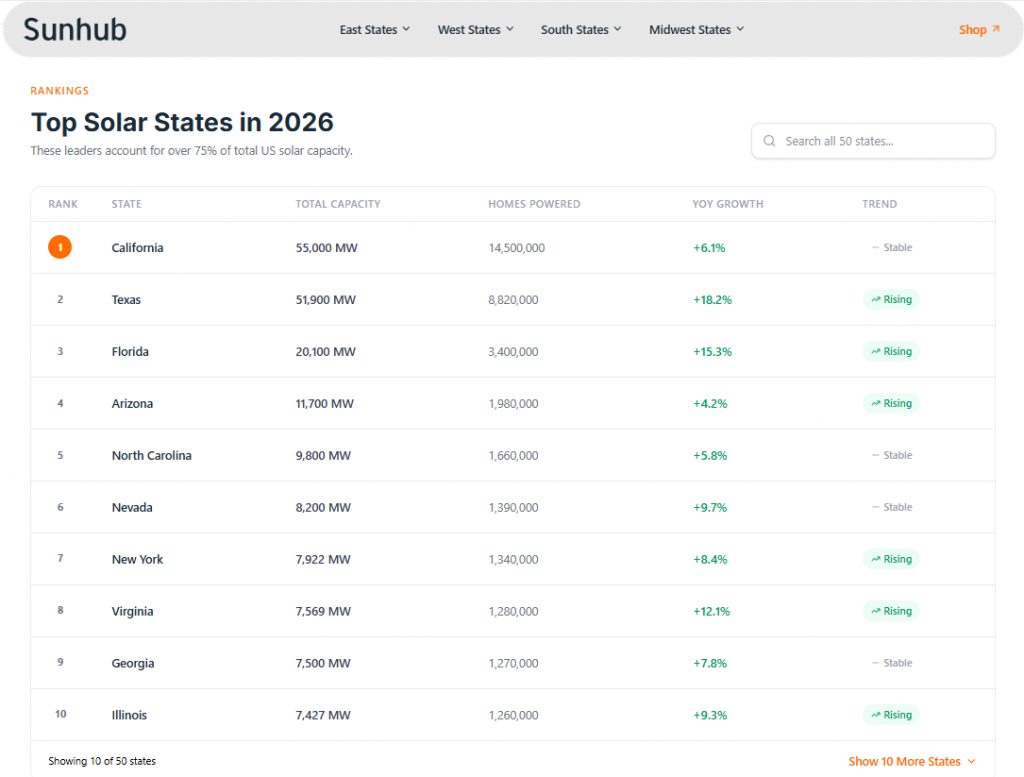
Explore U.S. Solar State Rankings
Compare solar rankings, installed capacity, growth trends, and market performance across all 50 states. Discover regional insights to support smarter procurement and expansion decisions.
LTL vs. FTL Solar Panel Shipping
Choosing the right transportation method can significantly affect total shipping expenses.
Two common options are less-than-truckload (LTL) and full truckload (FTL) shipping.
Less-than-truckload (LTL)
LTL shipping combines freight from multiple customers within the same trailer.
It is generally suitable for smaller solar panel orders that do not require an entire truck.
For example, an installer purchasing two pallets of solar panels may find LTL more economical than paying for a dedicated trailer.
However, LTL shipments may pass through multiple freight terminals, increasing handling and potential damage exposure.
Full truckload (FTL)
FTL shipping reserves an entire trailer for one shipment.
It is commonly used for large commercial and utility-scale solar equipment orders.
Because FTL shipments typically involve fewer transfers between vehicles, they can reduce handling-related risks.
| Feature | LTL shipping | FTL shipping |
|---|---|---|
| Best suited for | Small to medium orders | Large palletized orders |
| Trailer space | Shared with other shipments | Dedicated to one shipment |
| Pricing basis | Freight class, weight, dimensions, route | Trailer, route, capacity, equipment |
| Handling | May involve multiple terminals | Usually fewer transfers |
| Transit time | May be longer | Often more direct |
| Damage exposure | More handling opportunities | Generally fewer handling events |
| Cost advantage | Smaller shipments | Larger consolidated shipments |
FTL is not automatically cheaper for every large order. The best option depends on shipment volume, route, carrier pricing, and available trailer capacity.



How Shipping Distance Affects Freight Costs
Transportation distance is a major factor in solar panel shipping cost.
A shipment traveling between nearby warehouses will generally cost less than one moving across several states.
However, distance alone does not determine pricing.
Freight rates also depend on route demand, carrier availability, fuel surcharges, and whether the destination is accessible using standard equipment.
For example, delivery to a commercial warehouse near a major transportation corridor may be easier to arrange than delivery to a remote solar construction site.
Installers should provide accurate pickup and destination ZIP codes when requesting freight estimates.
Understanding Solar Panel Freight Class
Freight class is a classification system used in LTL shipping to determine how difficult or costly a shipment is to transport.
The National Motor Freight Traffic Association (NMFTA) establishes freight classifications through the National Motor Freight Classification (NMFC) system.
Freight class considers four characteristics:
- Density: Shipment weight relative to occupied space.
- Handling: How easily the freight can be moved.
- Stowability: How efficiently it fits alongside other shipments.
- Liability: Its susceptibility to damage or potential to damage other cargo.
Freight classes range from 50 to 500.
Solar panels may require special consideration because of their dimensions, glass construction, and packaging.
Importantly, there is no single freight class that applies to every solar panel shipment. The correct classification depends on the applicable NMFC provisions and shipment characteristics.
Incorrect classification can result in reclassification fees and unexpected freight charges.
Additional Delivery Fees to Consider
The initial freight quote may not include every service required at the destination.
Common additional charges include:
| Fee | When it may apply |
|---|---|
| Liftgate service | Delivery location lacks a loading dock or suitable unloading equipment |
| Residential delivery | Shipment is delivered to a residential address |
| Limited-access delivery | Construction sites or restricted facilities require special arrangements |
| Delivery appointment | Carrier must coordinate a specific receiving window |
| Inside delivery | Freight must be moved beyond the standard unloading point |
| Detention or waiting time | Driver experiences delays beyond the allowed unloading period |
Liftgate fees
A liftgate is a hydraulic platform attached to a delivery truck that lowers freight from trailer height to ground level.
Liftgate service may be necessary when the recipient lacks a loading dock or forklift.
However, solar panel pallets can be oversized or too heavy for standard liftgates.
Before requesting this service, confirm the pallet’s gross weight, dimensions, and the carrier’s liftgate capacity.
For construction sites receiving multiple pallets, arranging suitable unloading equipment may be more practical.
How to Prevent Solar Panel Shipping Damage
Solar modules contain glass and delicate electrical components that can be damaged during transportation.
Proper packaging and handling are therefore essential.
Use manufacturer-approved packaging
Whenever possible, transport panels in their original manufacturer packaging.
Protective corners, reinforced bases, dividers, and securing materials help prevent movement and impact damage.
Secure pallets correctly
Pallets should be stabilized using appropriate straps and protective materials.
Avoid placing excessive pressure on module glass or frames.
Follow the manufacturer’s approved orientation and stacking instructions rather than assuming all modules can be transported identically.
Reduce unnecessary handling
Consolidating shipments and selecting appropriate freight services can reduce transfers between vehicles.
This is particularly important for large or high-value solar panel orders.
Inspect shipments upon delivery
Receiving teams should examine packaging for visible damage before accepting delivery.
Photograph damaged pallets, document discrepancies on the delivery receipt, and follow the carrier’s claims procedures.
Because concealed damage may not be immediately visible, inspections should also follow manufacturer recommendations.
How to Estimate Solar Panel Shipping Costs
Accurate freight estimates begin with reliable shipment information.
Before requesting a quote, gather the following details:
- Pickup and delivery ZIP codes
- Number of pallets
- Packed pallet dimensions
- Gross shipment weight
- Applicable freight classification
- Required delivery date
- Loading dock or forklift availability
- Additional delivery services
Solar professionals can use the Sunhub Freight Estimator to help plan transportation expenses when sourcing solar equipment.
Comparing freight estimates alongside equipment pricing provides a clearer understanding of total procurement costs.
Conclusion
Solar panel shipping cost depends on more than the distance between the supplier and installation site.
Shipment dimensions, weight, freight class, transportation method, and delivery requirements all influence the final price.
LTL shipping can be economical for smaller orders, while FTL may offer advantages for larger shipments that benefit from dedicated transportation and fewer handling events.
Additional charges, including liftgate and limited-access delivery fees, should also be considered before finalizing a freight budget.
By using accurate shipment specifications, selecting appropriate transportation services, and following proper damage-prevention practices, solar professionals can improve delivery reliability and control project logistics costs.
Frequently Asked Questions
Is LTL or FTL cheaper for shipping solar panels?
LTL is generally more economical for smaller shipments, while FTL may provide better value for larger orders. Actual costs depend on the route, pallet quantity, and carrier rates.
What is a liftgate fee?
A liftgate fee is an additional charge for using a truck-mounted hydraulic platform to unload freight when a suitable loading dock is unavailable.
Does freight class affect solar panel shipping costs?
Yes. Freight class influences LTL rates based on shipment density, handling, stowability, and liability characteristics.
How can solar panels be protected during shipping?
Use manufacturer-approved packaging, secure pallets properly, minimize unnecessary handling, and inspect shipments immediately upon delivery.