

Solar energy is no longer just panels bolted to a roof or field. In 2026, new solar panel technology is driving dramatic improvements in how we capture, store, and use sunlight. Ongoing breakthroughs in materials, design, integration with storage and smart systems, and entirely new concepts are making solar more efficient, more versatile, and more accessible than ever before. These technologies matter not only for homeowners and commercial developers but for utilities, grid operators, architects, and energy planners alike.
In this blog, you’ll learn what’s new in solar panel technology, how these innovations work, why they matter, and what impact they will have on energy generation in the coming decade.
How solar panels convert sunlight to electricity
At its core, a solar panel uses photovoltaic (PV) cells to convert sunlight into electricity. When photons from the sun strike the cell surface, they knock electrons loose in a semiconductor material, creating a flow of electricity. Traditional solar panels use silicon as their semiconductor material. Over decades, improvements in silicon processing and cell architectures have steadily increased conversion efficiency, the percentage of sunlight a panel can turn into usable power.
Emerging technologies aim to go beyond the limits of conventional silicon cells by using new materials, layering different materials together, and integrating solar functions directly into building materials or smart energy systems.
Efficiency gains and new cell designs
Efficiency, the proportion of sunlight that becomes electricity, remains a central focus of solar innovation.
Next-generation tandem cells
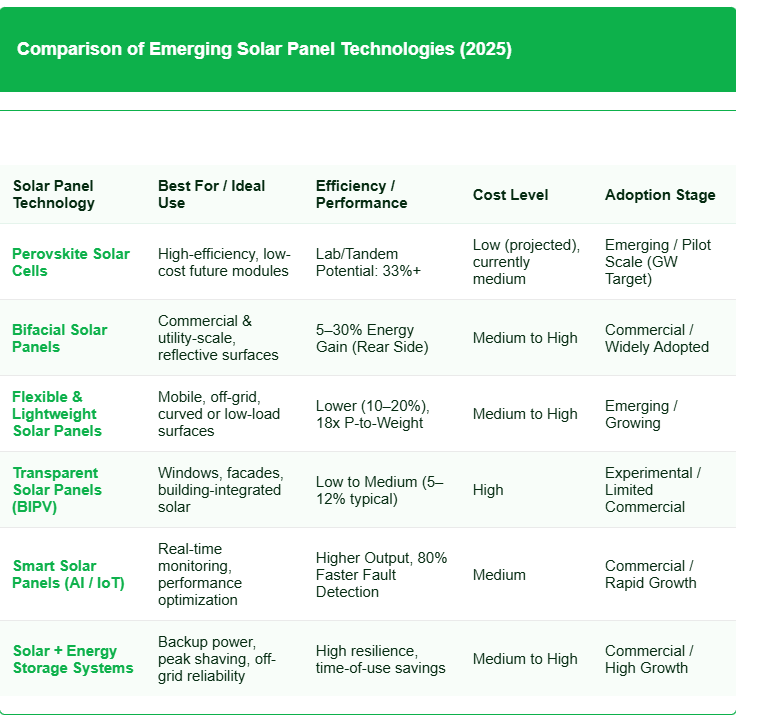
One of the most exciting developments in solar technology today is the rise of tandem solar cells. A tandem solar cell stacks two or more photovoltaic materials with different light-absorption properties. For example, a layer of perovskite on top of traditional silicon enables each material to capture different parts of the solar spectrum. Silicon excels at absorbing lower-energy (infrared) light, while perovskites efficiently capture higher-energy (visible) light. That combination increases overall conversion efficiency beyond what either material could achieve alone.
Lab and early commercial tandem cells are already pushing efficiency levels well above 30 percent, a significant leap compared with conventional silicon modules that typically achieve around 20–25 percent in real projects today.
Commercial companies such as Oxford PV and Trina Solar are producing perovskite-silicon tandem prototypes with high efficiencies and real-world promise. As these designs scale and manufacturing challenges are solved, tandem cells could become a new standard for both rooftop and utility-scale installations. (Spectrum Energy Systems)
Advanced silicon technologies
Before tandem cells fully take hold, improvements in silicon-based technologies continue to push the performance of mainstream modules:
- TOPCon cells (Tunnel Oxide Passivated Contact): enhance charge collection and reduce recombination losses to achieve higher efficiencies and lower degradation.
- HJT cells (Heterojunction Technology): combine crystalline silicon with ultra-thin amorphous layers to improve efficiency and temperature performance, making them especially suited for hot climates.
These advancements bolster today’s commercial solar modules, helping drive efficiency closer to theoretical limits set by physics.
New materials and unconventional designs
Perovskite technology
Perovskite solar cells use a class of materials that can be processed at lower temperatures and with simpler manufacturing methods than silicon. This flexibility has opened new possibilities for lightweight, flexible, and low-cost panels. Perovskite layers are being integrated into tandem structures with silicon to dramatically expand overall performance.
Researchers are also experimenting with all-perovskite cells and hybrid materials, which could one day rival or exceed silicon’s dominance in efficiency and cost. While challenges such as long-term stability and environmental sensitivity remain, steady progress suggests perovskite modules may become common within the next decade.
Flexible and lightweight solar panels
Traditional solar panels are rigid and heavy, limiting how and where they can be installed. New flexible PV materials, often based on perovskites or thin-film technologies, can bend around curved surfaces, adhere to non-flat structures, or be incorporated into fabrics and portable systems. These designs expand solar’s applications into areas such as vehicle roofs, tents, portable power stations, and wearable electronics.



Capturing more sunlight with innovative configurations
Bifacial solar panels
Unlike traditional monofacial panels that collect light from one side only, bifacial panels capture sunlight on both the front and back surfaces. Reflected light from the ground, nearby structures, or light-colored surfaces can add significant additional power, sometimes boosting electricity production by up to 30 percent compared with traditional designs.
Bifacial technology has moved from a premium option to a mainstream choice in 2026, particularly in commercial and utility installations where reflected light opportunities are plentiful.
Transparent and building integrated PV
Another emerging design is transparent solar panels, which incorporate photovoltaic materials into windows, skylights, and other architectural features without blocking light. These semi-transparent panels can turn building façades and glass surfaces into electricity generators, blending aesthetics with function.
Building-integrated photovoltaics (BIPV) go further by embedding solar cells directly into building materials like roof tiles and façade panels. BIPV eliminates separate panel racks and integrates generation into the structure itself, making solar power generation part of everyday construction.
Energy storage and smarter solar systems
Solar panels generate power only when the sun shines. To make that power available when needed, at night or during cloudy periods, energy storage technologies are increasingly integrated with solar systems.
Energy storage systems, including advanced lithium-ion and emerging flow battery technologies, are becoming standard parts of solar installations. These systems hold excess power generated during peak sunlight for use later, reducing utility costs and increasing energy independence.
AI and sensor systems are also being built into new solar panel arrays, enabling smart solar functions such as real-time performance monitoring, predictive maintenance alerts, automated angle optimization, and integration with home or commercial energy management systems. This makes solar panels not just electricity producers but active participants in intelligent energy networks.
Sustainability and long-term lifecycle improvements
As solar capacity grows worldwide, so does attention to lifecycle and sustainability. New panel technologies focus not only on efficiency but also on materials that are recyclable or have reduced environmental impact. Initiatives that recycle old solar modules into new products, or repurpose materials in second-life applications, are gaining traction as solar installations reach the end of their useful lives.
Projects such as solar recycling initiatives in India highlight how used modules can be upcycled into energy-efficient tools for agriculture, demonstrating the potential for circular economy practices in solar technology.
Real world impact of emerging technologies
The combination of these innovations moves solar energy toward higher performance, lower cost, and broader application. For homes, this means smaller arrays can generate more power. For commercial and utility projects, higher-efficiency panels and bifacial designs increase energy yield and reduce land usage per megawatt installed. For architecture and urban design, BIPV and transparent panels turn windows and façades into energy generators, expanding the reach of solar power into everyday infrastructure.
While traditional crystalline silicon panels still dominate the market, new technologies like tandem cells and smart PV systems are poised to drive the next wave of solar adoption, pushing conversion efficiencies higher and enabling solar to compete more effectively with conventional energy sources.
Concluding thoughts
New solar panel technology in 2026 represents one of the most dynamic periods in the evolution of renewable energy. Innovations in cell design, material science, energy storage integration, and smart energy systems are expanding the capabilities and applications of solar power. As costs fall, efficiencies rise, and integration becomes more intelligent, solar energy continues its transformation from a supplementary option to a central pillar of global energy systems.
Whether you are considering solar for your home, business, or community project, understanding these emerging technologies helps you make informed decisions that maximize both performance and long-term value.
Sources:
Latest trends in solar panel technology for 2026. (GreenLancer)
Commercial advancements in tandem and bifacial technology. (Spectrum Energy Systems)
Efficiency and material innovations in solar cells. (Rayzon Solar)