
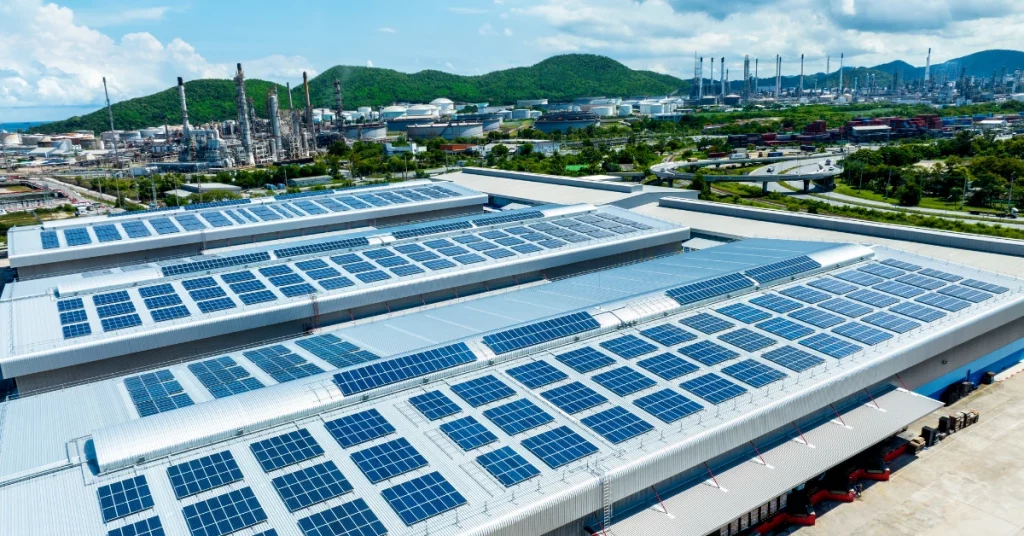
Solar panels can operate effectively in cold climates, but winter introduces a structural challenge that has little to do with electricity generation: the weight of accumulated snow and ice.
During severe winter weather, snow can place substantial downward pressure on photovoltaic modules, their mounting systems, and the structure supporting the array. The U.S. Department of Energy (DOE) warns that sufficiently heavy accumulation can cause modules to warp or break, while ice can add weight and redistribute loads across the system.
This is where a solar panel snow load rating becomes important.
Module datasheets commonly express mechanical load capacity in pascals (Pa). But a 5,400 Pa module does not mean every roof equipped with that panel can safely support the equivalent snow load. Module strength is only one part of the structural system.
Racking, attachment points, roof construction, local snow conditions, array tilt, mounting configuration, and engineering calculations all need to work together.
Table of Contents
What Is a Solar Panel Snow Load Rating?
A solar panel snow load rating indicates how much mechanical pressure a module has been qualified to withstand under specified test and mounting conditions.
DOE notes that PV modules are typically certified according to IEC 61215 and that their load ratings are generally expressed in pascals. A typical module rating cited by DOE is 2,400 Pa, while the agency recommends selecting modules certified for at least 5,000 Pa in locations at risk of heavy snow accumulation.
The rating can typically be found in:
- The solar panel datasheet
- The manufacturer’s installation manual
- Mechanical load documentation
- Certification documentation
However, buyers should not stop at the headline number.
The actual allowable load can depend on exactly how and where the module is attached to its racking system.
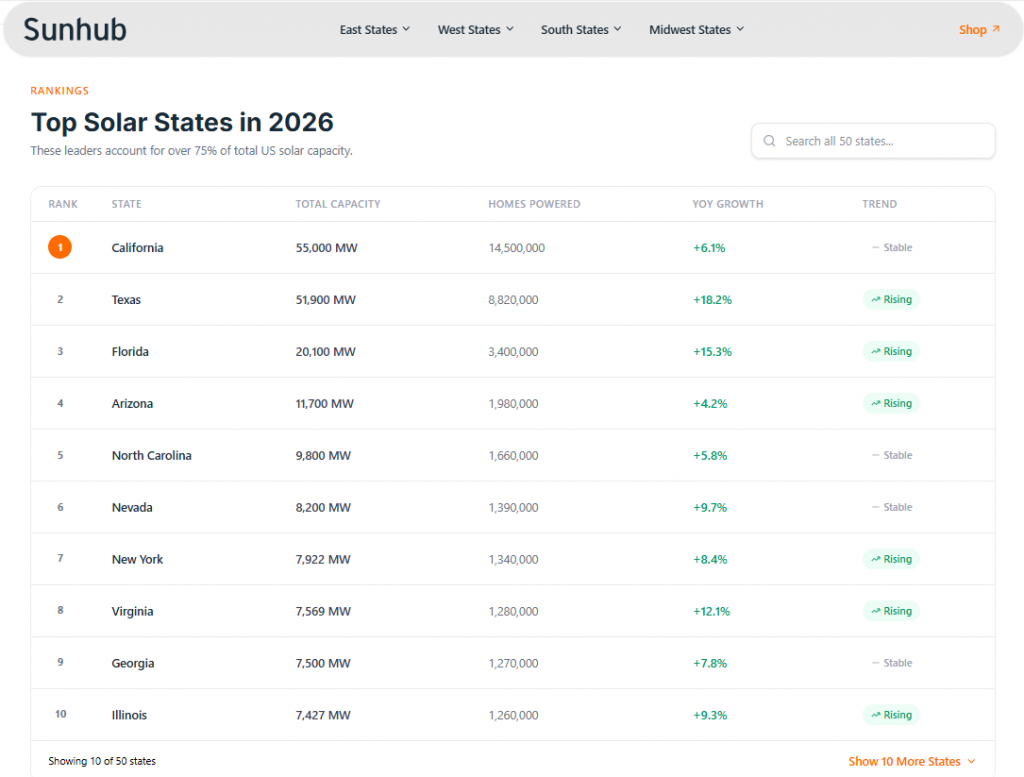
Explore U.S. Solar State Rankings
Compare solar rankings, installed capacity, growth trends, and market performance across all 50 states. Discover regional insights to support smarter procurement and expansion decisions.
What Does Pa Mean on a Solar Panel?
Pa stands for pascal, the SI unit of pressure.
One pascal equals one newton of force distributed over one square meter:
1 Pa = 1 N/m²
Solar module mechanical load ratings commonly run into the thousands of pascals.
For example:
2,400 Pa = 2.4 kPa
5,400 Pa = 5.4 kPa
A higher Pa rating generally indicates that the module has demonstrated resistance to greater pressure under the applicable test conditions.
DOE’s severe weather guidance, for example, recommends minimum module pressure ratings of 5,400 Pa on the front side and 3,600 Pa on the back side for enhanced resilience.
Common Solar Panel Load Ratings Explained
The following table illustrates several ratings buyers may encounter and how they should be interpreted.
| Mechanical load rating | Approx. pressure | General interpretation |
|---|---|---|
| 2,400 Pa | 2.4 kPa | Common baseline module load rating cited by DOE |
| 3,600 Pa | 3.6 kPa | Higher mechanical load capability |
| 5,000 Pa | 5.0 kPa | DOE recommended minimum certification level for locations at risk of heavy snow |
| 5,400 Pa | 5.4 kPa | High front load rating commonly seen on stronger modules |
| 6,000 Pa+ | 6.0 kPa+ | Higher load module design; installation conditions still need verification |


A higher number does not automatically mean the entire installed solar system can withstand that pressure.
The rating applies to the module under defined test and mounting conditions. The roof, attachments, rails, fasteners, and supporting structure must be evaluated separately.
Front Load vs. Rear Load Ratings
One detail that can be confusing on solar panel datasheets is the presence of two different mechanical load ratings.
For example, a panel might specify:
Front load: 5,400 Pa
Rear load: 2,400 or 3,600 Pa
The difference exists because the forces acting on the two sides of a solar panel are not necessarily the same.
Front load rating
The front load rating generally describes pressure pushing against the glass side of the module.
Snow is one of the primary examples.
Accumulated snow presses downward against the front surface of an array. Heavy snow and ice can therefore test the module’s ability to resist bending, frame deformation, glass damage, and cell cracking.
DOE’s severe weather guidance recommends 5,400 Pa front load capability as an enhanced specification.
Rear load rating
The rear load rating describes pressure or pulling forces acting in the opposite direction.
Wind uplift is a major consideration.
Strong winds can create suction forces underneath an array, effectively attempting to pull modules away from their mounting structure.
DOE’s severe weather design guidance recommends 3,600 Pa back load capability for enhanced resilience.
This means a specification such as:
+5,400 Pa / -3,600 Pa
should not automatically be interpreted as two different snow ratings.
The positive/front rating generally relates to downward pressure, while the negative/rear rating represents uplift or pressure in the opposite direction.
Solar Panel Front and Rear Loads Compared
| Rating | Direction of force | Common weather concern | DOE enhanced resilience example |
|---|---|---|---|
| Front load | Pressure against front/glass side | Snow and downward wind pressure | 5,400 Pa |
| Rear load | Pressure/uplift against rear side | Wind uplift | 3,600 Pa |
Both matter because winter storms rarely create snow loads in complete isolation.
DOE specifically recommends considering combined snow and wind loads when designing PV systems because the hazards can occur together.
Why a 5,400 Pa Rating Does Not Mean Your Roof Can Support 5,400 Pa
This is one of the most important distinctions when evaluating solar panel snow load.
A module’s mechanical load rating describes the tested strength of the module under specified conditions.
It does not certify the building underneath it.
A rooftop PV installation creates a load path:
Snow → solar module → clamps → rails/racking → roof attachments → roof structure → building
Every component in that chain must safely transfer the expected forces.
A module capable of surviving heavy snow is of little benefit if its clamps fail, rails deform, roof attachments pull out, or the building structure cannot safely carry the load.
DOE emphasizes that PV system design needs to account for module selection, racking parameters, module to rack and rack to roof attachments, system layout, and structural or foundation design.
Why Mounting Configuration Changes the Load Rating
A panel’s maximum mechanical load rating may depend on how it is installed.
DOE specifically advises buyers and designers to consult the module installation manual for the static snow load rating associated with the actual mounting configuration being used.
Consider a module tested with four attachment points positioned within specific manufacturer approved clamping zones.
Moving those clamps to different locations could change how forces are distributed through the frame.
Adding appropriately engineered support points can sometimes increase load resistance.
DOE cites a particularly useful example from Mount Rainier National Park. After severe winter conditions crushed modules mounted with four attachment points, the damaged equipment and racking were replaced with a configuration using eight attachment points and additional support underneath the modules. The redesigned system survived the following winter without damage.
The lesson is straightforward:
A module’s load rating cannot be separated from its mounting instructions.
Why Racking Matters for Solar Panel Snow Load
The racking system transfers loads from the modules to the building or ground mounted foundation.
Its design therefore has a direct impact on the structural resilience of the array.
DOE recommends considering thicker gauge racking in winter weather regions because a more robust structure is more likely to withstand heavy snow and ice.
Racking design can involve:
- Rail dimensions
- Material thickness
- Rail spacing
- Number of rails
- Clamp locations
- Attachment spacing
- Fastener strength
- Cross bracing
- Cantilever distances
- Roof attachments
- Foundation design
Reducing excessive cantilevers can also help improve structural performance.
Simply purchasing a high load module while pairing it with inadequately engineered racking does not create a high load PV system.
Why Roof Engineering Matters
For rooftop solar, snow loading must be evaluated at the building level.
DOE explains that site specific snow loads are commonly determined using ASCE 7, which establishes ground snow loads and methods for converting them into applicable roof snow loads based on site and building conditions.
A structural analysis may need to account for factors such as:
- Local ground snow load
- Roof geometry
- Roof slope
- Building exposure
- Thermal conditions
- Snow drifting
- Unbalanced snow
- Existing roof capacity
- Solar array dead load
- Racking and attachment weight
- Snow accumulation around the array
The engineering question is therefore not simply:
“Can this solar panel handle snow?”
It is:
“Can this complete module racking roof system safely withstand the loads expected at this particular site?”
Snow Is Not Always Distributed Evenly
A major mistake is assuming that snow creates perfectly uniform pressure across every module.
Solar panels are generally tilted.
As snow begins to move down the module, it can accumulate toward the lower edge and place greater stress on that portion of the frame.
DOE specifically warns designers not to assume uniform loading. The agency notes that snow accumulation on tilted modules can place greater stress on the lower portion of the module.
IEC 62938 addresses the load bearing capability of framed modules subjected to non uniform snow loads.
This matters because a module that performs well under a uniform laboratory pressure may experience a different stress pattern when real snow piles unevenly along its lower frame.
Module Size Can Affect Snow Load Resistance
Module dimensions can also influence structural behavior.
DOE notes that smaller modules can typically withstand higher loads.
Large format modules have become increasingly common because they can offer high wattage and reduce the number of modules required for a project.
But when designing for heavy snow, wattage should not be the only procurement consideration.
Buyers should compare:
- Module dimensions
- Frame thickness
- Glass construction
- Mechanical load rating
- Approved clamp zones
- Number of support points
- Installation requirements
A physically larger, higher wattage panel is not automatically structurally preferable for every high snow environment.
Framed vs. Frameless Modules
Snow behavior can also differ between framed and frameless modules.
Framed modules may retain snow near their lower edge because the frame can act as a small barrier.
Frameless modules can potentially shed snow more easily.
However, DOE warns that frameless modules may have lower snow and wind load ratings than framed alternatives and recommends prioritizing the actual mechanical load rating over snow shedding ability alone.
That means procurement teams should not choose a module simply because its construction appears more likely to shed snow.
The documented structural rating comes first.
Does Panel Tilt Reduce Snow Load?
Tilt can help.
DOE states that higher module tilt angles can allow snow to shed more quickly while also reducing the amount of snow weight transferred to the module.
However, increasing tilt introduces another structural consideration:
wind.
A steeper array can experience greater wind loads.
Therefore, engineers need to balance:
Snow shedding + solar production + wind loading + structural cost
rather than optimizing exclusively for one variable.
For tracker systems, DOE recommends considering a snow stow mode, which moves panels to a steeper angle during heavy snowfall to encourage shedding. The system still needs to be engineered for a worst case situation in which the tracker cannot move or snow cannot shed.
Ice Can Create Additional Structural Loads
Snow is not the only winter load that matters.
Ice can accumulate on modules, racking, wiring, and other system components.
DOE notes that ice can both add weight and redistribute loads across a PV system, potentially overstressing module frames and supporting structures.
For racking, DOE recommends treating the structure as an ice sensitive structure under ASCE 7 where appropriate.
Snow can also melt and refreeze, producing ice dams or concentrated loads.
A winter resilient design therefore needs to consider:
snow + ice + wind
rather than treating snow load as an isolated number on a panel datasheet.
Can Heavy Snow Damage Solar Cells Without Breaking the Glass?
Yes.
A panel does not necessarily need visibly shattered glass to suffer mechanical damage.
DOE notes that heavy mechanical loads can create invisible cracks within solar cells. If cracks propagate, they can contribute to reduced production and potentially other reliability concerns.
This is another reason mechanical load specifications matter.
A module may appear intact after a severe winter event while still requiring further evaluation if it experienced loads beyond its design conditions.
How to Read a Solar Panel Datasheet for Snow Load
When evaluating a module, look for specifications labeled:
Mechanical Load
Static Load
Front Load
Rear Load
Snow Load
or similar terminology.
You might encounter something like:
Maximum front static load: 5,400 Pa
Maximum rear static load: 2,400 Pa
Do not immediately assume those numbers apply to every possible installation.
Next, open the manufacturer’s installation manual and determine:
- Which mounting configurations support the stated load.
- Where clamps must be positioned.
- How many attachment points are required.
- Whether different clamp zones have different allowable loads.
- Whether rails or supports must be positioned in specified locations.
- Whether the rating represents a test load or allowable/design load.
That last distinction is particularly important because manufacturers and certification documentation may distinguish between tested mechanical loads and allowable design loads.
What Solar Buyers Should Compare
For projects exposed to significant winter weather, module procurement should include more than wattage and efficiency.
A useful comparison includes:
| Specification | Why it matters |
|---|---|
| Front mechanical load rating | Indicates resistance to downward pressure such as snow |
| Rear mechanical load rating | Indicates resistance to uplift, particularly wind |
| IEC 61215 certification | Provides standardized module qualification |
| Approved mounting configuration | Determines whether the stated load rating applies |
| Clamp zones | Affect how forces transfer through the frame |
| Module dimensions | Influence structural behavior |
| Frame design | Helps resist deformation |
| Glass construction | Influences mechanical durability |
| Racking compatibility | Ensures loads can transfer properly |
| Warranty | Determines applicable manufacturer coverage |
Installers, EPCs, developers, and other solar professionals can also browse solar panels on Sunhub when sourcing modules for upcoming projects.
For snow prone sites, buyers should obtain the manufacturer’s installation manual and mechanical load documentation before finalizing equipment selection.
Solar Panel Rating vs. Site Snow Load
It is important not to compare a panel’s Pa rating directly with a weather forecast or measured snow depth.
Ten inches of light, dry snow and ten inches of dense, wet snow do not create the same load.
Likewise, snow can drift, compact, melt, refreeze, and accumulate unevenly.
Site snow load requirements should therefore come from the project’s structural design process rather than an informal conversion from inches of snowfall into pascals.
DOE recommends using applicable ASCE 7 procedures to determine snow loads for the specific location and structure.
How to Improve PV Resilience in Heavy Snow Areas
DOE’s winter weather guidance points to several strategies for improving PV resilience.
Higher mechanical load modules can provide additional structural capacity. Stronger racking and additional module support can improve load transfer. Increased tilt can encourage snow shedding, while adequate ground clearance can prevent shed snow from accumulating against the lower edge of ground mounted arrays.
Designers should also consider frost depth for ground mounted foundations, ice accumulation, wind loading, snow drifting, and non uniform loading.
The key is treating winter resilience as a system level engineering problem, rather than attempting to solve it through module selection alone.
Conclusion
A solar panel snow load rating tells you how much mechanical pressure a module has been qualified to withstand under specified conditions.
These ratings are expressed in pascals (Pa).
DOE notes that 2,400 Pa is a typical module load rating and recommends modules certified for at least 5,000 Pa in locations at risk of heavy snow accumulation. Its broader severe weather guidance identifies 5,400 Pa front load and 3,600 Pa back load ratings as enhanced module specifications.
But the module rating is only the beginning.
Front load ratings primarily help describe resistance to forces such as snow pressing against the module face. Rear load ratings are particularly relevant to forces such as wind uplift.
Neither number tells you whether the entire installed system is structurally adequate.
Snow loads ultimately travel through the module, clamps, rails, roof attachments, and building structure. The mounting configuration can even change the load a particular module is allowed to withstand.
For that reason, high snow projects need coordination between module selection, racking design, manufacturer mounting requirements, local snow load calculations, and structural roof engineering.
A 5,400 Pa panel does not create a 5,400 Pa roof.
The complete system has to be engineered to carry the load.
Frequently Asked Questions
What does 5,400 Pa snow load mean on a solar panel?
It indicates that the module has been tested or rated for a specified front mechanical pressure under defined conditions. The manufacturer’s documentation should be checked to determine the applicable mounting configuration and whether the figure represents a test or allowable design load.
Is 2,400 Pa enough for snow?
It depends on the location and project. DOE describes 2,400 Pa as a typical module rating but recommends modules certified to withstand at least 5,000 Pa in locations at risk of heavy snow accumulation.
What is the difference between front and rear solar panel load ratings?
Front load ratings describe pressure against the module’s front surface and are particularly relevant to snow. Rear load ratings describe loading in the opposite direction and are particularly relevant to wind uplift. DOE’s enhanced resilience recommendations identify 5,400 Pa front and 3,600 Pa back pressure ratings.
Does a higher Pa rating mean a solar panel is better?
Not universally. A higher mechanical load rating can be valuable in severe weather regions, but module efficiency, electrical characteristics, temperature performance, degradation, warranty, dimensions, cost, and compatibility also matter.
Does the solar panel snow load rating include the roof?
No. The module’s rating applies to the panel under specified test and mounting conditions. The racking, attachments, roof, and supporting building structure require their own engineering evaluation.
Can changing the mounting points affect a panel’s snow load rating?
Yes. DOE specifically recommends consulting module installation manuals for the static snow rating associated with the mounting configuration being used. Additional mounting points can sometimes increase load capacity.
Can snow damage a panel even if the glass does not break?
Yes. Heavy mechanical loads can cause cell microcracks that may not be visible from the outside. DOE identifies invisible cell cracking as one potential consequence of heavy loading.
Sources
U.S. Department of Energy: Solar Photovoltaic Hardening for Resilience: Winter Weather
U.S. Department of Energy: Severe Weather Resilience in Solar Photovoltaic System Design
U.S. Department of Energy: PV System Owner’s Guide to Weather Vulnerabilities, Risks, and Impacts