

As the solar industry expands, understanding where equipment comes from has become increasingly important. Solar panels pass through multiple manufacturing stages, often involving suppliers across different countries. Without reliable documentation, identifying the origin of materials and verifying responsible sourcing practices can be challenging.
Solar supply chain traceability helps manufacturers, developers, and equipment buyers track materials from their original sources through production and delivery.
For U.S. solar businesses, traceability also supports procurement decisions, regulatory due diligence, and supply-chain risk management.
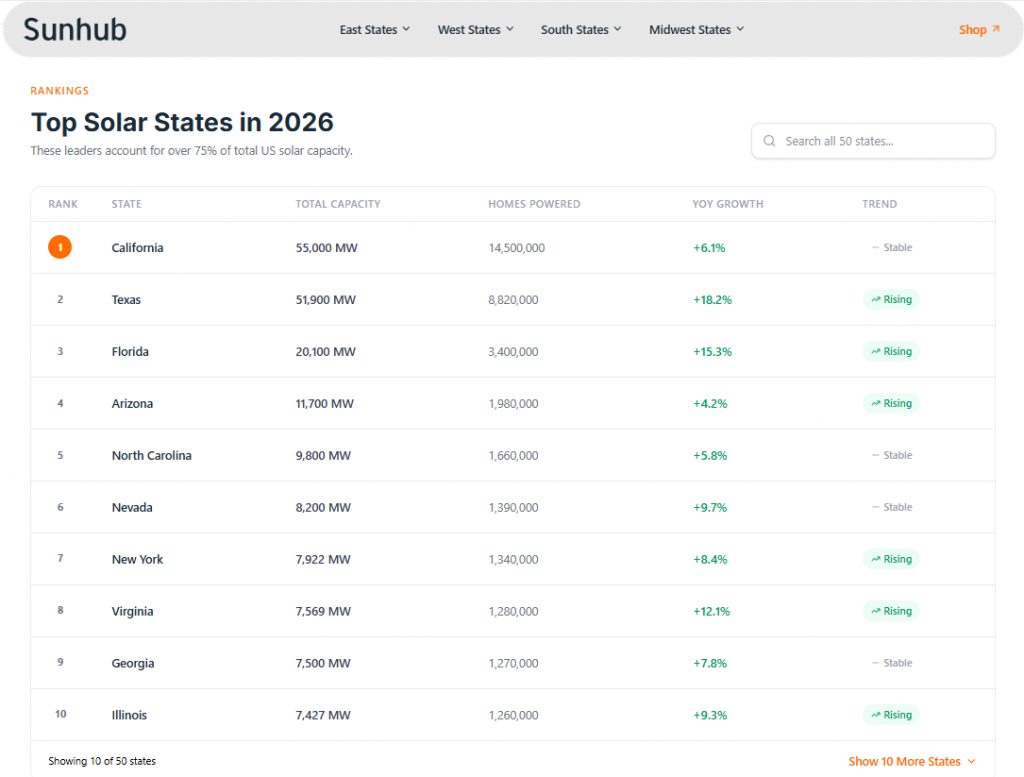
Explore U.S. Solar State Rankings
Compare solar rankings, installed capacity, growth trends, and market performance across all 50 states. Discover regional insights to support smarter procurement and expansion decisions.
Table of Contents
What Is Solar Supply Chain Traceability?
Solar supply chain traceability is the process of tracking materials, components, and products through each stage of the solar manufacturing and distribution process.
It involves documenting where materials originate, which companies process them, and how they move between facilities.
For photovoltaic (PV) modules, traceability is particularly important because manufacturing involves several distinct production stages.
A reliable traceability system connects supplier information with manufacturing records, transactions, and shipment documentation.
The objective is to establish a verifiable history of the materials used in a finished solar product.
How the Solar Panel Supply Chain Works
Most crystalline silicon solar panels move through several production stages before reaching an installer or developer.
| Supply chain stage | Primary activity | Traceability information |
|---|---|---|
| Raw material extraction | Quartzite mining | Mine location and supplier |
| Silicon production | Metallurgical-grade silicon processing | Production facility and material origin |
| Polysilicon manufacturing | Production of purified silicon | Manufacturer and production records |
| Ingot production | Silicon crystal formation | Material batches and facility details |
| Wafer manufacturing | Cutting silicon into wafers | Batch identification and supplier |
| Solar cell production | Converting wafers into photovoltaic cells | Cell manufacturer and production records |
| Module assembly | Combining cells into finished panels | Module manufacturer and component records |
| Distribution | Shipping equipment to buyers | Shipment, warehouse, and transaction records |
Traceability becomes more complicated when materials from different suppliers enter the same manufacturing process.
Without consistent recordkeeping, connecting a finished module to its upstream material sources may be difficult.

What Is the Solar Stewardship Initiative?
The Solar Stewardship Initiative (SSI) is a multistakeholder initiative focused on improving environmental, social, governance, and traceability practices across the solar value chain.
In December 2024, SSI published its Supply Chain Traceability Standard, establishing a framework for tracking silicon and other photovoltaic semiconductor materials.
The standard complements the SSI Environmental, Social and Governance (ESG) Standard.
While the ESG Standard evaluates responsible practices at manufacturing sites, the traceability standard focuses on identifying material origins and documenting their movement.
Both standards are mandatory within SSI’s manufacturing-member certification framework.
In March 2026, SSI announced its first two manufacturing-site certifications under the Supply Chain Traceability Standard.
These certifications demonstrate that the assessed sites have established traceability systems. They do not automatically mean every product leaving those facilities has a fully certified upstream supply chain.
Understanding Chain of Custody in Solar Manufacturing
A central concept in solar supply chain traceability is chain of custody (CoC).
Chain of custody refers to the documented sequence of physical and legal possession of materials as they move through the supply chain.
The SSI standard establishes a segregation-based chain-of-custody model for specified silicon supply-chain stages.
Under this approach, certified materials must remain separate from uncertified materials.
Materials from multiple certified sources may be combined when the applicable certification requirements are satisfied.
This distinction helps preserve the integrity of material-origin claims.
An effective chain-of-custody system can also make it easier to identify affected products when supplier discrepancies or sourcing concerns arise.
What Documents Are Needed for Solar Supply Chain Traceability?
Traceability requires more than a supplier’s declaration of origin.
Manufacturers and buyers need documentation connecting physical materials with production and commercial transactions.
| Document | Purpose |
|---|---|
| Supplier declarations | Identify suppliers and declared material origins |
| Purchase orders | Establish purchasing relationships |
| Commercial invoices | Document transactions between companies |
| Bills of lading | Record material transportation |
| Production records | Connect inputs with manufactured outputs |
| Batch and lot records | Identify specific material quantities |
| Warehouse records | Track incoming and outgoing inventory |
| Audit reports | Provide independent assessment evidence |
The SSI framework emphasizes reviewing physical and digital records, including information held in enterprise resource planning (ERP) and manufacturing execution systems (MES).
Records should be consistent across suppliers, manufacturing facilities, and logistics providers.
Why Traceability Matters for U.S. Solar Compliance
Solar supply chain transparency has become especially important for companies importing equipment into the United States.
Under the Uyghur Forced Labor Prevention Act (UFLPA), certain goods connected to Xinjiang or entities on the UFLPA Entity List are subject to a rebuttable presumption prohibiting their importation.
Importers may need extensive documentation to demonstrate the origins of materials and address forced-labor concerns.
The Solar Energy Industries Association’s SEIA 101 Solar and Energy Storage Supply Chain Traceability Standard provides additional guidance on due diligence, documentation, and supply-chain management.
Traceability can also support assessments involving prohibited foreign entity restrictions under applicable federal clean-energy tax-credit rules.
However, traceability certification alone does not establish UFLPA compliance, tax-credit eligibility, or compliance with every applicable law.
Each requirement must be evaluated separately.
Benefits of Solar Supply Chain Traceability
Effective traceability systems provide several operational advantages.
Improved supplier accountability: Buyers can better identify the companies involved in manufacturing their equipment.
Stronger risk management: Documentation helps identify sourcing concerns before equipment is purchased or imported.
More efficient audits: Organized records can reduce the time required to respond to documentation requests.
Better procurement decisions: Buyers can compare suppliers using information beyond equipment specifications and price.
Greater supply-chain visibility: Manufacturers can track material movement and investigate inconsistencies more effectively.
These benefits depend on the quality, completeness, and independent verification of the underlying information.
How Solar Businesses Can Improve Traceability
Manufacturers, distributors, and project developers can strengthen traceability through a structured procurement process.
The first step is mapping upstream suppliers and identifying the facilities responsible for producing critical materials.
Businesses should then establish documentation requirements covering material origins, production records, and commercial transactions.
Digital inventory systems can help connect material batches with manufacturing and shipment information.
Independent audits and recognized traceability standards provide additional assurance that documented processes are being followed.
Solar companies can also explore Sunhub’s business services when evaluating equipment sourcing and procurement requirements.
Regardless of the purchasing channel, buyers should independently verify supplier documentation and applicable compliance requirements.
Conclusion
Solar supply chain traceability is becoming an essential part of responsible solar equipment procurement.
By tracking materials from extraction through manufacturing and distribution, businesses gain better visibility into supplier relationships, production processes, and potential sourcing risks.
Frameworks such as the SSI Supply Chain Traceability Standard and SEIA 101 provide structured approaches to documenting material origins and strengthening due diligence.
For solar manufacturers, developers, and equipment buyers, reliable traceability supports more informed purchasing decisions and greater confidence in increasingly complex global supply chains.
Frequently Asked Questions
What is solar supply chain traceability?
It is the process of tracking materials, components, and products through the solar manufacturing and distribution chain using verifiable records.
What is chain of custody in solar manufacturing?
Chain of custody is the documented sequence of possession and movement of materials between suppliers, manufacturers, and other supply-chain participants.
Is solar supply chain traceability mandatory?
Requirements depend on the applicable law, market, contract, or certification program. SSI traceability certification is mandatory within its manufacturing-member framework, but SSI certification is not universally required for all solar products.
Does traceability certification guarantee U.S. import compliance?
No. Certification can support due diligence, but importers must independently satisfy applicable U.S. customs and forced-labor requirements.
For related procurement planning, read Sunhub’s guide to sourcing solar equipment.
Sources
- Solar Stewardship Initiative : Supply Chain Traceability Standard
- Solar Stewardship Initiative : Frequently Asked Questions
- Solar Stewardship Initiative : First Traceability Certifications, March 2026
- Solar Energy Industries Association : SEIA 101: Solar and Energy Storage Supply Chain Traceability Standard
- U.S. Customs and Border Protection : Uyghur Forced Labor Prevention Act