
Shipping solar panels across the United States requires more than calculating transportation distance and pallet weight. For less-than-truckload (LTL) shipments, freight classification also plays an important role in determining shipping costs.
Solar panel freight class depends on the applicable National Motor Freight Classification (NMFC) provisions, shipment density, packaging, and handling requirements.
For solar distributors, installers, and EPC contractors, understanding freight classification can help prevent unexpected charges, improve shipping estimates, and reduce the risk of damaged equipment.
Table of Contents
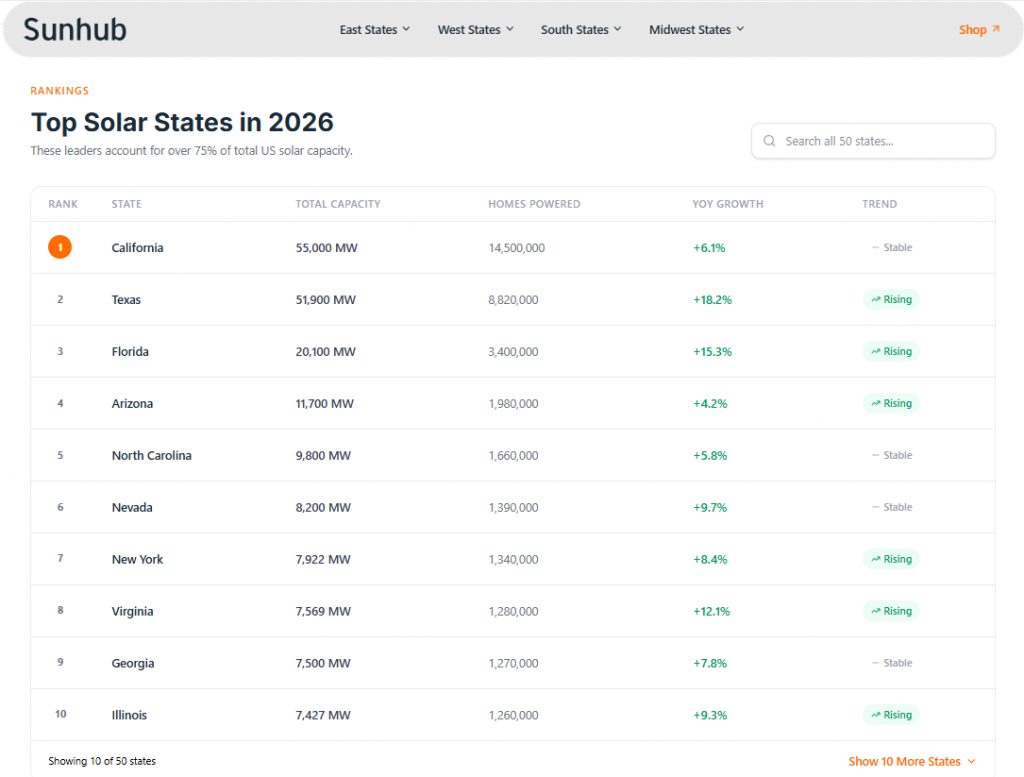
Explore U.S. Solar State Rankings
Compare solar rankings, installed capacity, growth trends, and market performance across all 50 states. Discover regional insights to support smarter procurement and expansion decisions.
What Is Solar Panel Freight Class?
Freight class is a standardized classification used by LTL carriers to categorize shipments according to their transportation characteristics.
The National Motor Freight Traffic Association (NMFTA) maintains the NMFC system, which considers four primary factors:
- Density: Shipment weight relative to the space it occupies.
- Handling: How easily the shipment can be loaded and unloaded.
- Stowability: How efficiently the freight fits alongside other cargo.
- Liability: The risk of damage, loss, or other transportation concerns.
Freight classes range from 50 to 500. Generally, lower classes are associated with denser, easier-to-handle freight, while higher classes may result in higher transportation charges.
However, freight class alone does not determine the final shipping price.
What Freight Class Are Solar Panels?
Solar panels are commonly referenced under NMFC item 177010, with third-party freight guides suggesting classes between 85 and 125 for certain palletized shipments.
However, these figures should be treated as planning references, not universal classifications.
The applicable NMFC description, packaging requirements, density provisions, and carrier tariff must be verified before shipping.
| Freight consideration | Planning reference |
|---|---|
| Commonly referenced NMFC item | 177010 : verify applicability |
| Illustrative freight class range | 85–125 |
| Illustrative density range | 6–12 pounds per cubic foot |
| Typical shipping method | Palletized or crated LTL freight |
| Important handling concern | Fragile glass modules |
The 2025 NMFC updates expanded standardized density classifications, making it particularly important to verify current requirements rather than relying on older freight class charts.
How to Calculate Solar Panel Freight Density
Freight density is measured in pounds per cubic foot (PCF).
Density (PCF) = Total shipment weight (lb) ÷ Shipment volume (ft³)
To calculate volume using inches:
Volume (ft³) = Length × Width × Height ÷ 1,728
Measurements should include the entire shipping unit, including its pallet, crate, protective packaging, and any overhang.
Example: Solar panel pallet density
Suppose a palletized solar panel shipment has these specifications:
| Measurement | Value |
|---|---|
| Length | 84 inches |
| Width | 48 inches |
| Height | 48 inches |
| Gross weight | 1,000 lb |
First, calculate volume:
84 × 48 × 48 ÷ 1,728 = 112 ft³
Then calculate density:
1,000 ÷ 112 = 8.93 PCF
Under the standardized 2025 NMFC density scale, 8.93 PCF corresponds to Class 100 if the applicable commodity provisions use that full density scale.
This calculation does not independently establish the correct solar panel freight class. The NMFC item and carrier requirements must still be confirmed.
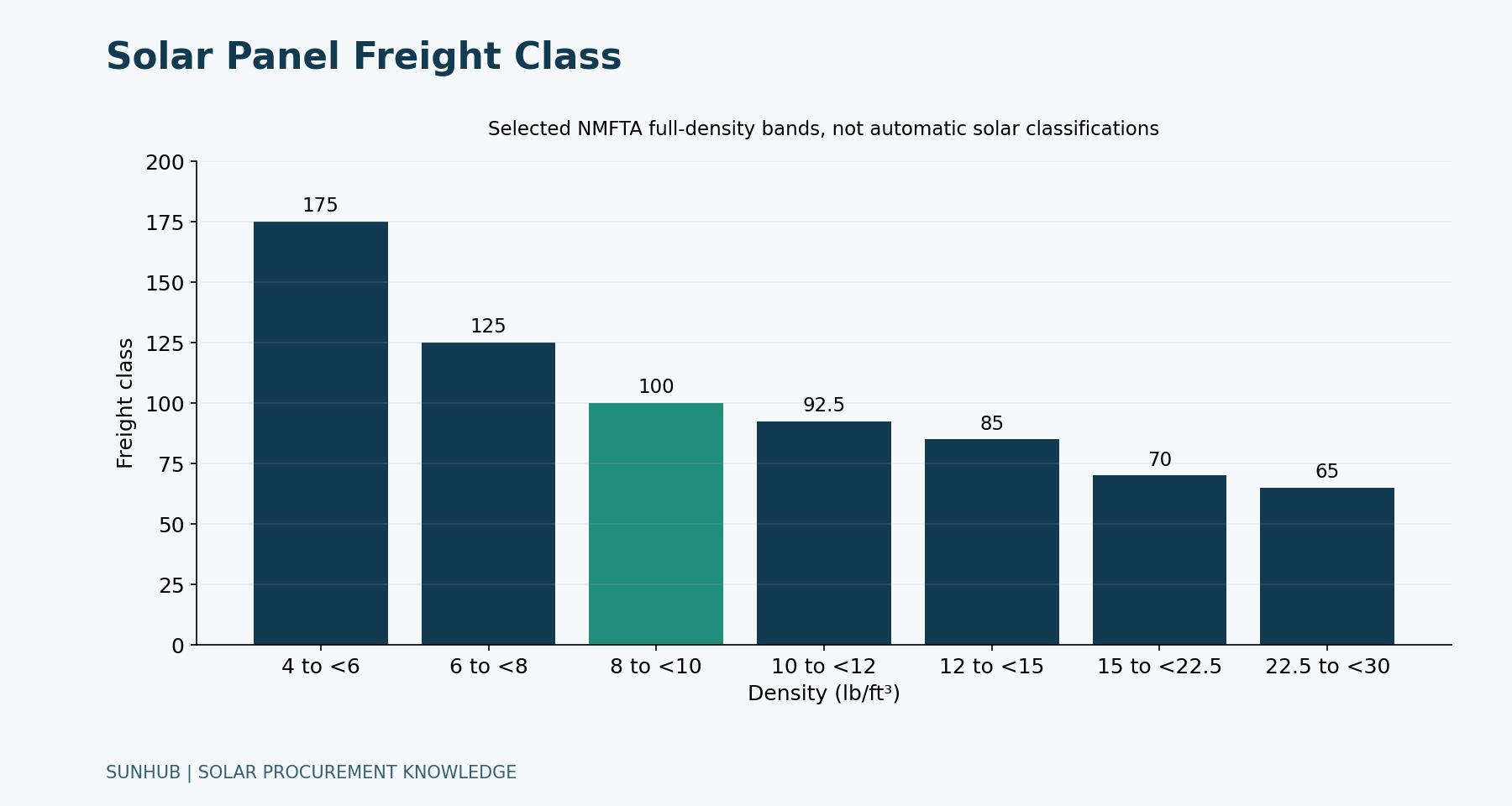
Solar Panel Freight Class by Density
The following table shows selected bands from the NMFTA’s standardized 13-tier density scale.
| Density (PCF) | Standard density class |
|---|---|
| 4 to less than 6 | 175 |
| 6 to less than 8 | 125 |
| 8 to less than 10 | 100 |
| 10 to less than 12 | 92.5 |
| 12 to less than 15 | 85 |
| 15 to less than 22.5 | 70 |
| 22.5 to less than 30 | 65 |
These values apply to commodities classified under the relevant full-density provisions. They should not be automatically assigned to every solar panel shipment.
What Affects Solar Panel Freight Costs?
Several factors influence the final cost of transporting photovoltaic modules.
Shipment dimensions and weight
Large pallets occupy more trailer space, while heavy shipments may require specialized handling equipment.
Accurate measurements help carriers calculate density and evaluate loading requirements.
Freight class
The applicable freight class influences LTL pricing. Incorrect classification can lead to invoice adjustments or reclassification charges.
Shipping distance
Longer transportation routes generally increase freight costs, although rates also depend on carrier networks and available capacity.
Packaging and handling
Solar panels contain fragile glass and sensitive photovoltaic cells.
Protective packaging may include reinforced cartons, edge protectors, manufacturer-approved pallets, and securing materials.
Additional services
Liftgate delivery, limited-access locations, appointment scheduling, and oversized freight may introduce additional charges.
How to Estimate Solar Panel Shipping Costs
Before arranging transportation, solar businesses should gather shipment dimensions, pallet count, gross weight, and pickup and delivery locations.
Sunhub’s Freight Cost Estimator helps EPCs, developers, and installers generate planning estimates for pallet, crate, and skid shipments across the contiguous United States.
The tool accepts origin and destination ZIP codes, pallet quantities, weight, and dimensions. It also provides optional settings for freight class, equipment, and additional services.
These estimates can support procurement planning and budget comparisons.
However, a carrier quote is still required before booking transportation.
How to Avoid Solar Panel Freight Reclassification
Freight reclassification occurs when a carrier determines that a shipment’s declared characteristics do not match the applicable classification.
To reduce this risk:
- Measure the complete packaged pallet rather than individual panels.
- Include pallets, crates, and protective materials in gross weight.
- Confirm the applicable NMFC item and classification provisions.
- Use manufacturer-approved packaging and loading methods.
- Record accurate shipment information on the bill of lading.
- Confirm additional handling requirements before booking.
NMFTA’s ClassIT+ classification tool can help verify current NMFC provisions.


Conclusion
Understanding solar panel freight class is essential for accurate LTL shipping estimates and efficient solar equipment transportation.
Although some industry references suggest Classes 85–125 for certain palletized solar shipments, the correct classification depends on the applicable NMFC provisions and shipment characteristics.
Accurate density calculations, proper packaging, and verified freight information help solar businesses avoid unexpected charges and protect valuable equipment.
Using a freight estimator during procurement planning can also provide better visibility into transportation expenses before finalizing a shipment.
Frequently Asked Questions
What is the NMFC code for solar panels?
NMFC item 177010 is commonly cited in third-party solar freight guides. Shippers should verify that the current item description and provisions apply to their specific product.
What is the typical solar panel freight class?
Some freight references suggest Classes 85–125, but the actual classification depends on the applicable NMFC provisions, packaging, and shipment characteristics.
Does pallet weight affect solar panel freight class?
Yes. Weight affects freight density, which can influence classification when the applicable NMFC provisions are density-based.
Can I calculate solar panel freight costs online?
Yes. Online freight estimators can provide preliminary shipping estimates using shipment details and transportation routes. Final pricing requires carrier confirmation.