
The United States is reportedly considering a new combination of tariffs and minimum import pricing for polysilicon and products made from it.
The proposed measures are intended to support domestic manufacturing, reduce dependence on foreign supply chains, and strengthen access to materials used in solar panels and semiconductor chips.
However, additional trade protections could also affect solar panel prices, equipment availability, project budgets, and procurement strategies across the United States.
According to an August 4, 2026 Reuters report, the administration is evaluating a hybrid system that could combine a polysilicon price floor with additional tariffs.
No final tariff rate, minimum price, country coverage, product scope, or implementation date had been officially announced as of August 4, 2026.
For installers, EPCs, developers, distributors, and solar equipment buyers, the key is to understand what is being considered without treating the reported proposal as finalized policy.
Key Takeaways
- The U.S. government is reportedly considering a minimum import price and additional tariffs on polysilicon and derivative products.
- The proposal remains under consideration and has not been officially finalized.
- China held an estimated 93% of global polysilicon manufacturing capacity in 2024.
- Covered Chinese polysilicon and solar wafers already face a 50% Section 301 tariff.
- U.S. solar module manufacturing capacity reached 65.5 GW in 2025.
- Domestic solar cell manufacturing capacity remained at approximately 3 GW in Q1 2026.
- New trade protections could support domestic production but may also increase equipment costs or limit supplier flexibility.
- The effect on solar prices will depend on the final tariff rate, product coverage, exemptions, inventory levels, and implementation timeline.
Solar Tariff Proposal by the Numbers
| Key figure | What it means |
|---|---|
| 50% | Existing Section 301 tariff on covered Chinese polysilicon and solar wafers since January 1, 2025 |
| 93% | China’s estimated share of global polysilicon manufacturing capacity in 2024 |
| 65.5 GW | U.S. solar module manufacturing capacity online in 2025 |
| 3 GW | U.S. solar cell manufacturing capacity reported in Q1 2026 |
| 2.4% | Approximate share of global polysilicon demand associated with semiconductor manufacturing |
These figures illustrate the challenge facing U.S. policymakers.
The United States has rapidly expanded its ability to assemble finished solar modules. However, domestic capacity remains much smaller at earlier stages of production, particularly solar cells and wafers.
At the same time, upstream global manufacturing remains heavily concentrated in China.
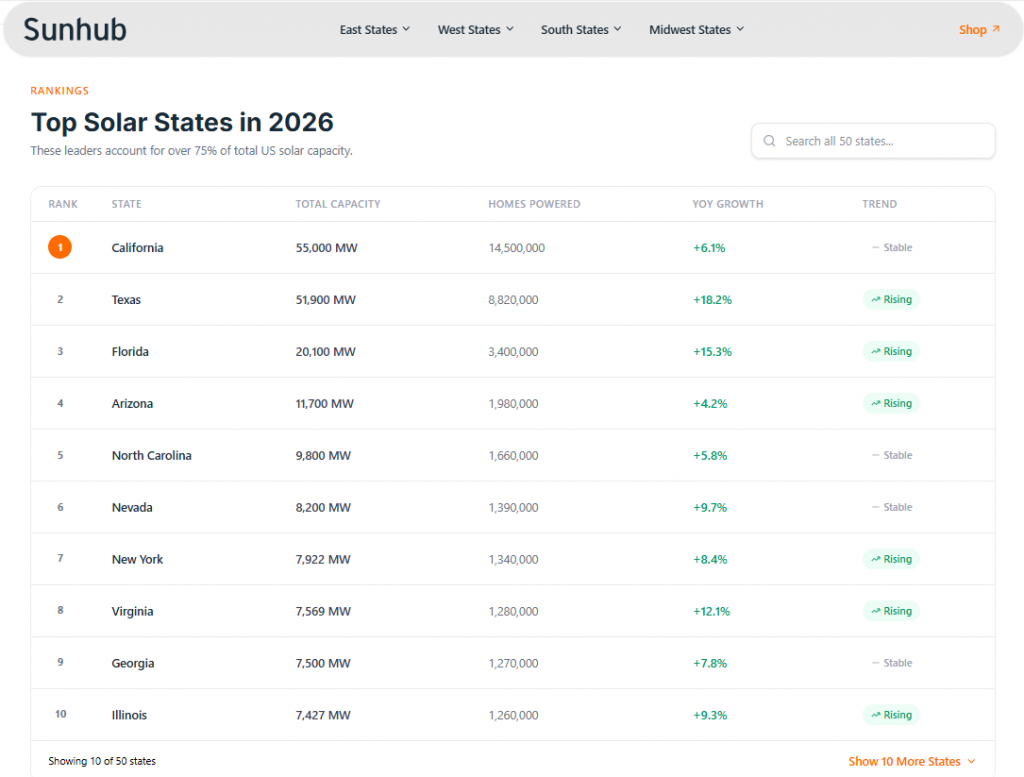
Explore U.S. Solar State Rankings
Compare solar rankings, installed capacity, growth trends, and market performance across all 50 states. Discover regional insights to support smarter procurement and expansion decisions.
What Is Polysilicon?
Polysilicon is a highly purified form of silicon used to manufacture solar cells and semiconductor chips.
In the solar industry, polysilicon is one of the earliest materials in the crystalline silicon manufacturing process. Changes in its cost or availability can move through the entire supply chain.
How Polysilicon Becomes a Solar Panel
The crystalline silicon solar manufacturing process generally follows these stages:
- Raw silicon is purified into polysilicon.
- Polysilicon is melted and formed into ingots.
- Ingots are sliced into thin wafers.
- Wafers are processed into solar cells.
- Solar cells are connected and assembled into solar modules.
A supply disruption or cost increase at the polysilicon stage can affect manufacturers producing wafers, cells, and finished modules.
Why Polysilicon Matters Beyond Solar
Polysilicon is also used to produce semiconductor wafers.
Semiconductor-grade polysilicon generally requires a higher purity level than solar-grade material. Although the semiconductor industry accounts for a relatively small portion of global polysilicon demand, reliable access to high-purity material is strategically important.
Semiconductors are used in:
- Vehicles
- Data centers
- Artificial intelligence infrastructure
- Consumer electronics
- Telecommunications equipment
- Medical devices
- Aerospace and defense systems
This connection helps explain why polysilicon is being considered as both an energy security and national security issue.
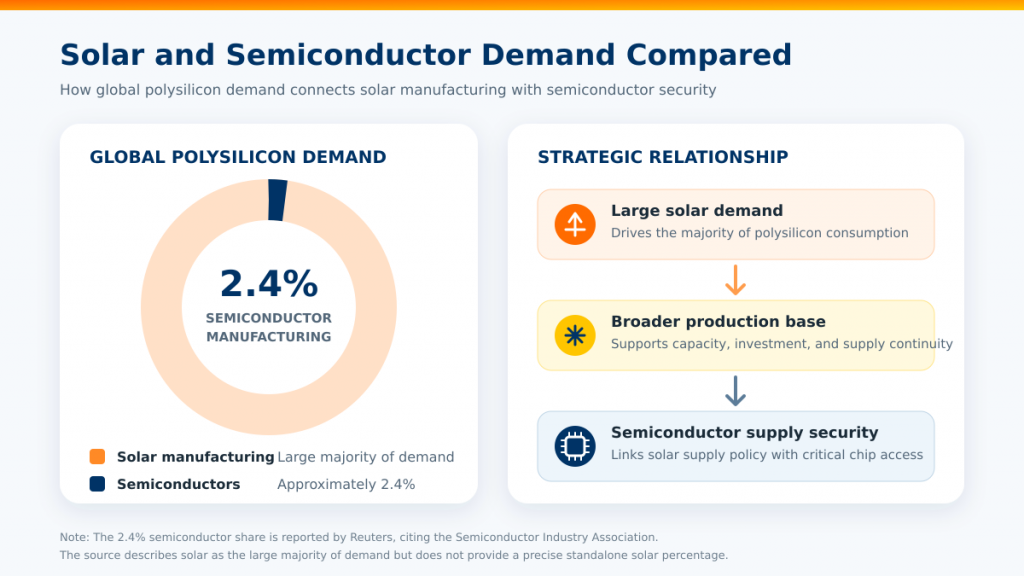
Source: Reuters.
What Is the U.S. Government Considering?
The reported proposal includes two trade mechanisms that could operate together.
A Minimum Import Price for Polysilicon
A minimum import price, also called a price floor, would establish the lowest value at which covered polysilicon or related products could enter the United States.
If an imported product were sold below that level, an additional duty could potentially increase its effective import cost to the required minimum.
Why Introduce a Polysilicon Price Floor?
A minimum price is intended to prevent heavily subsidized or unusually inexpensive foreign production from undercutting domestic manufacturers.
Supporters may argue that a price floor would:
- Give U.S. manufacturers greater pricing stability
- Support investment in domestic factories
- Reduce dependence on foreign suppliers
- Protect strategically important production capacity
- Improve long-term supply chain resilience
Critics may argue that the policy would prevent U.S. buyers from benefiting from lower global material prices.
Higher import costs could eventually be passed to module manufacturers, distributors, installers, developers, or project customers.
Status as of August 4, 2026
The reported price floor remains a proposal.
The minimum price, calculation method, eligible countries, enforcement process, exemptions, and affected products have not been officially confirmed.
Additional Tariffs on Polysilicon and Derivative Products
The second part of the reported plan could introduce additional tariffs on polysilicon and products manufactured from it.
The phrase “derivative products” is especially important.
Depending on the government’s final definition, the policy could potentially cover:
- Polysilicon
- Ingots
- Solar wafers
- Solar cells
- Finished solar modules
- Semiconductor materials
- Other products manufactured using polysilicon
A policy limited to raw polysilicon would have a different market impact from a policy that also includes imported wafers, cells, or finished panels.
Until official product classifications are published, solar buyers should not assume that every polysilicon-based product will be covered.
Potential Offsets for U.S. Manufacturing Investment
Reuters also reported that importers investing in U.S. wafer and solar cell manufacturing may be able to offset some costs associated with the proposed trade measures.
If adopted, this approach could encourage companies to build more stages of the solar supply chain inside the United States.
The arrangement could be designed to reward companies that invest in:
- Domestic wafer production
- Domestic solar cell manufacturing
- New manufacturing equipment
- Factory expansion
- Local supply agreements
- U.S. employment and workforce development
The eligibility requirements, investment thresholds, credit values, and compliance rules have not been published.
What Is Section 232?
The proposal is connected to an investigation under Section 232 of the Trade Expansion Act of 1962.
Section 232 allows the U.S. government to investigate whether certain imports threaten to impair national security.
If the Department of Commerce identifies a national security risk, the president can consider measures such as tariffs, quotas, fees, or other import restrictions.
The Commerce Department formally initiated its investigation into polysilicon and derivative products on July 1, 2025. The investigation was later published in the Federal Register.
Why Polysilicon Is Being Treated as a Security Issue
The investigation considers several potential risks:
- Dependence on foreign manufacturing
- Concentration of production in a limited number of countries
- Access to semiconductor-grade materials
- Stability of domestic solar manufacturing
- Exposure to trade disputes or supply interruptions
- U.S. manufacturers’ ability to expand production
- Availability of materials for critical infrastructure
- Dependence on imported wafers and solar cells
One of the most important concerns is the concentration of global solar manufacturing capacity in China.
China’s Share of Global Solar Manufacturing Capacity
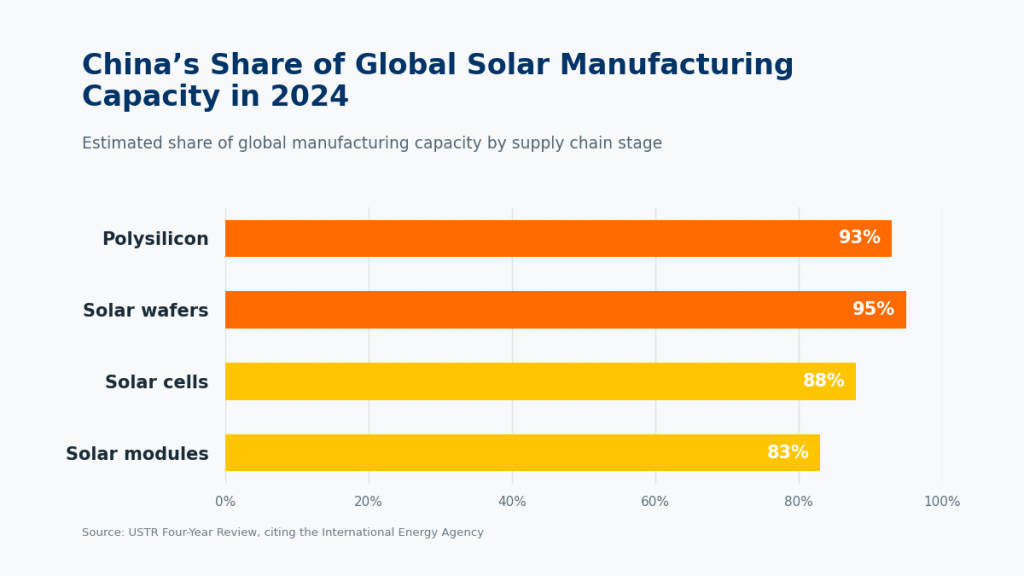
What the Data Shows
China’s position is strongest in the upstream stages of solar manufacturing.
The International Energy Agency estimated that China would control approximately 93% of global polysilicon capacity and 95% of wafer capacity in 2024.
Its estimated share was also 88% for solar cells and 83% for finished solar modules.
This concentration means that trade restrictions applied near the beginning of the supply chain could affect manufacturers and buyers across multiple downstream markets.
However, these percentages represent estimated global manufacturing capacity. They do not represent the exact share of solar products imported into the United States.
The figures should not be used to calculate a specific tariff-related increase in solar panel prices.
How the Reported Proposal Differs From Existing Solar Tariffs
The United States already applies several trade measures to imported solar products.
In 2024, the U.S. government increased Section 301 tariffs on covered Chinese solar wafers and polysilicon to 50%. The higher rate took effect on January 1, 2025.
The newly reported proposal would be separate from those existing tariffs.
Existing Tariffs Versus the Reported Proposal
| Trade action | Products | Rate or mechanism | Status |
| Section 301 tariffs | Covered Chinese polysilicon and solar wafers | 50% tariff | Effective January 1, 2025 |
| Section 232 investigation | Polysilicon and derivative products | No final rate announced | Investigation initiated July 1, 2025 |
| Reported hybrid proposal | Polysilicon and derivative products | Possible price floor plus tariffs | Reported by Reuters, not officially finalized |
| Possible investment offset | Importers investing in U.S. wafer and cell production | Details not published | Reported proposal only |
Sources: USTR tariff announcement, Federal Register, and Reuters.
1. The New Measures Could Be Based on National Security
Section 301 tariffs address specific foreign trade practices.
Section 232 measures are based on whether imports may impair U.S. national security.
This distinction affects the legal basis, investigation process, possible remedies, and countries that could be included.
2. The Policy Could Include More Countries
Existing Section 301 tariffs target covered products imported from China.
A Section 232 measure may not be limited to China. The final policy could potentially include polysilicon or derivative products entering the United States from other countries.
The impact could be broader if suppliers in countries such as Germany, Malaysia, or South Korea are included.
No final country coverage had been announced as of August 4, 2026.
3. The Policy Could Cover More Manufacturing Stages
The final definition of derivative products will determine the scope of the policy.
Possible coverage could include products at several stages of the supply chain, including wafers, cells, and finished modules.
This is one of the most important details for solar buyers because the effect of a tariff on raw material alone could be significantly different from a tariff applied to finished solar panels.
Why the U.S. Wants More Domestic Solar Manufacturing
U.S. solar manufacturing capacity has expanded significantly, but much of the early growth has occurred in module assembly.
Module assembly is the final major stage of the manufacturing process. Many U.S. factories still depend on imported wafers and solar cells.
The Complete Solar Manufacturing Chain
A complete domestic crystalline silicon supply chain requires manufacturing across the following stages:
- Polysilicon
- Ingots
- Wafers
- Solar cells
- Finished modules
Building wafer and cell factories requires substantial capital, specialized equipment, technical knowledge, regulatory approvals, workforce development, and long-term supply agreements.
As a result, module assembly capacity can expand faster than upstream manufacturing.
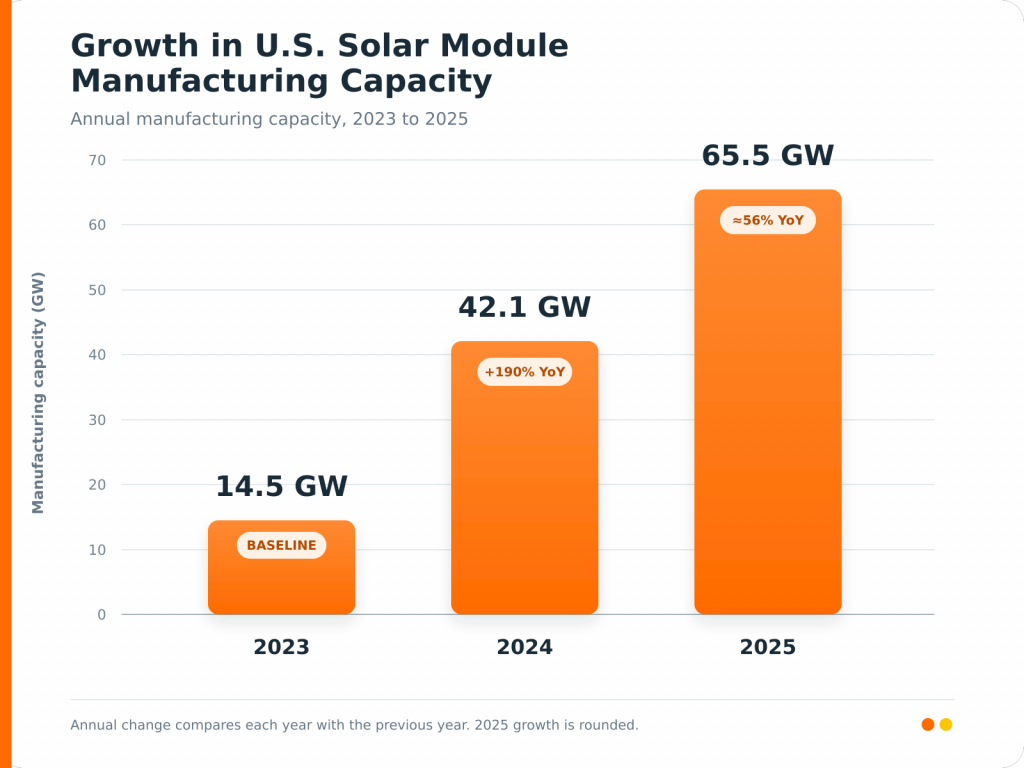
Growth in U.S. Solar Module Manufacturing
What the Manufacturing Data Shows
U.S. solar module manufacturing capacity increased from 14.5 GW at the end of 2023 to 42.1 GW at the end of 2024.
That represented annual growth of approximately 190%.
Capacity then reached 65.5 GW in 2025, an increase of approximately 56% from the previous year.
Overall, domestic module manufacturing capacity grew by approximately 352% between the end of 2023 and the end of 2025.
Manufacturing capacity does not necessarily equal actual production.
Factory utilization, equipment availability, labor, operating schedules, imported component availability, and customer demand determine how many modules are ultimately produced.
Sources: SEIA 2024 Year in Review and SEIA 2025 Report.
The U.S. Solar Manufacturing Gap
The growth of domestic module manufacturing is significant, but the United States still has limited capacity at earlier production stages.
| U.S. solar manufacturing indicator | Reported figure | What it shows |
| Module manufacturing capacity online in 2025 | 65.5 GW | Strong growth in final module assembly |
| Solar cell manufacturing capacity in Q1 2026 | 3 GW | Limited domestic capacity at an important upstream stage |
| Domestic module production as a share of 2025 installations | About 70% | U.S. factories are producing at meaningful scale |
| Additional module capacity added in Q1 2026 | 0 GW | Module capacity growth paused during the quarter |
Why Solar Cell Capacity Matters
SEIA reported approximately 3 GW of domestic solar cell manufacturing capacity in Q1 2026, compared with 65.5 GW of module manufacturing capacity online in 2025.
This does not mean that the remaining module capacity cannot operate. U.S. module factories can source solar cells internationally.
However, the difference shows why many domestic module manufacturers remain dependent on imported cells.
It also explains why the definition of polysilicon derivatives matters.
A policy limited to raw polysilicon would have a different effect from one that also covers wafers, cells, or finished modules.
Source: SEIA Solar Market Insight Q2 2026.

Request Solar Equipment Quotes
Submit your equipment requirements and receive competitive quotes from verified solar suppliers. Compare pricing, availability, and delivery options to source the right products for your projects.
Companies Investing in U.S. Solar Manufacturing
Solar manufacturers including Qcells, T1 Energy, Canadian Solar, Toyo, and Corning have announced or begun investments connected to U.S. solar manufacturing.
Domestic polysilicon is also produced by companies such as Hemlock Semiconductor in Michigan and Wacker Chemie in Tennessee.
Supporters of additional trade protections believe these investments may be difficult to sustain if U.S. factories must compete against imported materials sold at significantly lower prices.
The proposed investment offsets could potentially encourage companies to expand beyond module assembly and invest in domestic wafer and solar cell production.
Could Polysilicon Tariffs Raise Solar Panel Prices?
New tariffs or a polysilicon price floor could place upward pressure on solar panel prices.
However, the size and timing of any price change cannot be reliably calculated until the final policy is published.
Factors That Could Affect Solar Pricing
The market impact will depend on:
- The final tariff rate
- The minimum import price
- Countries covered by the policy
- Products classified as derivatives
- Exemptions for certain countries or products
- Credits for domestic manufacturing investments
- Existing U.S. inventory levels
- Supply agreements between manufacturers and buyers
- Available domestic polysilicon, wafer, and cell capacity
- Customs treatment and product classifications
- The time allowed before enforcement begins
- Current market demand
- Freight and warehousing costs
Why Immediate Price Increases Are Not Guaranteed
Polysilicon is only one part of a finished module’s cost.
Solar panel pricing also depends on:
- Solar cells
- Glass
- Aluminum frames
- Backsheets
- Encapsulants
- Junction boxes
- Labor
- Freight
- Warehousing
- Existing tariffs
- Supply and demand
Manufacturers and distributors may also hold inventory imported before a new policy takes effect.
For these reasons, pricing may not respond immediately or consistently across every product.
Why Some Solar Products Could Be Affected More Than Others
The level of exposure may vary according to:
- Country of module assembly
- Country of solar cell production
- Country of wafer production
- Polysilicon source
- Import date
- Domestic content
- Product technology
- Existing inventory
- Manufacturer supply contracts
- Applicable tariff exemptions
Two solar panels with similar wattage and technical specifications may face different cost exposure based on where their materials and components were produced.
Possible Benefits for the U.S. Solar Industry
If carefully structured, the proposed measures could provide several long-term benefits.
Greater Supply Chain Security
Expanding domestic polysilicon, wafer, and cell production could reduce dependence on a highly concentrated global supply chain.
More U.S. Manufacturing Investment
Price protection and investment credits may give manufacturers greater confidence to invest in expensive production facilities.
Stronger Upstream Production
The United States has developed significant module assembly capacity. New investment could help close gaps in wafer and solar cell manufacturing.
Better Supply Chain Visibility
New sourcing and documentation requirements could encourage manufacturers to provide clearer information about material origin and manufacturing locations.
Improved Market Resilience
A more complete domestic supply chain could help the solar market respond to shipping interruptions, trade disputes, geopolitical risks, and unexpected shortages.
Potential Risks for Solar Buyers and Developers
The same policies could create challenges, particularly while domestic capacity is still developing.
Higher Equipment Costs
If tariffs increase the cost of polysilicon, wafers, cells, or modules, manufacturers and distributors may pass some of those costs to buyers.
Reduced Supplier Flexibility
Broad country coverage could limit the number of suppliers able to offer competitively priced products.
Delayed Procurement Decisions
Uncertainty about future tariffs can make it difficult to finalize long-term module prices or sign supply agreements.
Pressure on Project Economics
Projects with limited margins may be sensitive to sudden equipment price changes.
Higher module costs could affect:
- Project budgets
- Financing requirements
- Expected returns
- Bid pricing
- Construction schedules
- Power purchase agreement economics
Temporary Supply Constraints
Domestic wafer and solar cell capacity cannot be built immediately.
If imports become more expensive before U.S. production is ready, buyers could experience short-term supply constraints or reduced product selection.
Request Solar Equipment Quotes
Submit your equipment requirements and receive competitive quotes from verified solar suppliers. Compare pricing, availability, and delivery options to source the right products for your projects.
What Solar Installers, EPCs, and Buyers Should Do Now
Solar companies do not need to stop buying equipment. They should take reasonable steps to understand and reduce potential exposure.
Review Procurement Timelines
Identify projects that will require solar panels during the next three to twelve months.
Determine which equipment orders are already secured and which projects remain exposed to possible pricing changes.
Confirm Product Origin
Ask suppliers for available information about:
- Country of module assembly
- Country of solar cell production
- Country of wafer production
- Polysilicon sourcing
- Domestic content
- Applicable tariffs and duties
- Customs documentation
- Current inventory location
Review Price Adjustment Clauses
Long-term supply contracts may permit price changes when new tariffs, customs duties, or government fees are introduced.
Buyers should understand:
- Who is responsible for new duties
- When quoted prices can change
- Whether deposits protect the original price
- Whether substitutions are allowed
- What happens if delivery is delayed
Compare Multiple Supply Options
Evaluate products from different manufacturers, manufacturing locations, and technology categories.
A broader sourcing strategy can reduce dependence on one supplier or supply route.
Avoid Speculative Purchasing
Purchasing more equipment than a confirmed project requires can create storage expenses, inventory risk, cash-flow pressure, and potential product obsolescence.
Procurement decisions should be based on real project demand rather than an unconfirmed tariff expectation.
Monitor Official Announcements
The final policy could differ substantially from current reporting.
Solar companies should monitor updates from:
- The White House
- U.S. Department of Commerce
- Federal Register
- Office of the U.S. Trade Representative
- U.S. Customs and Border Protection
Confirmed Facts Versus Unknown Details
| Confirmed as of August 4, 2026 | Still unknown |
| A Section 232 investigation was initiated in July 2025 | Final Section 232 tariff rate |
| Covered Chinese polysilicon and wafers already face a 50% Section 301 tariff | Minimum import price |
| U.S. module manufacturing capacity reached 65.5 GW in 2025 | Countries covered |
| U.S. solar cell capacity remained at approximately 3 GW in Q1 2026 | Definition of derivative products |
| Reuters reported that a hybrid policy is being prepared | Exemptions and investment offsets |
| No final measure had been publicly announced | Implementation and enforcement date |
This distinction is important.
The Section 232 investigation and existing Section 301 tariff are confirmed. The reported price floor, additional tariffs, investment offsets, and product coverage have not been officially finalized.
The Sunhub Perspective
The reported polysilicon proposal reflects a broader change in U.S. solar procurement.
Price remains important, but it is no longer the only factor buyers must consider.
Product origin, trade compliance, domestic content, equipment availability, lead time, tariff exposure, and supply chain transparency are becoming increasingly important to project planning.
Solar businesses should prepare for several possible outcomes without treating any single scenario as certain.
The strongest approach is to:
- Maintain supplier flexibility
- Confirm product and component origin
- Review contract exposure
- Monitor official policy updates
- Compare currently available inventory
- Avoid pricing future projects based on unconfirmed assumptions
Sunhub’s Marketplace helps installers, EPCs, distributors, developers, and procurement teams compare available solar equipment from multiple sellers and source products according to actual project requirements.
Conclusion
The U.S. government is reportedly considering a minimum import price and additional tariffs on polysilicon and derivative products.
The proposed measures are intended to strengthen domestic solar and semiconductor manufacturing while reducing dependence on concentrated foreign supply chains.
If adopted, the policy could encourage additional investment in U.S. polysilicon, wafer, and solar cell production.
It could also increase equipment costs, reduce supplier flexibility, or create temporary supply challenges if import restrictions take effect before domestic upstream capacity is ready.
The final impact will depend on the tariff rate, price floor, product definitions, exemptions, country coverage, investment offsets, and implementation timeline.
For now, solar buyers should avoid reacting to speculation.
The better approach is to verify product origin, understand contract terms, diversify sourcing, compare current inventory, and follow official policy announcements.
Frequently Asked Questions
What is a polysilicon tariff?
A polysilicon tariff is an import duty applied to covered foreign polysilicon entering the United States.
The tariff increases the effective cost of imported material and may be used to protect domestic production or address trade and national security concerns.
Has the U.S. approved the new polysilicon tariffs?
No final measure had been officially announced as of August 4, 2026.
Reuters reported that the administration was preparing a proposal involving tariffs and a minimum import price, but the final terms remained under consideration.
What is a polysilicon price floor?
A polysilicon price floor establishes a minimum import value for covered material.
Imports priced below that level could face an additional charge that raises their effective cost to the required minimum.
Do Chinese polysilicon imports already face tariffs?
Covered Chinese polysilicon and solar wafers have been subject to a 50% Section 301 tariff since January 1, 2025.
The newly reported Section 232 proposal would be separate from that existing measure.
Will polysilicon tariffs increase solar panel prices?
They could place upward pressure on prices, especially if the policy covers wafers, solar cells, or finished modules.
The actual effect will depend on tariff rates, exemptions, inventory levels, domestic production, supplier contracts, and the definition of derivative products.
Will the reported measures apply only to China?
That has not been confirmed.
Existing Section 301 tariffs target covered Chinese products, but Section 232 measures could potentially include imports from other countries.
The final country coverage will be one of the most important policy details.
What are polysilicon derivative products?
Derivative products are goods manufactured from polysilicon.
Depending on the final government definition, the term could include ingots, wafers, solar cells, finished modules, or certain semiconductor products.
Are all solar panels made with polysilicon?
Most solar panels use crystalline silicon cells that begin with polysilicon.
Thin-film solar technologies use different semiconductor materials and may have different exposure depending on the final policy scope.
Why is polysilicon considered a national security issue?
Polysilicon is used in solar panels and semiconductor manufacturing.
U.S. policymakers are concerned about foreign manufacturing concentration, supply disruptions, access to high-purity material, and dependence on imported solar components.
How much solar module manufacturing capacity does the U.S. have?
SEIA reported that U.S. solar module manufacturing capacity reached approximately 65.5 GW in 2025.
Domestic solar cell manufacturing capacity remained much smaller at approximately 3 GW in Q1 2026.
Should solar companies buy panels before the policy is announced?
Companies should base purchasing decisions on confirmed project demand, available pricing, product suitability, storage capacity, cash flow, and contract requirements.
Buying equipment solely because of an unconfirmed tariff proposal can create unnecessary inventory and financial risk.
What should buyers ask solar equipment suppliers?
Buyers should ask about module assembly location, solar cell origin, wafer origin, applicable tariffs, available inventory, lead times, domestic content, and whether quoted prices may change if new duties are introduced.
Sources
This article is based on the following sources:
- Reuters: U.S. weighs polysilicon price floor and tariffs
- Federal Register: Section 232 investigation of polysilicon imports
- USTR: Section 301 tariffs on polysilicon and solar wafers
- USTR Four-Year Review
- SEIA Solar Market Insight 2024 Year in Review