
Table of Contents

Explore U.S. Solar State Rankings
Compare solar rankings, installed capacity, growth trends, and market performance across all 50 states. Discover regional insights to support smarter procurement and expansion decisions.
How Does Safe Harbor Warehousing Work?
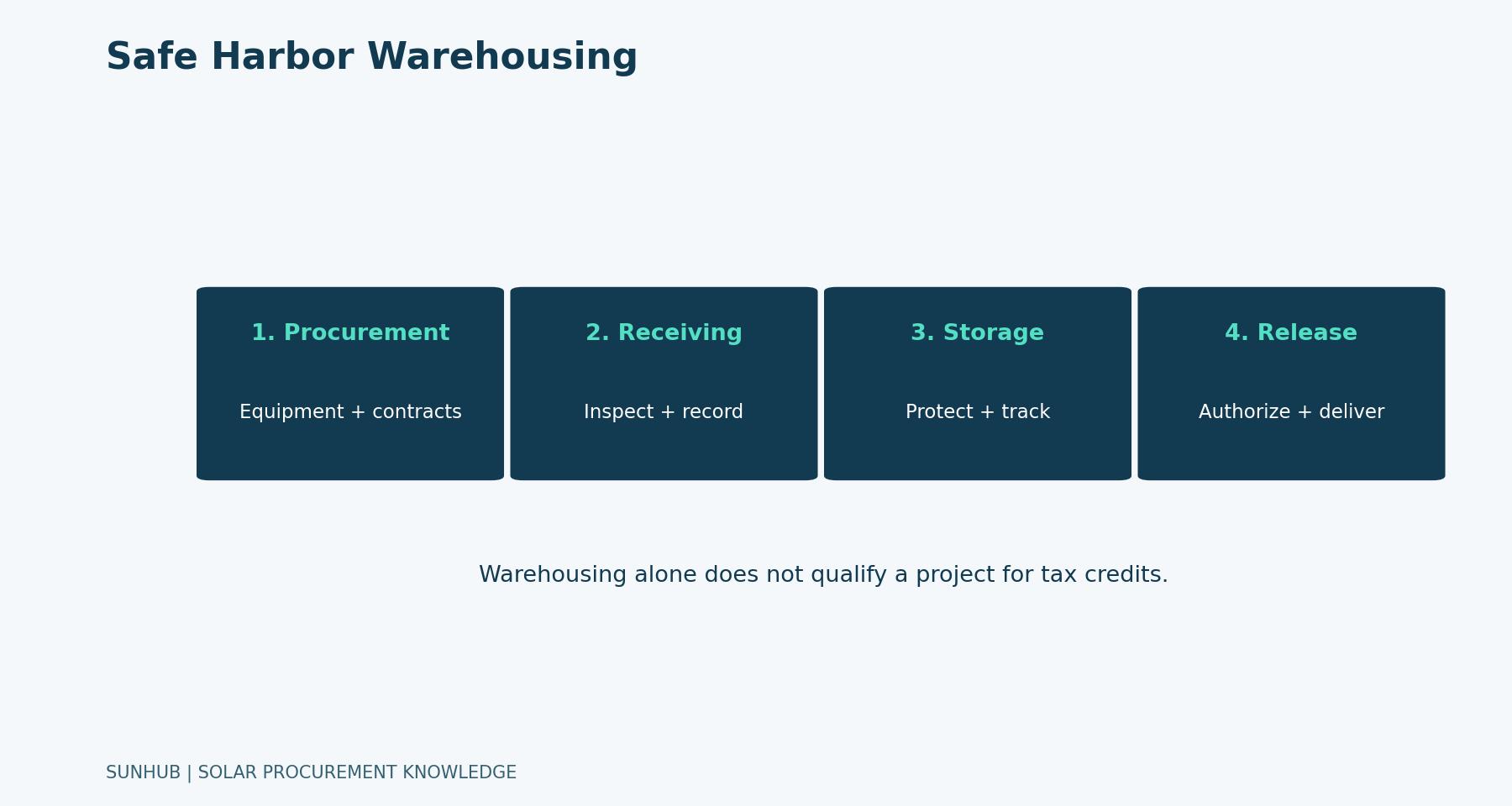
Safe harbor warehousing connects equipment procurement with construction schedules through a controlled storage process.
A developer may purchase solar modules, inverters, or other equipment before the project site is ready to receive them. Rather than sending the equipment directly to an unfinished construction site, the developer arranges secure storage until installation can begin.
A typical process includes four stages:
- Procurement: Purchase equipment and establish the applicable contractual and tax documentation.
- Receiving: Deliver equipment to a designated warehouse and inspect it for damage or shortages.
- Storage: Maintain secure inventory, ownership records, insurance, and equipment-specific storage conditions.
- Release: Transport equipment to the project site according to construction schedules.
This approach helps developers coordinate early procurement without overwhelming construction sites with equipment they cannot immediately install.
Safe Harbor Warehousing and IRS Tax Credit Rules
Safe harbor warehousing is often discussed alongside the IRS beginning-of-construction requirements for federal solar tax credits.
Historically, eligible projects could establish the beginning of construction through either significant physical work or a Five Percent Safe Harbor based on qualifying project costs.
However, the rules changed in 2025.
For this November 2026 guide, the July 4, 2026 construction-start deadline has already passed. The notice addresses the termination of credits for applicable solar facilities placed in service after December 31, 2027, if construction begins after July 4, 2026. Warehousing arrangements made now cannot retroactively meet that construction-start deadline.
Under IRS Notice 2025-42, applicable solar facilities beginning construction on or after September 2, 2025, generally must satisfy the Physical Work Test to establish a beginning-of-construction date for purposes of the Sections 45Y and 48E solar credit termination provisions.
A limited Five Percent Safe Harbor exception applies for qualifying low-output solar facilities with a maximum net output of 1.5 MW AC or less, subject to the notice’s requirements.
The distinction matters because purchasing and storing equipment does not, by itself, establish that construction has begun under the Physical Work Test.
Furthermore, these rules address specific tax-credit termination provisions and should not be confused with other tax-credit eligibility requirements.
Developers should obtain project-specific guidance from qualified tax advisers before relying on equipment procurement or warehousing as part of a safe harbor strategy.
What Equipment Can Be Stored?
Safe harbor warehouses may accommodate several categories of solar equipment.
| Equipment | Important storage considerations |
|---|---|
| Solar panels | Protective packaging, pallet handling, moisture exposure |
| Inverters | Temperature, humidity, dust, and manufacturer instructions |
| Battery systems | Fire safety, temperature, monitoring, and storage requirements |
| Transformers | Moisture protection, equipment condition, and inspection |
| Racking and trackers | Corrosion protection, component organization |
| Switchgear and BOS equipment | Security, identification, and environmental protection |
Each equipment category requires appropriate storage procedures. Manufacturer instructions and applicable safety requirements should determine the final arrangement.
Why Solar Developers Use Safe Harbor Warehousing
Better control over procurement schedules
Developers may secure equipment before installation begins, reducing dependence on last-minute purchasing.
Protection against project delays
Interconnection approvals, permitting, and construction schedules can change unexpectedly. Warehousing provides flexibility when equipment arrives before the site is ready.
Improved inventory visibility
Serialized tracking and warehouse management systems help teams identify equipment locations, quantities, and project allocations.
Reduced handling risks
A suitable warehouse can protect equipment from unnecessary exposure and repeated movement around unfinished construction sites.
Coordinated project deliveries
Equipment can be released in scheduled shipments that match installation requirements, reducing site congestion.
Documentation Requirements for Safe Harbor Warehousing
Accurate records are important for inventory management, insurance, project financing, and potential tax reviews.
| Document | Purpose |
|---|---|
| Purchase agreements | Establish purchasing terms and equipment identification |
| Invoices and payment records | Document commercial transactions |
| Bills of lading | Track equipment transportation |
| Warehouse receiving reports | Confirm delivery quantities and condition |
| Serial-number records | Identify individual modules or equipment |
| Inventory reports | Document equipment location and allocation |
| Insurance records | Establish relevant coverage arrangements |
| Release authorizations | Track approved equipment movement |
These records can support a project’s evidence trail, but their existence does not independently establish tax-credit eligibility.
The required documentation should be determined with the project’s legal, tax, and financing advisers.
Choosing a Safe Harbor Warehousing Provider
Solar developers should evaluate warehousing providers based on equipment-handling capabilities, inventory systems, security, and transportation coordination.
A suitable provider should offer appropriate storage facilities, documented receiving procedures, reliable inventory reporting, and controlled outbound deliveries.
Developers should also review insurance arrangements, equipment ownership provisions, and warehouse access rights.
Solar businesses exploring Sunhub’s procurement and fulfillment services can consider how coordinated equipment sourcing, storage, and logistics fit into their broader project schedules.

Common Safe Harbor Warehousing Mistakes
One major mistake is assuming that equipment stored in a warehouse automatically qualifies a project for tax incentives.
Another is failing to maintain clear ownership, payment, and inventory records.
Improper storage can also create problems. Solar modules may develop hidden damage from incorrect stacking, while electrical equipment may deteriorate if manufacturer environmental requirements are ignored.
Finally, developers should avoid choosing a warehouse based solely on monthly storage rates. Receiving, handling, insurance, transportation, and release costs all contribute to the total expense.
Conclusion
Safe harbor warehousing for solar helps developers manage equipment purchased ahead of construction schedules through controlled storage, inventory tracking, and coordinated delivery.
It can improve procurement flexibility, protect valuable equipment, and support documentation requirements.
However, warehousing is a logistics strategy, not an automatic tax-credit qualification method.
With changing federal solar tax rules, developers should coordinate procurement decisions with qualified tax advisers while ensuring their logistics providers maintain accurate records and appropriate storage conditions.
Frequently Asked Questions
What is safe harbor warehousing in solar?
It is a controlled storage arrangement for solar equipment purchased before installation, often used alongside project financing and tax-credit planning.
Does storing solar panels qualify a project for tax credits?
No. Storage alone does not establish tax-credit eligibility or satisfy IRS beginning-of-construction requirements.
What is the Five Percent Safe Harbor for solar projects?
Historically, it allowed eligible projects to establish beginning of construction by paying or incurring at least 5% of qualifying project costs, subject to applicable rules. Its availability is now restricted for certain solar projects under IRS Notice 2025-42.
Can solar equipment remain in storage for several months?
Potentially, provided the storage arrangement complies with manufacturer requirements, contractual obligations, and applicable safety standards.