
UL 9540 vs UL 9540A is a key distinction in solar battery procurement. Battery energy storage systems (BESS) are becoming an increasingly important part of residential, commercial, and utility-scale solar installations. However, as battery storage adoption increases, so does the importance of evaluating electrical safety, fire risks, and installation requirements.
Two standards frequently encountered in the U.S. energy storage industry are UL 9540 and UL 9540A.
Although their names are similar, they serve different purposes. UL 9540 addresses the safety of complete energy storage systems, while UL 9540A provides testing methods for evaluating thermal runaway and fire propagation.
Understanding UL 9540 vs UL 9540A helps solar installers, developers, and equipment buyers evaluate battery safety documentation and meet applicable installation requirements.
Table of Contents

Explore U.S. Solar State Rankings
Compare solar rankings, installed capacity, growth trends, and market performance across all 50 states. Discover regional insights to support smarter procurement and expansion decisions.
What Is UL 9540?
UL 9540, Energy Storage Systems and Equipment, is a safety standard covering complete energy storage systems.
It evaluates the safety of integrated equipment, including batteries, battery management systems, power conversion equipment, and associated controls.
Rather than assessing battery cells in isolation, UL 9540 considers how components function together as an energy storage system.
Its evaluation addresses electrical, mechanical, and other safety hazards associated with system operation.
Products that meet the applicable requirements can receive certification from an accredited certification body.
For solar installers, UL 9540 certification is an important consideration when selecting battery systems for projects subject to U.S. electrical and building codes.
What Is UL 9540A?
UL 9540A is the Test Method for Evaluating Thermal Runaway Fire Propagation in Battery Energy Storage Systems.
It focuses specifically on the hazards associated with thermal runaway.
Thermal runaway occurs when a battery cell experiences an uncontrolled temperature increase that can lead to heat generation, gas release, fire, or other hazardous conditions.
UL 9540A testing evaluates how these events develop and whether they can propagate through a battery system.
The results help manufacturers, engineers, and authorities having jurisdiction (AHJs) assess installation risks and determine appropriate fire protection measures.
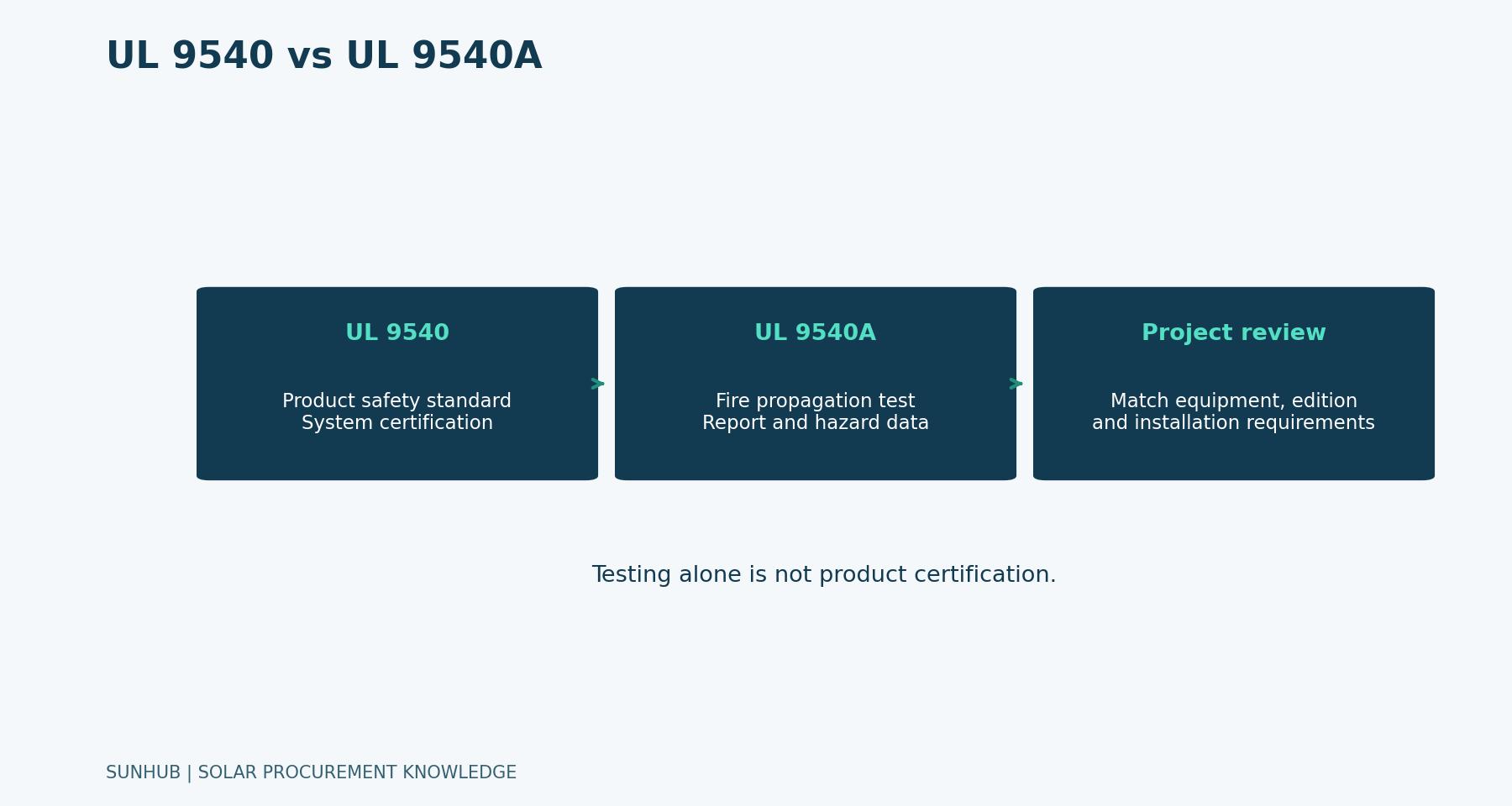
UL 9540A is a test method, not a product certification standard. A battery system cannot be described as UL 9540A-certified solely because it underwent this testing.
UL 9540 vs UL 9540A: Key Differences
| Feature | UL 9540 | UL 9540A |
|---|---|---|
| Primary purpose | Overall energy storage system safety | Thermal runaway and fire propagation testing |
| Type | Product safety standard | Standardized test method |
| Main focus | Integrated electrical and system safety | Fire, heat, and gas-related hazards |
| Evaluation scope | Complete energy storage equipment | Battery cells, modules, and larger system configurations |
| Certification | Can support product certification | Does not independently provide product certification |
| Primary users | Manufacturers, installers, AHJs | Manufacturers, fire safety engineers, AHJs |
| Relationship | May incorporate fire propagation evaluation requirements | Provides supporting test data |
The UL 9540 vs UL 9540A comparison shows why the two standards are complementary rather than interchangeable.
How Does UL 9540A Testing Work?
UL 9540A evaluates thermal runaway behavior at different levels, depending on the applicable edition and test program.
Cell-level testing
Evaluates whether individual battery cells undergo thermal runaway and characterizes released gases and associated hazards.
Module-level testing
Examines whether thermal runaway can spread between cells within a battery module.
Unit-level testing
Evaluates fire propagation, heat release, and other hazards involving larger battery assemblies.
Installation-level testing
Assesses fire behavior and protective measures under conditions intended to represent an energy storage installation.
Not every product undergoes every testing level. The required testing depends on the system configuration, applicable standard edition, and installation requirements.
What Changed in UL 9540A?
UL Solutions announced significant updates to UL 9540A in April 2025.
The fifth edition, published in March 2025, expanded testing considerations to address evolving battery technologies, including sodium-ion systems.
The updates also strengthened methods for evaluating fire hazards and thermal runaway behavior.
A sixth edition followed in March 2026, introducing further changes to large-scale fire testing and installation-level evaluations.
These developments reflect the industry’s growing focus on understanding how battery systems behave during severe failure events.
Manufacturers and project developers should confirm which edition is required by the applicable code, certification program, or AHJ.
Are UL 9540 and UL 9540A Required for Solar Batteries?
Requirements depend on the installation location, applicable code editions, system configuration, and local authority.
UL 9540 is referenced in U.S. energy storage installation requirements, including provisions associated with the National Electrical Code (NEC) and relevant fire codes.
UL 9540A testing may be required to support fire safety evaluations, installation configurations, or exceptions to certain separation and capacity limitations.
NFPA 855, Standard for the Installation of Stationary Energy Storage Systems, is particularly relevant to these decisions.
However, UL 9540A testing does not automatically authorize every installation arrangement.
The final design must satisfy applicable codes and AHJ requirements.
Why These Standards Matter for Solar Battery Procurement
Understanding UL 9540 vs UL 9540A documentation can affect equipment selection, permitting, installation costs, and project timelines.
Before purchasing a battery energy storage system, solar professionals should verify:
- Whether the complete system has an applicable UL 9540 certification.
- Which battery and inverter configurations are covered.
- Whether relevant UL 9540A test reports are available.
- Which edition of the test method was used.
- Whether installation instructions match the proposed project.
- Whether local authorities require additional fire safety documentation.
Buyers comparing solar batteries available through Sunhub should evaluate safety certification alongside battery capacity, chemistry, compatibility, warranties, and operating specifications.

Common Misconceptions About UL 9540 and UL 9540A
A common mistake is treating UL 9540A testing as equivalent to UL 9540 certification.
Another is assuming that a certified battery cell automatically makes the complete energy storage system certified.
System certification considers the integrated equipment and applicable operating configurations.
Buyers should also avoid assuming that UL 9540 certification eliminates all fire risks.
Safety standards establish evaluation requirements, but proper installation, maintenance, and compliance with local codes remain essential.
Conclusion
The main difference between UL 9540 vs UL 9540A is their purpose.
UL 9540 establishes safety requirements for complete energy storage systems, while UL 9540A provides testing methods for evaluating thermal runaway and fire propagation hazards.
Both play important roles in battery safety, but they are not substitutes for one another.
For solar installers, EPC contractors, and project developers, reviewing the correct certifications, test reports, and installation requirements supports safer equipment selection and more efficient project approvals.
Frequently Asked Questions
Is UL 9540A a certification?
No. UL 9540A is a standardized test method. It generates fire safety data but does not independently certify an energy storage product.
Does UL 9540 certification include UL 9540A testing?
UL 9540A testing may be required to support UL 9540 evaluations under applicable conditions. The specific requirements depend on the product and certification program.
What is the difference between UL 9540 and NFPA 855?
UL 9540 addresses energy storage equipment safety, while NFPA 855 establishes installation safety requirements for stationary energy storage systems.
Can a solar battery pass UL 9540A but not be UL 9540-certified?
Yes. A manufacturer may complete UL 9540A testing without obtaining certification of the complete energy storage system under UL 9540.
Sources
- UL Solutions : Enhancements to Battery Energy Storage System Safety Test Methods
- UL Solutions : UL 9540A Test Method for Battery Energy Storage Systems
- UL Standards & Engagement : UL 9540A, Sixth Edition (2026)
- Sustainable Energy Action Committee : UL 9540 and UL 9540A Informational Bulletin (2026)
- UL Solutions : Safety Testing for Residential Energy Storage Systems