

Installing solar panels is only one part of connecting a photovoltaic (PV) system to the electric grid. Before many grid-connected systems can begin exporting electricity, the project must complete the applicable utility or grid operator’s interconnection process. An important part of that process may be a Solar Interconnection Agreement.
A Solar Interconnection Agreement establishes the terms and technical requirements under which a solar generating system can connect to the electric grid. Depending on the project, the agreement may address system specifications, equipment requirements, testing, metering, operating responsibilities, maintenance, insurance, and conditions for exporting electricity.
Interconnection requirements vary significantly according to project size, location, utility territory, and whether the project connects to a distribution or transmission system. Understanding the process early can help homeowners, businesses, installers, EPCs, and developers avoid unnecessary project delays.
Table of Contents
Table of Contents
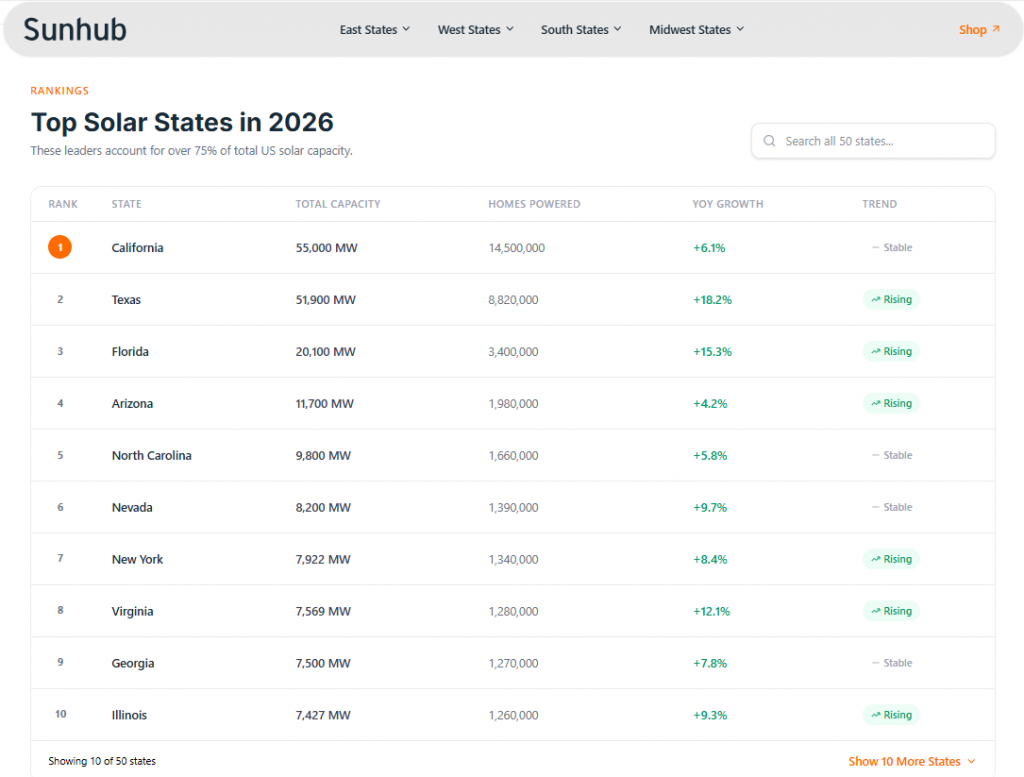
Explore U.S. Solar State Rankings
Compare solar rankings, installed capacity, growth trends, and market performance across all 50 states. Discover regional insights to support smarter procurement and expansion decisions.
What Is a Solar Interconnection Agreement?
A Solar Interconnection Agreement is a formal agreement governing how a solar generation facility connects to and operates in parallel with an electric power system.
Solar installations are examples of distributed energy resources (DERs) when they connect to local distribution networks. The U.S. Department of Energy (DOE) explains that distributed solar resources typically connect to lower-voltage distribution grids rather than the high-voltage transmission system used by traditional large generators. (The Department of Energy’s Energy.gov)
The Solar Interconnection Agreement helps establish responsibilities between the system owner and the entity operating the electric grid.
Depending on the utility and project, an agreement may address:
- System capacity
- Point of interconnection
- Approved equipment
- Protection requirements
- Metering
- Testing and inspection
- Maintenance responsibilities
- Operating requirements
- Access to equipment
- Insurance requirements
- Procedures for modifications
- Disconnection conditions
The exact requirements differ considerably between projects and jurisdictions.
Why Is an Interconnection Agreement Necessary?
Electric grids must continuously maintain safe and reliable operation while balancing electricity generation and consumption.
Adding a new electricity-generating resource changes how electricity can flow through part of that system. Utilities therefore need to evaluate whether the proposed installation can operate safely without negatively affecting grid equipment, power quality, or reliability.
DOE describes interconnection as the process through which renewable generation and energy storage resources connect to distribution and bulk power grids. (The Department of Energy’s Energy.gov)
For solar project owners, successfully completing a Solar Interconnection Agreement is therefore a critical step between designing a system and operating it as a grid-connected generation resource.
What Does the Solar Interconnection Process Look Like?
Requirements vary, but a distributed solar project will generally move through several stages.
1. Submit an interconnection application
The project owner or installer submits information about the proposed solar system to the relevant utility or authority.
Information may include:
- System capacity
- Solar panel specifications
- Inverter specifications
- Electrical diagrams
- Site plans
- Equipment certifications
- Proposed point of connection
Accurate documentation is important because missing or inconsistent information can delay technical review.
2. Utility technical review
The utility evaluates whether the proposed installation can safely connect to its distribution system.
Small projects may qualify for simplified or expedited review processes, while larger or more complicated systems may require additional engineering studies.
DOE’s Distributed Energy Resource Interconnection Roadmap recognizes the need to make interconnection simpler, faster, and more affordable while maintaining grid reliability and security. (The Department of Energy’s Energy.gov)
3. Additional studies or upgrades
Some projects require further analysis.
A utility may determine that existing infrastructure needs modifications before the project can safely interconnect.
Potential requirements can include:
- Transformer upgrades
- Protection equipment
- Voltage-control equipment
- Metering changes
- Distribution system upgrades
For larger projects, these requirements can significantly influence project costs and schedules.
4. Interconnection agreement
Once applicable technical requirements have been established, the project owner may execute an interconnection agreement with the utility or transmission provider.
The Solar Interconnection Agreement formalizes the conditions under which the system will connect and operate.
5. Construction, inspection, and testing
The solar installation must then be constructed according to the approved design and applicable electrical, building, utility, and safety requirements.
Utilities may require inspections, equipment testing, documentation, or other verification before authorizing operation.
FERC’s pro forma Small Generator Interconnection Agreement, for example, includes provisions addressing inspection, testing, authorization, and access. (Federal Energy Regulatory Commission)
6. Authorization to operate
Completing physical installation does not necessarily mean the system can immediately begin operating in parallel with the grid.
The applicable utility or grid operator may require final documentation and authorization before grid-connected operation begins.

Solar Interconnection Agreements and System Size
Interconnection requirements can differ dramatically depending on system size.
A small residential rooftop installation generally presents different engineering challenges from a multi-megawatt commercial solar project.
At the federal transmission level, FERC maintains standard interconnection procedures and agreements for small generators of 20 MW or less, as well as separate procedures for generators larger than 20 MW. (Federal Energy Regulatory Commission)
However, not every residential or commercial solar project falls under FERC jurisdiction. Many distributed solar projects are governed by state rules, public utility commissions, municipal utilities, cooperatives, or individual utility requirements.
This is why installers and developers should identify the applicable interconnection rules at the beginning of project development rather than assuming one nationwide procedure applies.
Technical Standards for Solar Interconnection
Technical standards are an important part of each Solar Interconnection Agreement and of safely connecting solar and other DERs to the grid.
One of the most significant is IEEE Standard 1547-2018, which establishes requirements for interconnection and interoperability between distributed energy resources and electric power systems.
DOE identifies IEEE 1547-2018 as establishing technical criteria and requirements for DER interconnection with electric power systems and associated interfaces. (The Department of Energy’s Energy.gov)
NREL also maintains technical resources specifically designed to help utilities, regulators, developers, policymakers, and other stakeholders understand and implement IEEE 1547-2018. (NREL)
Equipment selection therefore matters during interconnection planning. Inverters and other electrical equipment must satisfy the applicable technical and certification requirements for the project.
How Long Does Solar Interconnection Take?
There is no universal Solar Interconnection Agreement timeline.
Processing time depends on:
- Project size
- Utility territory
- Application completeness
- Grid conditions
- Required engineering studies
- Utility workload
- Equipment changes
- Required infrastructure upgrades
A straightforward residential installation may move through review relatively quickly, while a large commercial project requiring detailed engineering studies or grid upgrades can take substantially longer.
The challenge is significant enough that DOE’s DER Interconnection Roadmap establishes national improvement targets for 2030. Its targets include reducing the median period from interconnection request to agreement to less than one day for systems below 50 kW, less than 75 days for projects between 50 kW and 5 MW, and less than 140 days for projects above 5 MW. These are future performance targets, not current guaranteed processing times. (The Department of Energy’s Energy.gov)
Common Causes of Interconnection Delays
Some Solar Interconnection Agreement delays are outside a project developer’s control, but good preparation can reduce avoidable problems.
Common issues can include:
- Incomplete applications
- Incorrect equipment information
- Design changes after submission
- Missing electrical diagrams
- Incompatible equipment
- Grid capacity constraints
- Required infrastructure upgrades
- Delays completing inspections
Changing equipment after receiving approval can be particularly problematic if the replacement has different electrical characteristics.
Installers and EPCs should therefore consider equipment availability before submitting final designs.
Interconnection for Commercial and Utility-Scale Solar
Larger solar projects require significantly more interconnection planning.
Transmission-level projects may require detailed grid-impact studies, engineering analysis, financial deposits, and network upgrades before construction.
FERC’s Order No. 2023 introduced major reforms to generator interconnection procedures for transmission providers, including a shift toward a first-ready, first-served cluster study process in which multiple proposed generating facilities can be evaluated together. (Federal Energy Regulatory Commission)
The reforms are intended to improve efficiency, transparency, and timeliness while addressing increasingly large interconnection queues.
For commercial developers and EPCs, the Solar Interconnection Agreement should therefore be considered during early project feasibility, not after equipment has already been purchased.
Solar Plus Battery Storage and Interconnection
Adding battery energy storage can also affect interconnection requirements.
A solar-plus-storage system may operate differently depending on whether the battery:
- Charges from solar only
- Charges from the grid
- Exports electricity
- Provides backup power only
- Participates in utility programs
These operating modes can affect how utilities evaluate the project and structure the Solar Interconnection Agreement.
DOE explicitly includes battery energy storage among the distributed energy technologies that must navigate grid interconnection processes. (The Department of Energy’s Energy.gov)
Developers should clearly define the intended operating configuration when submitting an interconnection application.
Why Interconnection Should Be Considered Early
A common mistake is treating interconnection as paperwork to complete after the solar system has been designed.
Instead, it should be part of early project planning.
Before finalizing equipment purchases, developers should understand:
- Applicable utility requirements
- Interconnection application procedures
- Required technical standards
- Potential upgrade costs
- Expected review timelines
- Approved inverter requirements
- Export limitations
- Metering requirements
This can prevent a project from purchasing equipment or completing designs that later need to be modified.
Conclusion
A Solar Interconnection Agreement is an important part of connecting many solar energy systems to the electric grid. It establishes the conditions under which a project can interconnect and operate while helping utilities maintain grid safety and reliability.
The process can range from relatively straightforward reviews for smaller distributed systems to extensive engineering studies and agreements for large commercial and utility-scale projects.
Because requirements vary by utility, jurisdiction, system size, and grid conditions, project owners should investigate interconnection requirements early. Accurate applications, compliant equipment, clear system designs, and early coordination with the relevant utility can help reduce avoidable delays and keep solar projects moving toward operation.
Frequently Asked Questions
What is a Solar Interconnection Agreement?
It is an agreement establishing the technical and operational conditions under which a generating system such as solar can connect to an electric grid.
Do all solar systems need an interconnection agreement?
Grid-connected projects generally must follow the applicable utility or grid operator’s interconnection requirements, but the exact process and documentation vary by jurisdiction, project size, and system configuration.
Can solar panels operate before interconnection approval?
Physical installation does not necessarily authorize grid-connected operation. Project owners should follow their utility’s requirements and obtain any required authorization before operating the system in parallel with the grid.
What is IEEE 1547?
IEEE 1547 is an important technical standard governing the interconnection and interoperability of distributed energy resources with electric power systems. DOE and NREL provide resources supporting implementation of IEEE 1547-2018. (The Department of Energy’s Energy.gov)
Can battery storage affect a solar interconnection application?
Yes. The battery’s charging, exporting, and operating configuration can affect how the project interacts with the grid and therefore how it is evaluated during interconnection.
Sources
- U.S. Department of Energy : Distributed Energy Resource Interconnection Roadmap
- U.S. Department of Energy : Interconnection Resources
- U.S. Department of Energy : Distributed Energy Resources
- U.S. Department of Energy : Essential Grid Reliability Standards for Inverter-Based Resources
- Federal Energy Regulatory Commission : Standard Interconnection Agreements and Procedures for Small Generators
- Federal Energy Regulatory Commission : Generator Interconnection
- FERC : Improvements to Generator Interconnection Procedures and Agreements
- National Renewable Energy Laboratory : IEEE 1547-2018 Standard Guidance