
For solar installers, project success depends on more than technical knowledge and installation quality. Reliable equipment sourcing, competitive pricing, product availability, and coordinated delivery are also essential to completing projects on schedule and within budget.
Choosing the right solar panels for installers requires careful evaluation of module performance, electrical compatibility, certifications, warranties, supplier reliability, logistics, and total delivered cost.
Installers must also manage changing inventory levels, project-specific requirements, customer expectations, and multiple bills of materials. Digital procurement tools and Request for Quote systems can simplify this process by allowing installers to compare equipment and supplier offers through a centralized workflow.
This guide explains what installers should consider when purchasing solar panels, how to evaluate suppliers, and how modern procurement methods can reduce sourcing time and project risk.
Key Takeaways
- Installers should compare module performance, certifications, warranties, dimensions, electrical specifications, and long-term availability.
- The best solar panel is the one that fits the project design, installation environment, customer requirements, and budget.
- IEC 61215 addresses module design qualification and type approval. IEC 61730 and UL 61730 address module safety qualification.
- Certification does not automatically prove that a panel will provide the same service life in every climate or installation environment.
- RFQs allow installers to submit project requirements once and compare responses from multiple suppliers.
- The lowest panel price may not produce the lowest total project cost after freight, labor, storage, substitutions, and warranty risk are considered.
- Installers should verify inventory location, product condition, warranty eligibility, and delivery timelines before payment.
- Managing panels, inverters, batteries, racking, and balance-of-system equipment together can improve project coordination.
Why Equipment Selection Matters for Solar Installers
Every completed installation reflects the installer’s reputation.
Incorrect or unreliable equipment can create problems during system design, permitting, installation, inspection, commissioning, and long-term operation.
Selecting suitable equipment can help installers:
- Reduce product-related service calls
- Minimize warranty claims
- Avoid last-minute design changes
- Improve installation consistency
- Meet customer expectations
- Maintain project schedules
- Reduce component compatibility problems
- Improve long-term system performance
The lowest-priced solar panel may not be the best choice if it creates additional engineering, racking, electrical, labor, or warranty expenses.
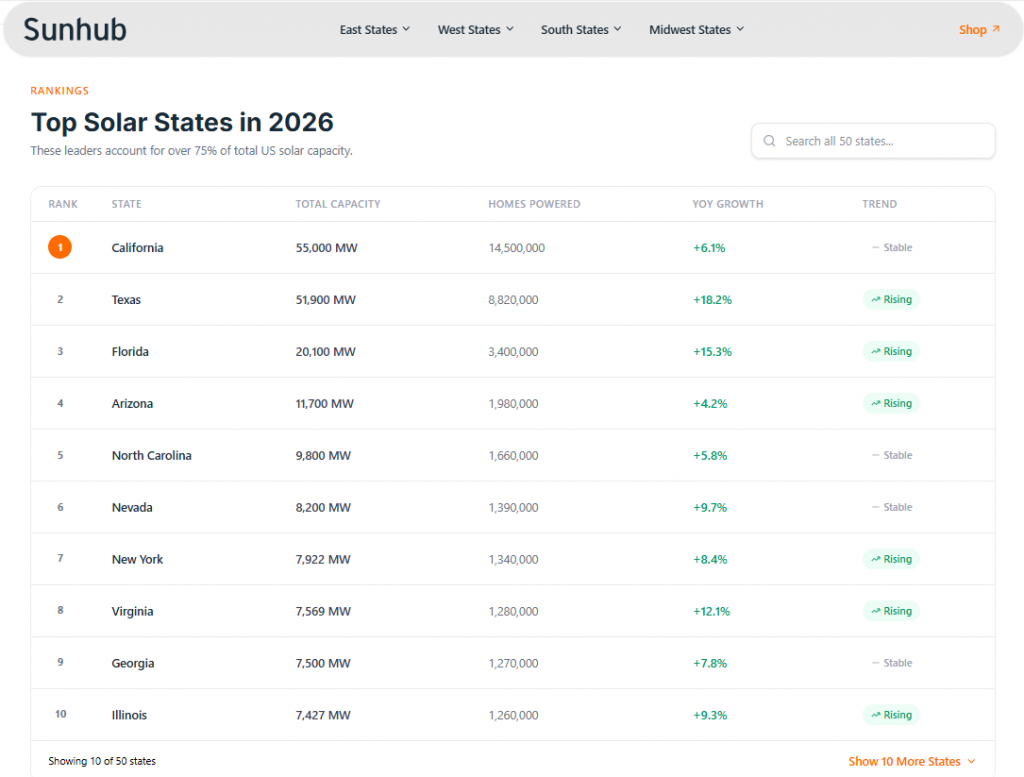
Explore U.S. Solar State Rankings
Compare solar rankings, installed capacity, growth trends, and market performance across all 50 states. Discover regional insights to support smarter procurement and expansion decisions.
What Installers Should Compare When Selecting Solar Panels
Solar panels should be evaluated at the model level rather than by manufacturer name alone.
Rated Power
Rated power shows the module’s output under standard test conditions.
Higher wattage can reduce the number of modules required for a target system size. However, higher-wattage panels may also be physically larger or have electrical characteristics that require changes to the system design.
Installers should confirm that the selected wattage works with:
- Available roof or ground space
- Racking layout
- Inverter input limits
- String sizing
- System voltage
- Transportation and handling requirements
Module Efficiency
Module efficiency measures how effectively a panel converts sunlight into electricity under standardized conditions.
Higher-efficiency modules can be valuable for projects with limited installation space. However, efficiency should be considered together with module dimensions, wattage, price, temperature behavior, and project conditions.
A physically larger panel may produce more power without necessarily providing a major efficiency advantage.
Temperature Coefficient
Solar panel output generally declines as cell temperature increases.
The temperature coefficient indicates how module performance changes when operating temperature rises above the reference condition.
This specification can be particularly important for:
- Hot climates
- Low-clearance rooftop systems
- Commercial roofs with high surface temperatures
- Projects with limited ventilation behind the array
A less negative power temperature coefficient generally indicates better relative performance at elevated module temperatures.
Annual Degradation Rate
Solar panels gradually lose some power-producing capability over time.
Installers should review:
- First-year degradation allowance
- Annual degradation allowance
- Final warranted power level
- Length of the performance warranty
- Testing and claim requirements
A lower degradation rate can support greater expected energy production over the system’s operating life.
Product Warranty
The product warranty generally addresses eligible defects in materials or manufacturing.
Installers should examine:
- Warranty duration
- Covered defects
- Exclusions
- Claim procedures
- Required records
- Transferability
- Shipping responsibilities
- Labor coverage
- Repair or replacement terms
A long warranty period is valuable only if the coverage is applicable, understandable, and supported by the manufacturer.
Performance Warranty
The performance warranty describes the minimum power output that the manufacturer warrants over a specified period.
A performance warranty is not the same as a guarantee of actual system energy production. Real-world production also depends on design, shading, weather, soiling, temperature, installation quality, equipment operation, and system availability.
Dimensions and Weight
Module dimensions affect:
- Roof layout
- Setbacks
- Racking quantities
- Attachment locations
- Row spacing
- Ground-mount design
- Pallet configuration
- Warehouse requirements
- Manual handling
- Labor planning
A module substitution with similar wattage may still require a redesign if its dimensions, weight, clamp zones, or mounting requirements differ.
Mechanical Load Ratings
Installers should review the manufacturer’s mechanical load specifications and installation instructions.
Project engineers may need to consider:
- Wind conditions
- Snow loads
- Hail exposure
- Module orientation
- Clamp locations
- Support points
- Racking compatibility
- Local building requirements
Passing a basic certification test does not automatically establish suitability for every high-wind, high-snow, or severe-hail location.
Electrical Specifications
Installers should review:
- Open-circuit voltage
- Maximum power voltage
- Short-circuit current
- Maximum power current
- Maximum system voltage
- Maximum series fuse rating
- Connector type
- Cable length
- Power tolerance
- Bifacial electrical characteristics, when applicable
These values affect inverter selection, conductor sizing, string design, overcurrent protection, and code compliance.
Solar Panel Specification Comparison Table
| Specification | Why installers should review it |
|---|---|
| Rated power | Determines the number of panels required for the target system capacity |
| Module efficiency | Affects energy-producing capacity within the available installation area |
| Dimensions | Influences layout, racking, setbacks, shipping, and storage |
| Weight | Affects structural review, handling, and installation labor |
| Temperature coefficient | Indicates how power changes as module temperature increases |
| Open-circuit voltage | Affects maximum string length and cold-temperature voltage calculations |
| Short-circuit current | Influences conductor and overcurrent protection calculations |
| Maximum system voltage | Must match the approved system architecture |
| Mechanical load rating | Helps evaluate suitability for project wind and snow conditions |
| Product warranty | Covers eligible defects according to the manufacturer’s terms |
| Performance warranty | Describes warranted power retention over time |
| Connector type | Must work with the approved electrical design |
| Clamp zones | Determine where the module can be securely attached |
| Bifacial rating | Matters when rear-side energy production is included in the design |
Understanding Solar Panel Certifications
Installers should verify that the exact panel model complies with the standards and listing requirements that apply to the project.
IEC 61215
IEC 61215 addresses the design qualification and type approval of terrestrial photovoltaic modules intended for long-term outdoor operation.
The testing evaluates whether a module design can withstand specified electrical, mechanical, and environmental stresses.
However, IEC states that the results should not be interpreted as a quantitative prediction of a module’s service life in every operating environment. IEC 61215-1:2021
IEC 61730
IEC 61730 addresses photovoltaic module safety qualification.
The standard covers construction and testing requirements intended to reduce risks involving:
- Electric shock
- Fire
- Mechanical injury
- Environmental and mechanical stresses
IEC 61730-1 contains construction requirements, while IEC 61730-2 establishes safety testing requirements. IEC 61730-1:2023, IEC 61730-2:2023
UL 61730
UL 61730 is commonly used for photovoltaic module safety qualification in North America.
Installers should confirm that the exact manufacturer and model number appear in the applicable certification or listing record.
A general statement on a datasheet should not replace model-specific verification.
Certification Does Not Replace Project Review
A certified solar panel may still be unsuitable for a particular project.
Installers must also confirm compliance with:
- Local electrical codes
- Building requirements
- Fire classifications
- Utility requirements
- Structural design
- Permitting rules
- Financing requirements
- Insurance conditions
- Manufacturer installation instructions
Certification is one part of equipment qualification, not the complete project approval process.
Review Environmental and Site Conditions
A module that performs well on one project may not be the best option for another.
High-Temperature Locations
Installers working in hot regions should review:
- Temperature coefficient
- Maximum operating temperature
- Rooftop ventilation
- Inverter string voltage at temperature extremes
- Cable and connector ratings
High-Wind Locations
Projects in high-wind areas may require additional attention to:
- Module mechanical load ratings
- Approved clamp zones
- Attachment spacing
- Racking certification
- Structural engineering
- Edge and corner zones
Snow-Prone Areas
For projects exposed to snow, installers should evaluate:
- Front-load rating
- Frame strength
- Module orientation
- Support locations
- Snow accumulation patterns
- Local structural requirements
Hail-Prone Regions
Installers should not assume that basic certification testing establishes strong resistance to severe hail.
The U.S. Department of Energy notes that the standard IEC 61215 hail test uses 25-millimeter ice balls, while larger optional test sizes can provide additional information for severe hail locations. U.S. Department of Energy hail guidance
Coastal and Corrosive Environments
Projects near coastlines, industrial areas, farms, or other corrosive environments may require additional module and racking qualifications.
Installers should review available documentation for:
- Salt mist exposure
- Ammonia resistance
- Frame and fastener materials
- Connector protection
- Grounding and bonding components
Choosing the Right Solar Panel Manufacturer
Installers may encounter products from manufacturers such as:
- Canadian Solar
- JinkoSolar
- LONGi Solar
- Trina Solar
- JA Solar
- Qcells
- REC Group
- First Solar
The best manufacturer depends on the project rather than brand recognition alone.
Installers should compare:
- Model-level specifications
- Current product availability
- Warranty terms
- Technical documentation
- Certification records
- Manufacturer support
- Module dimensions
- Electrical compatibility
- Track record in the project market
- Availability of replacement panels
- Financing or approved-vendor requirements
A familiar manufacturer may offer several product lines with different technologies, warranties, dimensions, and intended applications.
Compare Solar Panel Technologies
Monocrystalline Solar Panels
Monocrystalline modules are widely used in residential, commercial, and utility-scale projects.
They are available in numerous wattages, dimensions, cell formats, and efficiency levels.
N-Type Solar Panels
N-type modules have become increasingly common across the solar market.
Depending on the specific design, potential advantages may include:
- Lower degradation
- Stronger high-temperature performance
- Improved bifacial performance
- Higher module efficiency
Installers should compare actual product specifications rather than assuming every N-type panel provides the same advantages.
TOPCon Solar Panels
TOPCon is an N-type cell architecture used by multiple manufacturers.
Installers should review model-specific:
- Efficiency
- Temperature coefficient
- Degradation allowance
- Bifaciality
- Dimensions
- Warranty terms
Bifacial Solar Panels
Bifacial panels can generate electricity from light reaching both the front and rear surfaces.
Rear-side production depends on:
- Ground reflectivity
- Row height
- Row spacing
- Racking design
- Shading
- Surface conditions
- Module construction
Bifacial modules may be more valuable for ground-mounted systems and elevated structures than for roof installations with limited rear-side light.
Thin-Film Solar Panels
Thin-film modules use different semiconductor materials and may offer different performance, form-factor, and temperature characteristics.
Their suitability depends on project design, available area, system requirements, procurement availability, and installation experience.
Procurement Challenges Facing Installers
Solar installers frequently manage several projects at different stages of sales, permitting, procurement, and construction.
Common sourcing challenges include:
- Inventory shortages
- Product discontinuations
- Changing module wattages
- Long lead times
- Multiple supplier communications
- Price volatility
- Shipping delays
- Incomplete documentation
- Managing bills of materials
- Coordinating several delivery locations
- Warranty uncertainty
- Last-minute equipment substitutions
- Limited warehouse capacity
Traditional procurement may require installers to contact several distributors separately, repeat the same requirements, and manually compare quotes with different formats and commercial terms.
Start With a Clear Purchasing Specification
Before requesting solar panel quotes, installers should define the project requirements.
A purchasing specification may include:
- Required total system capacity
- Preferred module wattage range
- Maximum module dimensions
- Maximum module weight
- Cell technology
- Minimum efficiency
- Electrical characteristics
- Maximum system voltage
- Required certifications
- Fire classification
- Mechanical load requirements
- Product warranty
- Performance warranty
- Acceptable degradation rate
- Delivery location
- Required delivery date
- Preferred manufacturers
- Acceptable equivalent products
- Required product condition
- Required quantity
- Pallet or truckload preferences
Clear specifications help suppliers provide comparable offers and reduce the risk of quoting unsuitable products.
Compare More Than the Module Price
A useful supplier comparison should include all costs and commercial conditions.
Installers should request:
- Price per panel
- Price per watt
- Available quantity
- Minimum order quantity
- Product condition
- Inventory location
- Freight cost
- Insurance cost
- Taxes or duties
- Handling charges
- Payment terms
- Quote expiration date
- Estimated shipping date
- Estimated delivery date
- Warranty eligibility
- Return terms
- Freight claim process
- Replacement availability
Calculate Total Delivered Cost
The total delivered cost may include:
- Solar panel cost
- Freight
- Insurance
- Taxes
- Duties
- Brokerage
- Storage
- Unloading
- Final-mile delivery
- Payment processing
- Inspection
- Replacement risk
- Financing costs
A lower price per watt can become more expensive after shipping, storage, handling, and project redesign costs are added.
U.S. Solar Installation Demand by Market Segment
The scale of solar deployment influences equipment demand, supplier inventory, and procurement planning.
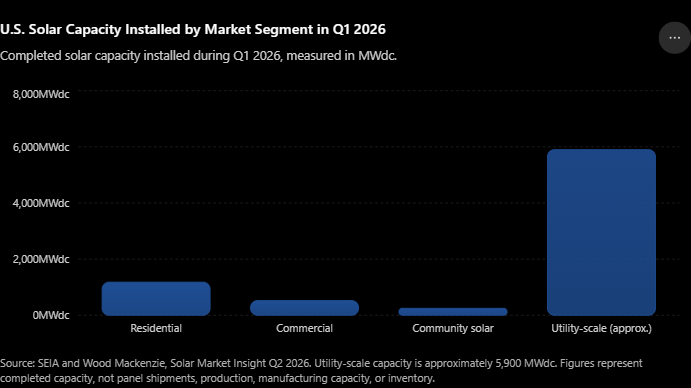
SEIA reported that the United States installed approximately 7.8 GWdc of solar capacity during the first quarter of 2026. Utility-scale projects represented most of that capacity, while residential, commercial, and community solar together accounted for almost 2 GWdc. SEIA Solar Market Insight Q2 2026
U.S. solar capacity installed by segment in Q1 2026
New solar capacity installed during the first quarter of 2026, measured in MWdc.0MWdc2,000MWdc4,000MWdc6,000MWdc8,000MWdcResidentialCommercialCommunity solarUtility-scale
Evaluate Solar Equipment Suppliers
Supplier reliability can be as important as module selection.
Before placing an order, installers should evaluate:
- Legal business information
- Solar industry experience
- Inventory access
- Warehouse location
- Manufacturer relationships
- Product documentation
- Technical support
- Warranty assistance
- Shipping capabilities
- Claims procedures
- Payment security
- Customer references
Confirm Physical Inventory
A supplier listing a module does not always mean the requested quantity is immediately available.
Installers should ask:
- Is the inventory physically in stock?
- Where is it stored?
- How many panels are available?
- Is the quantity already reserved?
- Are all modules the same model?
- What is the product condition?
- When can the order ship?
- Can current photographs be provided?
- Are serial number records available?
Installers working against firm construction schedules should distinguish between in-stock inventory and products that still need to be manufactured or imported.
Confirm Product Condition
Solar panels may be offered as:
- New
- New old stock
- Surplus inventory
- Open-box
- B-grade
- Used
- Refurbished
- Damaged packaging
The product condition should be clearly stated in the quote, invoice, and purchase agreement.
Verify Payment Instructions
Installers should confirm the supplier’s legal name, address, authorized representative, and banking information before sending payment.
Any unexpected change in payment instructions should be verified through a previously confirmed communication method.
Using RFQs to Compare Solar Suppliers
A Request for Quote allows an installer to submit project requirements and request commercial offers from one or more suppliers.
Information to Include in an RFQ
A detailed RFQ should include:
- Equipment category
- Manufacturer preference
- Acceptable alternatives
- Model number, when required
- Required quantity
- Target system capacity
- Technical specifications
- Product condition
- Delivery address
- Required delivery date
- Warranty requirements
- Certification requirements
- Shipping preferences
- Payment requirements
- Project notes
The more precise the request, the easier it becomes to compare supplier responses.
What to Compare in RFQ Responses
Installers should compare:
- Price per panel
- Price per watt
- Available quantity
- Inventory location
- Product condition
- Shipping cost
- Delivery timeline
- Warranty coverage
- Commercial terms
- Quote validity
- Substitution conditions
- Return and claims policies
- Supplier support
Benefits of an RFQ Process
RFQs can help installers:
- Reduce repetitive supplier communication
- Receive multiple offers
- Improve pricing visibility
- Compare inventory availability
- Document procurement decisions
- Identify suitable alternatives
- Coordinate larger project pipelines
- Reduce sourcing time
Installers can submit equipment requirements through Sunhub’s RFQ platform to request competitive quotes from solar suppliers.
Protect Projects From Unapproved Substitutions
Equipment substitutions are common when inventory changes, but they should not be approved based only on similar wattage.
A proposed replacement panel may affect:
- Array dimensions
- Roof layout
- Structural loading
- Clamp locations
- String sizing
- Inverter compatibility
- Conductor calculations
- Racking quantities
- Fire pathways
- Permit documents
- Energy models
- Customer agreements
- Warranty expectations
Before approving a substitute, installers should compare the original and replacement datasheets line by line.
Engineering documents, permits, bills of materials, and customer approvals may also need to be updated.
Review Documentation Before Purchasing
Installers should request the available documentation before approving an order.
This may include:
- Manufacturer datasheet
- Installation manual
- Warranty document
- Certification records
- Safety listing information
- Current product photographs
- Serial number information
- Packing list
- Commercial invoice
- Bill of lading
- Flash-test data, when available
- Manufacturer authorization information, when applicable
The U.S. Department of Energy recommends using technical specifications throughout procurement, design, delivery, installation, and commissioning. DOE photovoltaic procurement guidance
Plan Solar Panel Logistics
Bulk solar panel deliveries require coordination between the supplier, freight carrier, warehouse, installation team, and project site.
Confirm Shipping Details
Before shipment, installers should confirm:
- Number of pallets
- Panels per pallet
- Pallet dimensions
- Total shipment weight
- Carrier information
- Tracking information
- Delivery appointment requirements
- Receiving hours
- Site access
- Vehicle restrictions
- Unloading responsibility
- Liftgate requirements
- Forklift availability
- Storage location
Inspect Solar Panels on Arrival
The receiving team should inspect the delivery before signing the receipt.
Check for:
- Crushed packaging
- Broken pallets
- Torn wrapping
- Water exposure
- Shifted modules
- Broken glass
- Damaged frames
- Missing pallets
- Incorrect labels
- Incorrect quantities
Visible damage or shortages should be recorded on the delivery receipt before the carrier leaves.
Installers should photograph:
- The complete shipment
- Pallets
- Packaging
- Product labels
- Visible damage
- Trailer conditions, when relevant
Freight claims should be submitted according to the supplier’s or carrier’s stated procedure.
Store Panels Correctly
If the panels will not be installed immediately, installers should follow the manufacturer’s storage instructions.
Poor storage may expose equipment to:
- Moisture
- Impact damage
- Excessive stacking
- Unstable surfaces
- Connector contamination
- Theft
- Unauthorized handling
Warehouse capacity and storage costs should be considered before purchasing equipment for unconfirmed projects.
Managing Warranties and Serial Numbers
Installers should maintain organized records for every project.
Important records may include:
- Purchase invoice
- Supplier quote
- Module model number
- Serial numbers
- Delivery receipt
- Warranty documents
- Certification records
- Product photographs
- Installation date
- Commissioning results
- Customer information
- System layout
These records can make future warranty claims, maintenance, system expansion, or panel replacement easier to manage.
Understand Warranty Responsibility
The manufacturer usually provides the module product and performance warranties.
The supplier may assist with documentation or communication, but supplier support does not necessarily replace the manufacturer’s warranty responsibilities.
Installers should confirm:
- Whether the manufacturer recognizes the product
- Whether the warranty applies in the project country
- Whether the sales channel affects eligibility
- What documentation is required
- Who pays for shipping
- Whether labor is covered
- What remedy is provided
The DOE’s procurement specifications guidance notes that module warranties may not cover labor costs, making it important to evaluate the actual value and limitations of the coverage. DOE procurement specifications
Beyond Solar Panels
A complete installation requires more than photovoltaic modules.
Installers may also need:
- Solar inverters
- Microinverters
- Power optimizers
- Battery storage systems
- Mounting and racking
- Monitoring equipment
- Rapid shutdown equipment
- Charge controllers
- Solar cables
- Connectors
- Combiner boxes
- Disconnects
- Electrical panels
- Grounding and bonding equipment
- Other balance-of-system components
Centralizing equipment requirements can help procurement teams identify compatibility issues and coordinate delivery schedules.
Managing the Bill of Materials
A bill of materials should identify every major component required for the project.
A detailed BOM may include:
- Manufacturer
- Model number
- Quantity
- Technical description
- Approved equivalents
- Required certification
- Supplier
- Unit cost
- Delivery date
- Project assignment
- Procurement status
- Substitution status
Installers managing multiple projects should avoid assigning the same inventory to more than one project.
A centralized inventory and BOM process can improve visibility across sales, engineering, procurement, warehousing, and installation teams.
Procurement Best Practices for Installers
Before purchasing solar equipment, installers should:
- Define technical requirements before requesting quotes.
- Compare multiple supplier offers.
- Verify the exact manufacturer and model.
- Confirm product certifications and listing records.
- Review datasheets and installation manuals.
- Confirm warranty eligibility.
- Calculate total delivered cost.
- Verify physical inventory.
- Confirm delivery timelines.
- Review product condition.
- Check compatibility between system components.
- Document approved substitutions.
- Inspect equipment when it arrives.
- Maintain invoices, serial numbers, and warranty records.
- Avoid purchasing excessive inventory without confirmed project demand.
Solar Panel Procurement Checklist
Project Requirements
- Confirm system capacity.
- Identify the project type.
- Define the module wattage range.
- Confirm maximum dimensions.
- Establish electrical requirements.
- Identify environmental conditions.
- Confirm certification and code requirements.
Product Review
- Verify manufacturer and model number.
- Review rated power and efficiency.
- Check temperature coefficient.
- Review degradation terms.
- Confirm dimensions and weight.
- Review mechanical load ratings.
- Verify electrical specifications.
- Confirm connector and cable details.
Supplier Review
- Verify the supplier’s business information.
- Confirm the inventory location.
- Verify product condition.
- Request current inventory evidence.
- Review supplier support.
- Confirm payment instructions.
- Understand return and claims procedures.
Pricing Review
- Compare price per panel.
- Compare price per watt.
- Include freight and insurance.
- Include handling and storage.
- Review taxes and duties.
- Calculate total delivered cost.
- Check the quote expiration date.
Logistics Review
- Confirm pallet quantities.
- Verify shipment dimensions and weight.
- Check delivery site access.
- Arrange unloading equipment.
- Prepare a receiving inspection process.
- Confirm storage requirements.
Documentation Review
- Obtain the datasheet.
- Obtain the installation manual.
- Review warranty documents.
- Verify certification records.
- Retain invoices and shipping documents.
- Record serial numbers.
The Future of Solar Equipment Procurement
Solar procurement is becoming increasingly digital as installers manage larger project pipelines, more equipment options, and rapidly changing inventory.
Digital sourcing tools can help installers:
- Reduce procurement time
- Compare suppliers efficiently
- Improve inventory visibility
- Access competitive pricing
- Organize RFQ responses
- Maintain purchasing records
- Coordinate multiple projects
- Identify alternative products
These tools do not eliminate the need for technical and supplier due diligence.
Installers must still verify product specifications, certification status, warranty eligibility, inventory availability, commercial terms, and delivery arrangements before purchasing.
Conclusion
Selecting suitable solar panels for installers involves much more than choosing a well-known manufacturer or finding the lowest price per watt.
Successful procurement requires installers to evaluate module efficiency, temperature behavior, electrical specifications, dimensions, warranties, certifications, supplier reliability, logistics, and total delivered cost.
A structured RFQ process can reduce repetitive communication and make it easier to compare pricing, inventory, delivery schedules, and commercial terms from multiple suppliers.
By combining digital procurement tools with careful technical review, installers can reduce sourcing delays, improve project coordination, and purchase equipment that meets the actual requirements of each installation.
Frequently Asked Questions
What should installers look for when buying solar panels?
Installers should compare module efficiency, temperature coefficient, electrical specifications, dimensions, mechanical load ratings, warranties, degradation rates, certifications, manufacturer support, availability, and project compatibility.
Why are RFQs useful for solar installers?
RFQs allow installers to submit project requirements and compare responses from multiple suppliers.
They can make it easier to evaluate pricing, inventory, shipping timelines, warranty terms, and commercial conditions.
Which certifications should solar panels have?
Applicable requirements depend on the project location.
Common standards include IEC 61215 for design qualification and type approval, IEC 61730 for module safety qualification, and UL 61730 for photovoltaic module safety qualification in North America.
Installers should verify the exact model and listing record.
Does IEC 61215 guarantee that a panel will last 25 years?
No. IEC 61215 evaluates whether a module design can withstand specified test conditions.
IEC states that the results are not a quantitative prediction of module lifetime. Actual service life depends on the design, environment, operation, installation quality, and maintenance.
How can installers compare panels with different wattages?
Price per watt can provide an initial cost comparison:
Price per watt = Panel price divided by rated wattage
Installers should also compare module dimensions, efficiency, freight, labor, racking, electrical design, warranties, and total delivered cost.
What equipment do solar installers typically source?
In addition to panels, installers may purchase inverters, batteries, racking, rapid shutdown equipment, monitoring systems, charge controllers, cables, connectors, electrical panels, and other balance-of-system components.
How can installers confirm that panels are physically in stock?
Installers can request the inventory location, available quantity, current photographs, product labels, serial number records, and an estimated shipping date.
The supplier should also confirm whether the inventory has been reserved for another customer.
What should installers do if a quoted solar panel becomes unavailable?
The supplier may propose an alternative, but the installer should compare the replacement’s dimensions, electrical specifications, mounting requirements, certifications, warranties, and compatibility.
Permits, engineering documents, energy models, and customer approvals may need to be updated.
Are manufacturer warranties enough to protect installers?
Not always. Warranty value depends on eligibility, exclusions, claim requirements, manufacturer support, shipping responsibilities, and available remedies.
Labor and project downtime may not be covered.
How can installers simplify solar procurement?
Installers can use a centralized RFQ workflow, maintain accurate bills of materials, compare total delivered costs, prequalify suppliers, track inventory, and standardize receiving and documentation procedures.
Sources
Sources: Solar Energy Industries Association and Wood Mackenzie, Solar Market Insight Q2 2026; U.S. Department of Energy, Life Cycle of Photovoltaic Systems: Procure a New Photovoltaic System