
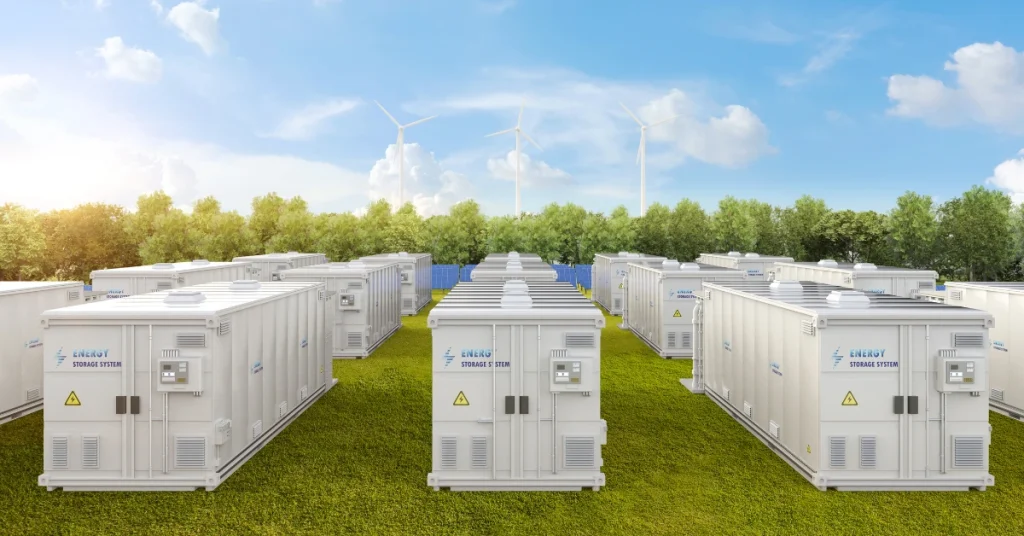
NFPA 855 battery storage safety starts with choosing suitable equipment and planning a compliant installation. Battery energy storage systems (BESS) are increasingly used alongside solar installations to store excess electricity, manage peak demand, and provide backup power. However, installing battery storage involves more than selecting the right capacity and inverter.
Fire safety, equipment certification, installation location, and emergency response planning are also important considerations.
NFPA 855 battery storage requirements provide a framework for reducing fire and related hazards associated with stationary energy storage systems.
For solar installers, EPC contractors, developers, and equipment buyers, understanding NFPA 855 helps support safer system design and more efficient permitting.
Table of Contents

Explore U.S. Solar State Rankings
Compare solar rankings, installed capacity, growth trends, and market performance across all 50 states. Discover regional insights to support smarter procurement and expansion decisions.
What Is NFPA 855?
NFPA 855, Standard for the Installation of Stationary Energy Storage Systems, establishes safety requirements for installing stationary energy storage equipment.
Developed by the National Fire Protection Association (NFPA), the standard addresses hazards associated with battery installations, including thermal runaway, fire propagation, explosion risks, and emergency response.
Its provisions cover areas such as:
- Installation locations and equipment separation
- Fire detection and suppression
- Ventilation and explosion control
- Equipment certification and testing
- Emergency planning and response
- Commissioning, operation, and maintenance
The requirements vary depending on battery technology, installation type, energy capacity, and applicable code provisions.
NFPA 855 vs. UL 9540 vs UL 9540A
Three standards frequently appear in battery storage safety discussions, but they serve different purposes.
| Standard | Primary purpose | What it addresses |
|---|---|---|
| NFPA 855 | Installation safety | Placement, separation, fire protection, and emergency planning |
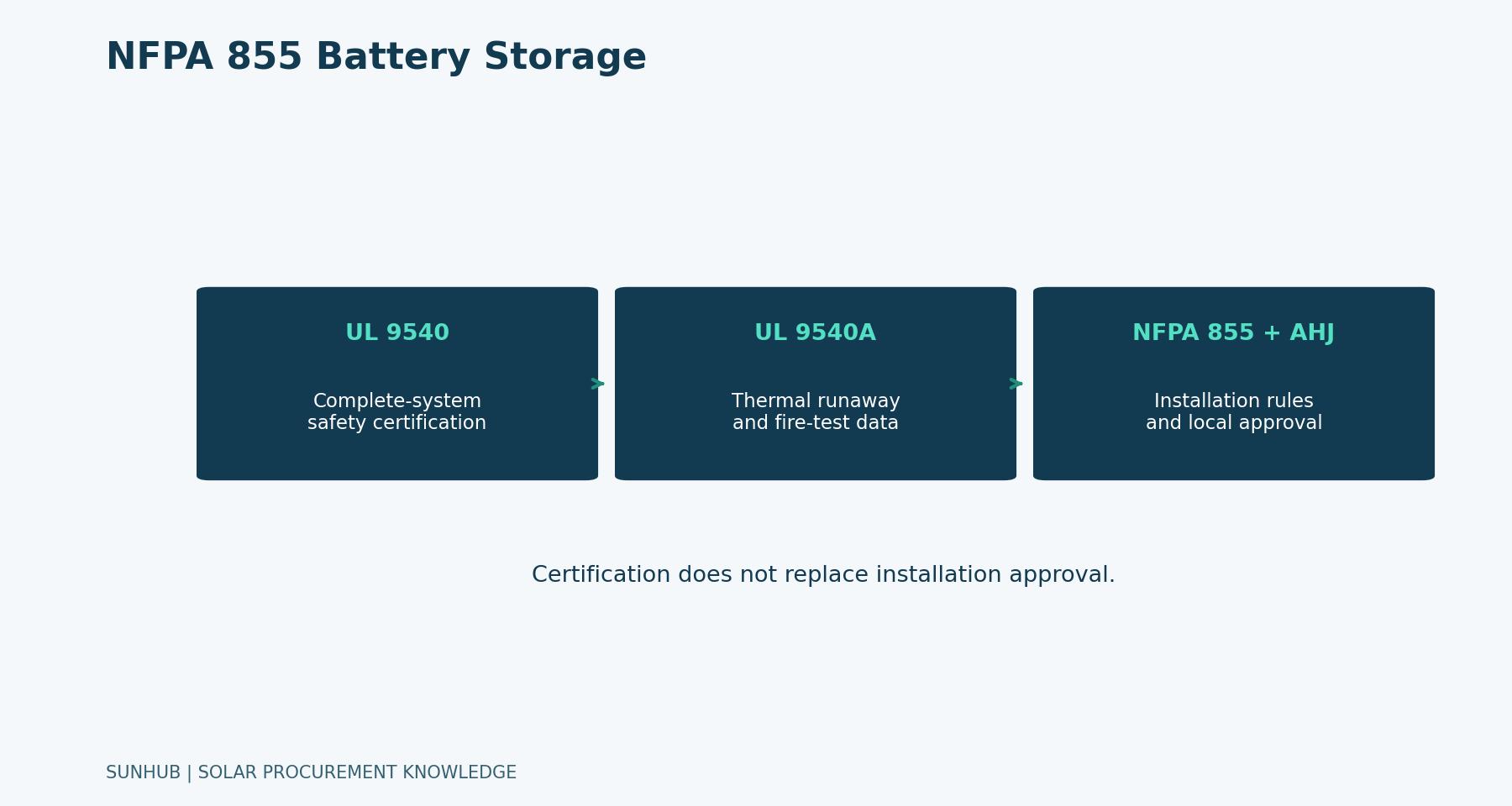
| UL 9540 | Equipment safety certification | Safety of complete energy storage systems |
| UL 9540A | Thermal runaway testing | Fire propagation and related hazards during battery failures |
NFPA 855 battery storage guidance focuses on how energy storage systems are installed, while UL 9540 evaluates the safety of the equipment itself.
UL 9540A provides test data that can help determine appropriate installation requirements.
Importantly, UL 9540A is a test method, not a product certification.
Key NFPA 855 Battery Storage Requirements
1. Equipment certification
NFPA 855 generally requires applicable energy storage systems to meet recognized equipment safety standards, including UL 9540.
Certification should cover the complete system configuration rather than individual battery cells alone.
Installers should verify that the proposed battery, inverter, and associated equipment match the certified configuration.
2. Installation location and separation
Battery systems may be installed indoors or outdoors, subject to applicable requirements.
Location restrictions and separation distances depend on factors such as battery chemistry, system capacity, building occupancy, and fire protection measures.
Some configurations may qualify for alternative arrangements when supported by appropriate testing and approval.
3. Fire detection and suppression
NFPA 855 includes fire protection requirements intended to reduce the consequences of battery failures.
Depending on the installation, these may involve fire detection systems, suppression equipment, or additional protective measures.
The specific requirements should be determined using the adopted code edition and the proposed installation design.
4. Ventilation and explosion control
Certain battery failure conditions can release flammable gases.
For installations where these hazards are relevant, ventilation and explosion control measures may be required.
UL 9540A testing can provide information about gas generation and other hazards that support engineering assessments.
5. Emergency response planning
Larger or more complex energy storage installations may require documented emergency response procedures.
These can include shutdown instructions, site access information, hazard identification, and coordination with emergency responders.
NFPA 855 Requirements for Residential Battery Storage
Residential battery installations are subject to requirements that differ from those for large commercial or utility-scale systems.
For example, the 2023 edition of NFPA 855 includes provisions addressing residential energy storage capacity, equipment location, and separation.
Commonly referenced residential limits include 20 kWh per individual energy storage unit and aggregate capacity limits that vary by installation location.
However, these values should not be applied universally.
Local jurisdictions may adopt different editions of NFPA 855, the International Residential Code, or other applicable requirements.
Installers must confirm the rules enforced by the local authority having jurisdiction (AHJ).
NFPA 855 and UL 9540A Fire Testing
UL 9540A testing plays an important role in evaluating thermal runaway hazards.
During testing, battery cells or larger assemblies are deliberately subjected to conditions that initiate thermal runaway.
The resulting data can help characterize heat release, gas generation, and fire propagation.
According to UL Solutions, these findings support decisions involving energy storage system separation distances and fire protection measures.
However, successful UL 9540A testing does not automatically exempt an installation from NFPA 855 requirements.
Any alternative configuration must be supported by the applicable code provisions and accepted by the AHJ.
Why NFPA 855 Matters for Solar Battery Procurement
NFPA 855 battery storage safety requirements can affect equipment selection, project costs, installation design, and permitting timelines.
Before purchasing an energy storage system, solar professionals should review the manufacturer’s safety documentation and confirm compatibility with the intended installation.
Buyers comparing solar batteries available through Sunhub should evaluate equipment certification, battery chemistry, capacity, installation requirements, and warranty coverage.
Selecting equipment that aligns with applicable safety requirements early in procurement can reduce the likelihood of redesigns or approval delays.

Common NFPA 855 Compliance Mistakes
One common mistake is assuming that UL 9540 certification automatically establishes compliance with every installation requirement.
Another is treating UL 9540A testing as a certification rather than a source of fire safety data.
Installers should also avoid applying residential capacity limits to commercial projects or assuming that requirements are identical across jurisdictions.
Finally, relying on outdated code editions can create permitting problems when local authorities enforce newer requirements.
Conclusion
NFPA 855 battery storage requirements provide an important safety framework for stationary energy storage installations.
The standard addresses equipment certification, installation locations, fire protection, explosion hazards, and emergency planning.
While UL 9540 evaluates complete energy storage equipment and UL 9540A provides thermal runaway test data, NFPA 855 establishes requirements for installing these systems safely.
For solar installers, EPC contractors, and developers, reviewing the applicable standards and local code requirements before procurement helps support safer projects and smoother permitting.
Frequently Asked Questions
Is NFPA 855 mandatory for solar battery installations?
It becomes enforceable where adopted or referenced by the applicable jurisdiction or governing code. Requirements depend on the installation and locally adopted edition.
Does NFPA 855 require UL 9540 certification?
NFPA 855 generally requires applicable energy storage systems to meet recognized safety certification requirements, including UL 9540, subject to the relevant provisions and exceptions.
What is the difference between NFPA 855 and UL 9540A?
NFPA 855 establishes installation safety requirements, while UL 9540A provides a standardized method for evaluating thermal runaway and fire propagation.
Does NFPA 855 apply to residential batteries?
Yes. NFPA 855 includes residential energy storage provisions, although applicable requirements depend on local codes, installation location, and system configuration.